Introduction
An AI medical scribe in India can help integrative medicine clinics and hospitals reduce documentation burden during busy OPD sessions. For teams that combine conventional care with nutrition, lifestyle guidance, mind-body approaches, and longitudinal follow-up, note-taking often becomes detailed and repetitive. A practical documentation copilot supports clinicians by turning consultation conversations into structured drafts that are easier to review, edit, and finalize.
MedScribe is designed for day-to-day clinical documentation rather than generic voice transcription. It converts consultation audio into usable clinical notes, supports SOAP formatting, identifies speakers, and provides coding suggestions for clinician review. For integrative medicine settings, this matters because visits often include symptom history, prior treatment response, lifestyle factors, medication review, and care-plan counseling in a single encounter. Instead of switching attention between the patient and the screen, clinicians can keep the conversation flowing and complete records with less manual effort.
This page focuses on how an AI medical scribe fits practical workflows in India, especially where multilingual consultations, variable documentation styles, and operational governance choices such as private or on-premise deployment are important.
Department workflow
Integrative medicine consultations usually involve more narrative detail than a short episodic visit. A clinician may review current complaints, sleep, stress, diet, physical activity, medication adherence, prior investigations, and patient goals before discussing a blended care plan. Follow-up visits may also require comparison against earlier symptoms, response to supplements or therapies, and reinforcement of lifestyle recommendations.
In this workflow, documentation challenges are predictable. First, the consultation is conversational and can move across multiple topics quickly. Second, the note must still be organized into a clinically usable structure. Third, coding and record completion should happen without delaying the next patient. Fourth, many clinics need flexibility for English and Indian language conversations, or mixed-language interactions within the same visit.
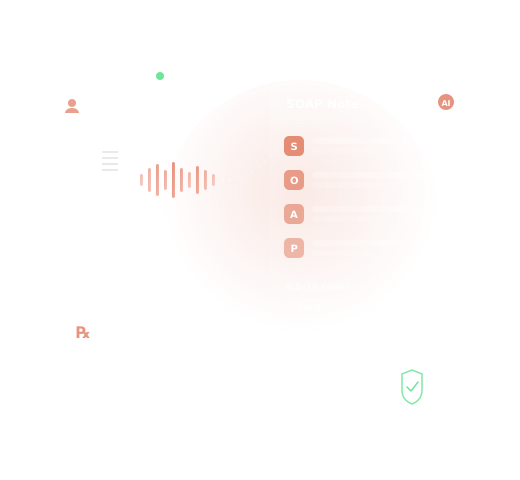
An AI medical scribe in India is most useful when it supports this real sequence: capture the encounter, separate speakers, structure the transcript, draft a SOAP note, surface coding suggestions, and leave the final decision to the clinician. That approach helps maintain clinical control while reducing repetitive typing.
Features mapped to workflow
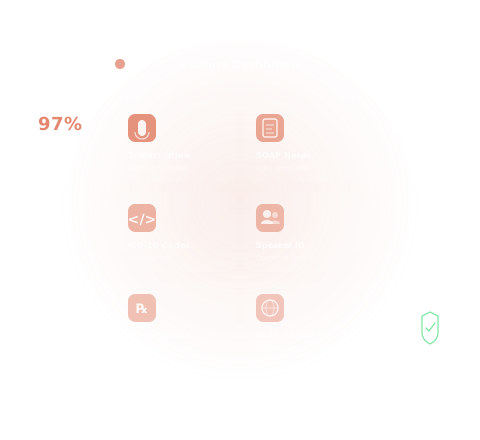
Conversation capture and transcription: The product listens to the consultation and converts speech into text for downstream documentation. This is useful for detailed integrative medicine visits where history and counseling take time.
Speaker diarization: By distinguishing clinician and patient speech, the draft is easier to interpret and organize. This is especially helpful when visits include extensive counseling, clarifying questions, or caregiver participation.
Automatic SOAP note generation: Instead of a raw transcript, the system drafts structured notes that clinicians can quickly review. For integrative medicine, this can help separate subjective concerns, objective findings, assessment, and plan.
ICD-10 and CPT suggestions: Coding support can reduce the effort of translating the encounter into billing-ready or reporting-friendly documentation. Suggestions remain reviewable rather than automatic decisions.
Multilingual support: Clinics in India often manage consultations in English, Hindi, or mixed-language patterns. Multilingual capability supports more natural patient interactions without forcing a single language workflow.
On-premise or private deployment options: Some organizations prefer tighter control over where documentation workflows run. Deployment posture can be chosen as an operational and governance decision based on internal requirements.
How It Works
The workflow below reflects how the product is intended to support real clinical documentation from start to finish.
- Capture the consultation conversation: During the visit, the clinician starts the documentation session so the encounter audio can be captured. This can support in-person OPD consultations where the discussion includes symptoms, lifestyle review, prior treatment response, and care planning.
- Transcribe and separate speakers: The system converts speech into text and uses speaker diarization to distinguish patient and clinician dialogue. This creates a cleaner base record than a single undifferentiated transcript, which is important when counseling and history-taking are both extensive.
- Structure the encounter into a draft: The transcript is organized into a clinically usable format, with automatic SOAP note generation helping convert conversation into a note draft. Instead of manually rewriting the visit, the clinician receives a structured starting point.
- Surface coding support: Based on the documented encounter, the product can suggest ICD-10 and CPT codes for review. These suggestions are intended to support workflow efficiency, while the clinician or authorized team member remains responsible for confirming what is appropriate.
- Review, edit, and sign off: Before the record is finalized, the clinician reviews the draft, corrects details, adjusts wording, and confirms the assessment and plan. Human review is an operational checkpoint, not an optional extra, and final sign-off happens only after the clinician is satisfied with the note.
- Choose deployment posture for governance needs: Depending on organizational preferences, teams may evaluate private or on-premise deployment options. This is best treated as a workflow and governance choice that supports internal data handling practices and infrastructure planning.
Local context
For clinics and hospitals evaluating an AI medical scribe in India, operational fit matters as much as feature lists. Many organizations manage high patient volumes, mixed digital maturity, and documentation habits that vary by specialty and clinician. Integrative medicine adds another layer because consultations may be longer, more narrative, and more counseling-heavy than routine episodic visits.
In this context, teams often look for practical benefits: less after-hours note completion, more consistent structure across encounters, and a workflow that does not force clinicians to become data-entry operators. Multilingual support is relevant in India because patient comfort and clarity often improve when the consultation can happen in the language that feels natural. At the same time, administrators may want deployment choices that align with internal IT and governance preferences.
An AI medical scribe in India should therefore be assessed on usability, review controls, note quality, and how well it fits existing OPD routines rather than on broad marketing claims.
Use cases
New patient assessments: Capture detailed history, symptom patterns, prior therapies, and lifestyle context without slowing the consultation.
Follow-up visits: Draft notes that reflect progress, adherence, symptom changes, and plan adjustments across repeated visits.
Counseling-heavy encounters: Support documentation when a large part of the visit involves education on diet, sleep, stress, exercise, or self-management.
Mixed-language consultations: Help clinics where clinicians and patients naturally switch between English and Indian languages during the same encounter.
Hospital outpatient departments: Standardize note drafting and coding support across multiple clinicians while preserving final review and sign-off.
Private practice efficiency: Reduce repetitive typing for solo or small-group practices that want cleaner records without adding a large documentation team.
These scenarios show why AI medical scribe India healthcare adoption is often driven by workflow improvement rather than by a single technical feature. The value comes from combining capture, structure, review, and finalization in one practical process.
FAQ
Can this replace clinician judgment?
No. The system is intended to assist with documentation and coding support, while the clinician reviews, edits, and signs off before the record is finalized.
Is it useful for integrative medicine consultations?
Yes, especially where visits are detailed, counseling-heavy, and involve longitudinal follow-up. Structured drafting can help organize complex conversations into usable notes.
Does it support multilingual consultations?
The product includes multilingual support, which can help clinics in India where consultations may happen in English, Hindi, or mixed-language patterns.
How should clinics think about deployment?
Deployment options such as private or on-premise setups should be evaluated as workflow and governance decisions based on internal IT, operational preferences, and data handling requirements.
CTA
If your team is evaluating an AI medical scribe in India for integrative medicine workflows, start with the practical questions: how the note is drafted, where human review happens, how coding suggestions are presented, and what deployment model fits your organization. Explore the product overview, features, integrations, and pricing paths to assess fit for your clinic or hospital. A well-designed documentation copilot can support more consistent records and a smoother OPD workflow without taking control away from the clinician.