Introduction
IVF and fertility consultations often involve long, sensitive conversations that cover history, prior treatments, investigations, medication plans, counselling, and next-step decisions. For clinicians, that means balancing patient attention with detailed documentation. An AI medical scribe in India can help fertility teams reduce manual note-taking during OPD visits and convert conversations into structured clinical drafts that are easier to review and finalize. Instead of replacing clinical judgment, the tool is designed to support doctors, coordinators, and front-office workflows with faster documentation, clearer summaries, and more consistent records.
For fertility centres, documentation needs are rarely limited to one short encounter. A single patient journey may include consultation notes, stimulation monitoring updates, procedure counselling, lab coordination, and follow-up planning. MedScribe is built as an AI medical documentation copilot that turns consultation audio into usable SOAP notes, coding suggestions, and structured summaries. In practical terms, an AI medical scribe in India can support daily clinic operations by helping clinicians spend less time typing and more time focusing on patient communication, review, and decision-making.
Department workflow
In IVF fertility practice, documentation usually spans multiple touchpoints. A new patient visit may include infertility duration, menstrual and ovulation history, prior conception attempts, male factor review, imaging, hormone workup, and treatment expectations. Follow-up visits may focus on scan findings, medication changes, cycle day updates, counselling, and procedure planning. Because these interactions are detailed and emotionally important, incomplete notes can create friction for both clinicians and care teams.
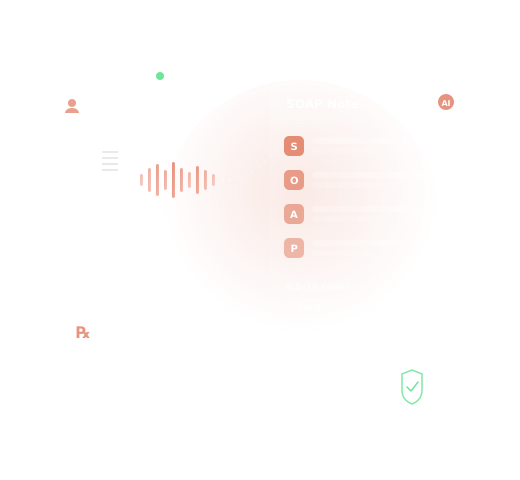
An AI medical scribe in India fits into this environment by supporting the natural flow of consultation rather than forcing a separate documentation task after the visit. During the encounter, the conversation can be captured and transcribed. The system then structures the content into a draft note, separating subjective history, objective findings, assessment, and plan. This is useful in fertility settings where doctors often need a concise but complete summary before moving to the next patient. It also helps when multiple team members need visibility into the same care journey, such as consultants, nurses, counsellors, and coordinators.
For hospitals and clinics in India, the value is practical: less repetitive typing, more standardized note drafts, and easier review before records are finalized. This makes the workflow especially relevant for busy OPDs, high-volume follow-up clinics, and centres that want documentation support without changing how clinicians conduct consultations.
Features mapped to workflow
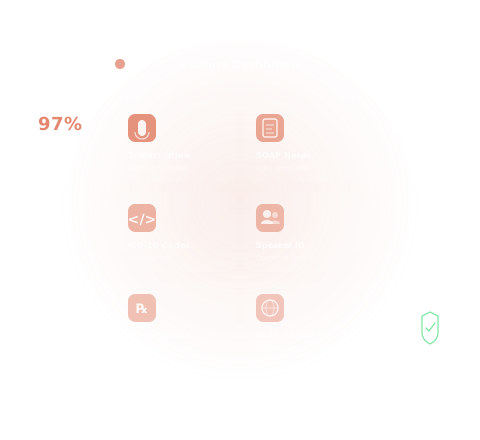
Automatic SOAP note generation: Fertility consultations often move between history, test interpretation, counselling, and treatment planning. Automatic SOAP drafting helps organize these discussions into a familiar clinical structure that can be edited quickly.
Speaker diarization: In IVF visits, both patient and clinician may speak at length, and sometimes a partner also contributes. Speaker separation helps create clearer transcripts and more usable note drafts.
ICD-10 and CPT suggestions: Coding support can help teams prepare documentation for downstream billing and record workflows. Suggestions should still be reviewed by the clinician or authorized staff before use.
Multilingual support: Fertility consultations in India may shift between English and regional languages. Multilingual capability supports more natural conversations while still producing structured documentation.
On-premise or private deployment options: Some clinics and hospitals prefer tighter control over infrastructure and data handling. Deployment choices can be aligned with internal governance, IT preferences, and workflow design.
Human review before finalization: Drafts are meant to accelerate documentation, not replace clinician oversight. Review, edits, and sign-off remain essential checkpoints in the workflow.
How It Works
Below is a practical view of how MedScribe supports fertility documentation from consultation to final note:
- Capture the consultation conversation: During an IVF OPD visit, the doctor conducts the consultation as usual while the conversation is captured through the configured workflow. This may include history taking, prior cycle discussion, scan review, counselling, and treatment planning.
- Transcribe and structure the interaction: The system converts speech into text and applies speaker diarization to distinguish who said what. It then organizes the transcript into clinically relevant sections so the raw conversation becomes easier to review.
- Draft a SOAP note automatically: Based on the structured transcript, MedScribe generates a draft SOAP note. In fertility care, this can help summarize symptoms, prior treatment context, objective findings discussed in the visit, assessment themes, and the immediate plan.
- Suggest coding support: The platform can surface ICD-10 and CPT suggestions linked to the documented encounter. These are intended as workflow aids and should be checked by the clinician or billing team before final use.
- Review, edit, and sign off: The clinician reviews the draft, corrects details, adds missing context, and confirms the final note. This human review step is the operational checkpoint before the record is finalized.
- Choose deployment posture for governance needs: Depending on the clinic or hospital setup, teams may use on-premise or private deployment options to support workflows aligned with internal data handling and IT requirements.
Local context
In India, fertility clinics often manage a mix of walk-in consultations, scheduled follow-ups, counselling sessions, and procedure-related discussions within the same day. Documentation quality matters not only for continuity of care but also for internal coordination across consultants, nursing teams, and administrative staff. An AI medical scribe in India is useful in this setting because it supports practical OPD efficiency without requiring clinicians to change their communication style with patients.
Many centres also serve patients who are more comfortable speaking in a mix of English and local languages. That makes multilingual documentation support especially relevant. For larger hospitals and digitally mature clinics, deployment posture may also be an important operational decision. An AI medical scribe India healthcare workflow can therefore be evaluated not just on note quality, but also on how well it fits existing review processes, infrastructure preferences, and team responsibilities.
Use cases
New infertility consultation: Capture a detailed first visit and generate a structured draft covering history, prior investigations, and next-step planning.
Stimulation follow-up visits: Summarize medication changes, scan discussions, and cycle progression in a consistent note format.
Counselling sessions: Document treatment options, expectations, and patient questions without relying on extensive manual typing during the conversation.
Procedure planning discussions: Create clearer records for egg retrieval, embryo transfer, or related counselling visits where multiple instructions are discussed.
Multi-clinician continuity: Support handoffs when different doctors or team members need a concise view of the patient journey.
Busy OPD documentation support: Use an AI medical scribe in India to reduce after-hours note completion and help clinicians close records faster with review.
FAQ
Can this be used in fertility clinics with mixed-language consultations?
Yes. Multilingual support is useful for clinics where conversations move between English and regional languages, while still aiming to produce structured documentation for review.
Does the tool replace clinician documentation responsibility?
No. The platform creates draft notes and coding suggestions, but clinician review, edits, and final sign-off remain necessary before the record is finalized.
Is it suitable for both standalone IVF centres and hospitals?
Yes. The workflow can support fertility departments in standalone clinics as well as hospitals, depending on consultation volume, review processes, and deployment preferences.
Can it support coding workflows?
It can provide ICD-10 and CPT suggestions as documentation aids. These suggestions should be checked by the appropriate clinician or billing team before use.
CTA
If your fertility team wants faster documentation without disrupting patient conversations, MedScribe offers a practical path to structured note creation, coding support, and clinician-led review. Explore how an AI medical scribe in India can fit your IVF OPD workflow, compare deployment options, and assess whether the process aligns with your clinic or hospital documentation goals. For broader product details, teams can also review the MedScribe product, features, integrations, and pricing pages as part of their evaluation.