Introduction
An AI medical scribe in India can help joint replacement teams reduce documentation load during busy OPD sessions, pre-operative evaluations, and follow-up visits. For orthopaedic surgeons, registrars, and clinic coordinators, the challenge is rarely just note-taking. It is capturing symptoms, prior treatment history, imaging references, functional limitations, examination findings, procedure planning, and post-operative progress in a format that is usable inside daily clinical workflows. MedScribe is designed as an AI documentation copilot that converts consultation conversations into structured clinical notes and coding support, while keeping the clinician in control of review and final sign-off.
For hospitals and clinics in India, the value of an AI medical scribe in India is practical: less time spent typing, more consistent note structure, and smoother handoff between consultation, documentation, and billing support. In joint replacement settings, where visits often involve repeat assessments, implant planning discussions, pain scoring, mobility review, and rehabilitation instructions, a documentation assistant can support more complete records without forcing doctors to change how they speak with patients.
Department workflow
Joint replacement workflows usually move through a predictable but documentation-heavy path. A patient may present with chronic knee or hip pain, stiffness, reduced range of motion, gait difficulty, or failed conservative treatment. The surgeon reviews history, prior medications, physiotherapy, injections, imaging, co-morbidities, and functional impact. The visit may then include examination findings, discussion of operative versus non-operative options, pre-anaesthesia considerations, implant-related counselling, and post-operative expectations.
Each of these steps creates note burden. OPD teams need clear history capture, structured examination notes, procedure planning summaries, and follow-up documentation after surgery. In many clinics, this work is split across doctors, assistants, and front-desk staff, which can create inconsistency. An AI medical scribe in India fits into this workflow by listening to the consultation, separating speakers, transcribing the interaction, and drafting structured notes that the clinician can edit before saving to the record.
For joint replacement departments, this is especially useful in high-volume clinics where repeat visits are common and documentation must remain readable across surgeons, physiotherapists, and administrative teams. The goal is not to replace clinical judgment. It is to support a cleaner workflow from patient conversation to finalized documentation.
Features mapped to workflow
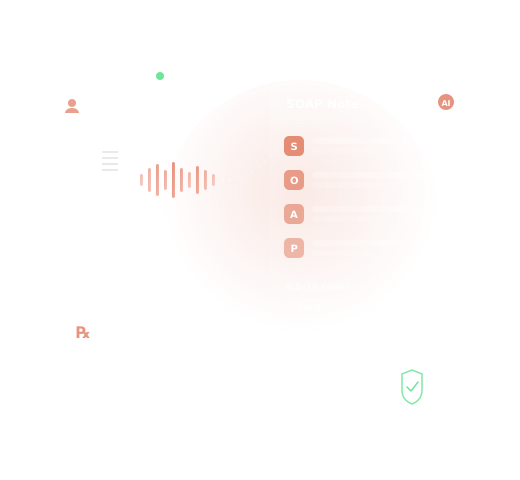
Automatic SOAP note generation: Joint replacement consultations often include long histories and multiple decision points. Automatic SOAP drafting helps convert conversation into a usable structure with subjective complaints, objective findings, assessment, and plan.
Speaker diarization: In orthopaedic OPD settings, both patient and clinician contribute important details. Speaker separation helps distinguish symptoms described by the patient from examination findings and recommendations stated by the surgeon.
Multilingual support: Many clinics in India handle consultations that move between English and regional languages. Multilingual capture supports more natural conversations without forcing rigid documentation behavior.
ICD-10 and CPT suggestions: Coding support can help teams prepare documentation for downstream administrative workflows. Suggestions are meant to assist review, not replace clinician oversight.
On-premise or private deployment options: Hospitals may prefer different deployment postures based on internal IT, governance, and workflow needs. The product is designed to support workflows aligned with institutional data handling preferences.
Integration-ready product structure: Teams evaluating an AI medical scribe in India often want a practical path from pilot to routine use. MedScribe sits alongside documentation workflows and can complement broader product pages for features, integrations, and pricing decisions.
How It Works
The workflow is built for real consultation documentation rather than generic dictation. In a joint replacement clinic, the process typically follows these steps:
- Capture the consultation conversation: During the OPD visit, the clinician and patient speak naturally about pain, mobility, prior treatment, imaging, and surgical options. The system captures the conversation and uses speaker diarization to separate patient and clinician inputs.
- Transcribe and structure the interaction: The audio is converted into text and organized into clinically relevant sections. This helps surface history, symptoms, examination cues, and treatment discussion in a format that is easier to review than a raw transcript.
- Draft a SOAP note automatically: Based on the consultation, the product generates a draft SOAP note. For joint replacement visits, this may include pain history, functional limitation, examination summary, assessment of degenerative joint disease or post-operative status, and the next-step plan.
- Provide coding support: The system can suggest ICD-10 and CPT codes based on the documented encounter. These suggestions are intended to support administrative review and should be checked by the clinician or billing team before use.
- Clinician review, edit, and sign-off: Before any record is finalized, the doctor reviews the draft, corrects wording, adds missing findings, and confirms the final note. Human review is an operational checkpoint, especially for surgical planning and follow-up documentation.
- Finalize within the chosen deployment workflow: Depending on hospital preference, teams may use private or on-premise deployment models as governance and workflow decisions. This helps align the documentation process with internal IT and record-management practices.
Local context
In India, joint replacement practices often balance high patient volumes with detailed counselling needs. Surgeons may need to explain conservative care, implant planning, expected recovery, rehabilitation, and follow-up timelines in the same visit. That makes documentation both important and time-consuming. An AI medical scribe in India can support this environment by helping clinicians document consistently without turning the consultation into a typing exercise.
For multi-doctor hospitals, specialty centres, and growing orthopaedic clinics, the practical question is whether the tool fits existing routines. The answer depends on how well it supports multilingual conversations, review checkpoints, and deployment preferences. MedScribe is positioned to support daily OPD workflows in India healthcare settings where documentation quality and speed both matter.
Use cases
New joint pain evaluation: Capture history of pain duration, prior medication use, injections, physiotherapy, and activity limitation, then draft a structured first-visit note.
Pre-operative counselling: Document discussion around surgical indication, expected outcomes, risks discussed, rehabilitation planning, and patient questions.
Post-operative follow-up: Summarize wound status, pain progression, mobility milestones, medication review, and physiotherapy advice in a consistent format.
Revision or complex case review: Support longer consultations where prior surgeries, imaging history, and functional concerns need to be documented clearly.
High-volume OPD documentation: Help orthopaedic teams maintain note quality during busy clinic sessions by reducing manual drafting effort.
FAQ
Can this be used during a live orthopaedic consultation?
Yes. It is designed to capture the consultation conversation, generate a draft note, and then allow clinician review before finalization.
Does it create final records automatically?
No. The workflow includes human review, edits, and final sign-off by the clinician before the note is treated as complete.
Is it useful for multilingual clinics?
Yes. Multilingual support can help clinics where consultations move between English and regional languages.
Can it support coding workflows?
It can provide ICD-10 and CPT suggestions to support documentation and administrative review, but those suggestions should be checked by the relevant team.
CTA
If your orthopaedic clinic or hospital is evaluating an AI medical scribe in India for joint replacement workflows, focus on the basics that matter in practice: accurate conversation capture, structured SOAP drafting, coding support, multilingual usability, and a clear clinician review step. Explore how MedScribe can fit your OPD documentation process, and review related product information for features, integrations, and pricing to plan the right rollout for your team.