Introduction
AI medical scribe in India is becoming a practical option for hospitals, diagnostic centres, and multispecialty clinics that want faster, more consistent clinical documentation without adding manual typing to already busy teams. In Laboratory Medicine, documentation often sits across clinician discussions, test ordering context, specimen notes, interpretation comments, and follow-up communication. An AI medical scribe can help convert consultation conversations into structured drafts that are easier to review, edit, and finalize.
For Indian healthcare organizations, the value is not only speed. It is also about making documentation more usable across OPD workflows, referral pathways, and internal coordination between clinicians, laboratory teams, and administrative staff. MedScribe is designed as an AI documentation copilot that supports conversation capture, structured transcription, SOAP note drafting, coding suggestions, speaker diarization, multilingual support, and deployment choices such as private or on-premise setups. Rather than replacing clinician judgment, it supports a review-first workflow where the doctor or authorized user checks, edits, and signs off before the record is finalized.
In Laboratory Medicine settings, this approach can be useful when clinicians discuss test rationale, review prior reports, explain next steps, or document interpretation-related conversations. The result is a more organized note creation process that supports workflows aligned with operational and governance needs in India.
Department workflow
Laboratory Medicine workflows often involve more than a simple test request. A patient interaction may include symptom review, prior history, medication context, referral details, test recommendations, sample collection instructions, result interpretation, and follow-up planning. In many organizations, these details are captured partly in the EHR, partly in LIS-linked notes, and partly in free-text communication.
This creates friction for clinicians and staff. Manual note-taking can slow consultations. Important context may be recorded inconsistently. Coding support may happen later, after the encounter, when details are less fresh. In high-volume OPD environments, even small documentation delays can affect turnaround time for downstream teams.
An AI medical scribe in India can fit into this workflow by helping capture the consultation conversation, separating speakers, converting speech to structured text, and drafting a usable clinical note. For Laboratory Medicine, that can support documentation around test indications, provisional impressions, interpretation summaries, and patient instructions. It can also help standardize note structure across clinicians while still allowing each doctor to review and personalize the final record.
Features mapped to workflow
Conversation capture and transcription: During or immediately after a consultation, the system can process spoken interaction and convert it into text. This reduces dependence on memory-based note entry later in the day.
Speaker diarization: In consultations where both clinician and patient speak extensively, speaker separation helps preserve context and makes review easier.
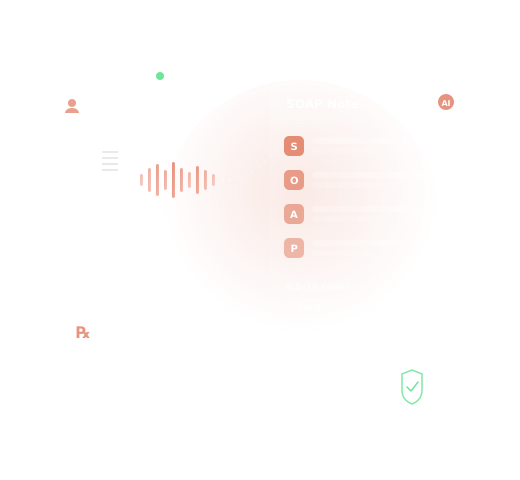
Automatic SOAP note generation: The transcript is organized into a draft SOAP format, helping clinicians move from raw conversation to a structured note more quickly.
ICD-10 and CPT suggestions: Coding support can assist teams during documentation review. Suggestions should still be checked by the clinician or coding team before use.
Multilingual support: In India, consultations may shift between English and regional languages. Multilingual capability can help maintain continuity in documentation across mixed-language interactions.
Private or on-premise deployment options: For organizations that prefer tighter control over infrastructure decisions, deployment posture can be chosen based on workflow, IT, and governance requirements.
These capabilities make AI medical scribe India healthcare adoption relevant not only for general OPD use, but also for departments like Laboratory Medicine where documentation quality affects coordination, interpretation, and follow-up.
How It Works
Below is a practical view of how MedScribe supports the documentation cycle in a Laboratory Medicine workflow:
- Capture the consultation conversation: The clinician starts with an in-person or virtual interaction where test history, symptoms, prior reports, and next steps are discussed. MedScribe captures the audio input for documentation support, including multilingual conversations where applicable.
- Transcribe and structure the interaction: The system converts speech into text and uses speaker diarization to distinguish who said what. This helps preserve context when the patient describes symptoms and the clinician explains test rationale or interpretation.
- Draft a SOAP note automatically: The transcript is transformed into a structured SOAP draft. In Laboratory Medicine, this may include the presenting concern, relevant history, assessment context, and plan such as investigations, repeat testing, or follow-up advice.
- Generate coding suggestions: Based on the documented encounter, the platform can surface ICD-10 and CPT suggestions to support downstream documentation and billing workflows. These are suggestions only and should be reviewed before final use.
- Review, edit, and sign off: The clinician checks the draft note, corrects details, adds interpretation nuance, and confirms the final version. Human review is the operational checkpoint before the record is finalized.
- Choose deployment posture for workflow needs: Depending on organizational preferences, teams can evaluate private or on-premise deployment options. This is a workflow and governance decision that can support internal data handling practices and IT planning.
Local context
Healthcare teams in India often work across mixed digital maturity levels. Some hospitals have established EHR and LIS environments, while others rely on a combination of software, scanned records, and manual coordination. In this setting, AI medical scribe in India needs to be practical rather than theoretical. It should support daily OPD realities such as multilingual consultations, variable documentation habits, and the need for quick review before the next patient.
For Laboratory Medicine, local context also includes referral-heavy workflows, repeat testing, chronic disease monitoring, and communication between clinicians, pathologists, and front-desk teams. A documentation copilot can help reduce the burden of recreating encounter details later, especially when the same patient returns with prior reports from different facilities. The goal is not to automate clinical judgment, but to make note creation more consistent and easier to finalize.
Use cases
Diagnostic centre consultations: Capture patient discussions around test indications, preparation instructions, and follow-up recommendations.
Hospital laboratory-linked OPD: Support clinicians who review symptoms, correlate prior reports, and document the plan for additional investigations.
Preventive health packages: Draft structured notes when discussing abnormal findings, repeat testing, and lifestyle or referral advice.
Chronic disease monitoring: Help document recurring visits where lab trends, medication context, and next-step testing need to be summarized clearly.
Multispecialty coordination: Create usable drafts when Laboratory Medicine discussions intersect with endocrinology, nephrology, oncology, or internal medicine workflows.
Across these scenarios, AI medical scribe in India can help teams spend less time on repetitive note drafting and more time on review, interpretation, and patient communication.
FAQ
Can this be used in Laboratory Medicine settings?
Yes. It is suited for workflows where clinicians discuss test rationale, prior reports, interpretation context, and follow-up plans, then need a structured draft for review.
Does it replace clinician review?
No. The intended workflow includes human review, edits, and final sign-off before the record is finalized.
Can it support multilingual consultations in India?
Yes. Multilingual support is useful for consultations that move between English and regional languages.
How does coding support work?
The platform can provide ICD-10 and CPT suggestions based on the documented encounter, but these should be checked by the clinician or coding team.
CTA
If your organization is evaluating AI medical scribe in India for Laboratory Medicine, start with the practical questions: where documentation slows clinicians down, how review happens today, and what level of deployment control your IT team prefers. MedScribe is designed to support usable note drafting, coding assistance, and clinician-first review workflows for Indian healthcare settings. Explore the product pages for features, integrations, and pricing, then assess how the workflow fits your OPD and laboratory documentation needs.