Introduction
An AI medical scribe in India can help medical education and training teams reduce documentation burden while improving the consistency of clinical note preparation during supervised care. In teaching hospitals, residency programs, and academic OPD settings, faculty and trainees often balance patient interaction, case discussion, note writing, and coding review in limited time. A practical documentation copilot supports this workflow by turning consultation conversations into structured drafts that clinicians can review, edit, and sign off.
For medical education training departments, the value is not just speed. It is also about creating a repeatable documentation process that helps trainees learn SOAP structure, capture relevant findings, and understand how coding suggestions may support downstream billing or record workflows. MedScribe is designed to convert consultation audio into usable clinical notes with speaker diarization, multilingual support, automatic SOAP drafting, and ICD-10/CPT suggestions. The result is a more teachable documentation workflow that supports supervision rather than replacing clinical judgment.
Because academic and hospital environments in India can vary widely in infrastructure, an AI medical scribe in India should fit real OPD operations, mixed language consultations, and governance preferences such as private or on-premise deployment. This makes the tool useful for both routine outpatient teaching and structured training sessions where note quality matters.
Department workflow
Medical education training departments typically work across supervised consultations, case presentations, note review, and feedback loops. In many settings, a trainee conducts or assists with the consultation, a senior clinician validates the assessment, and the final record is completed under time pressure. Documentation quality can vary depending on experience level, patient load, and the complexity of the case.
An AI medical scribe in India fits this environment by supporting the documentation layer of the encounter. During OPD or teaching clinic sessions, the conversation can be captured and transcribed, then organized into a draft SOAP note. This gives trainees a structured starting point and gives faculty a faster way to review whether the history, examination findings, assessment, and plan are documented clearly. Instead of writing every note from scratch, teams can focus on correcting, teaching, and approving.
For institutions handling multilingual interactions, speaker diarization and language support are especially useful. Faculty can distinguish who said what, and trainees can review how patient statements were translated into clinically relevant note sections. This supports learning in a practical way without changing the core supervision model.
Features mapped to workflow
Conversation capture and transcription: The platform captures consultation dialogue and converts it into text that can be used for documentation. This is useful in teaching clinics where multiple participants may be involved in the encounter.
Speaker diarization: When a trainee, consultant, and patient all speak during the same visit, speaker separation helps preserve context. This makes review easier and supports teaching around history taking and clarification.
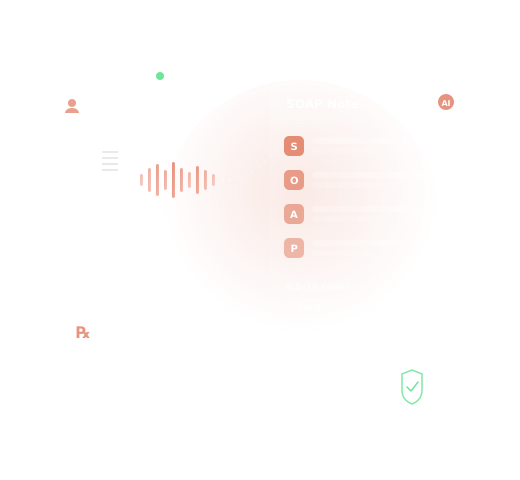
Automatic SOAP note generation: Drafting notes into Subjective, Objective, Assessment, and Plan format gives trainees a clear structure to learn from. Faculty can quickly identify gaps and coach on documentation quality.
ICD-10/CPT suggestions: Coding support can help teams understand how diagnoses and procedures may map to standard coding frameworks. Suggestions should always be reviewed by the clinician or authorized staff before use.
Multilingual support: In India, consultations may move between English and regional languages. Multilingual capability helps maintain continuity between patient communication and clinical documentation.
On-premise or private deployment options: For institutions with specific IT governance preferences, deployment posture can be chosen to support workflows aligned with internal data handling practices.
How It Works
The workflow is designed to support day-to-day clinical documentation in teaching and supervised care settings.
- Capture the consultation: During the OPD or training encounter, the consultation conversation is recorded through the configured workflow. The system is built to process multi-speaker interactions, which is useful when a trainee presents and a senior clinician intervenes.
- Transcribe and structure the dialogue: The audio is converted into text, with speaker diarization helping separate patient, trainee, and clinician contributions. The transcript is then organized into clinically relevant segments to prepare for note drafting.
- Generate a draft SOAP note: Based on the structured transcript, the system creates a draft SOAP note. This gives the team a usable first version rather than a blank page, helping trainees learn note structure while saving time for supervisors.
- Suggest coding support: The platform can surface ICD-10 and CPT suggestions linked to the documented encounter. These are intended as workflow aids and should be checked by the clinician or coding team before final use.
- Review, edit, and sign off: The clinician reviews the draft, corrects inaccuracies, adds missing findings, and confirms the final assessment and plan. Human review is the operational checkpoint before any record is finalized.
- Choose deployment posture for governance needs: Depending on institutional preferences, teams may use private or on-premise deployment models. This is a workflow and governance decision that can support internal operating requirements without changing the need for clinician oversight.
Local context
In India, medical education settings often combine high patient volumes, varied documentation habits, and multilingual communication. That makes consistency difficult, especially when trainees are still developing note-writing discipline. An AI medical scribe in India is most useful when it adapts to these realities instead of assuming a single workflow.
Teaching hospitals and academic clinics may also have different expectations around infrastructure, supervision, and record handling. Some teams may prefer cloud-based workflows for easier rollout, while others may evaluate private or on-premise options. The practical goal is to support documentation quality and clinician efficiency in a way that fits the institution's operating model. For this reason, AI medical scribe India healthcare adoption should be approached as a workflow improvement project, not just a software purchase.
Use cases
Residency OPD documentation: Residents can generate draft notes after consultations and then review them with faculty, improving both speed and teaching value.
Case-based teaching clinics: During supervised clinics, the system can help capture the encounter and create a structured note that supports discussion on assessment and plan formulation.
Faculty oversight: Senior clinicians can spend less time on repetitive note drafting and more time on correction, coaching, and final approval.
Coding familiarization: Trainees and administrative teams can use coding suggestions as a starting point for understanding documentation-to-code relationships, with appropriate human validation.
Multilingual patient interactions: Clinics serving diverse patient populations can benefit from documentation support that handles mixed-language conversations more effectively.
Across these scenarios, an AI medical scribe in India supports a practical balance between education, supervision, and operational efficiency.
FAQ
Can this replace clinician documentation review?
No. The draft output is intended to support clinicians and trainees. Final review, edits, and sign-off remain essential before the record is completed.
Is it useful for teaching hospitals and residency programs?
Yes. It can help standardize note structure, reduce repetitive writing, and create more time for feedback during supervised care.
Does it support multilingual consultations?
The product includes multilingual support, which can help in settings where patient conversations and clinical discussions move across languages.
How should coding suggestions be used?
ICD-10 and CPT suggestions should be treated as supportive prompts. They need clinician or authorized staff review before being used in operational workflows.
CTA
If your institution is evaluating an AI medical scribe in India for medical education training, focus on the daily workflow: consultation capture, structured note drafting, coding support, clinician review, and deployment fit. Explore how MedScribe can support teaching clinics, supervised OPD workflows, and documentation quality improvement. For broader product details, teams can review the main product, features, integrations, and pricing paths based on operational needs.