Introduction
Medical genetics consultations often involve detailed family histories, phenotype descriptions, prior reports, counselling discussions, and careful follow-up planning. That makes documentation important but time-consuming for clinicians, counsellors, and hospital teams. An AI medical scribe in India can help reduce manual note-taking by turning consultation conversations into structured draft documentation that clinicians can review and finalize. For genetics departments, this is useful when visits include long narratives, multiple participants in the room, and the need to capture both clinical and counselling context without interrupting patient interaction.
This page explains how an AI medical scribe supports practical genetics workflows in Indian clinics and hospitals. The focus is not on replacing clinical judgment. Instead, it is on helping teams document faster, maintain consistency in note structure, and support coding workflows where relevant. MedScribe is designed as an AI documentation copilot that converts consultation audio into usable clinical drafts, with speaker diarization, multilingual support, SOAP note generation, coding suggestions, and deployment options such as private or on-premise setups depending on operational needs.
For organisations evaluating an AI medical scribe in India, the key question is simple: can it fit into daily OPD and specialist workflows without adding friction? In medical genetics, that means supporting long consultations, review checkpoints, and final clinician sign-off before records are completed.
Department workflow
Medical genetics workflows differ from many high-volume specialties because the consultation often combines diagnostic reasoning, family history collection, counselling, and coordination with laboratory or imaging findings. A typical visit may include referral review, pedigree discussion, symptom chronology, developmental history, prior testing, differential considerations, and next-step planning. In some cases, parents, caregivers, or multiple family members contribute to the conversation, which increases documentation complexity.
In Indian healthcare settings, genetics teams may also work across mixed environments: tertiary hospitals, specialty centres, academic departments, and private clinics. Documentation needs can vary between first consultations, follow-up counselling visits, prenatal discussions, and multidisciplinary case reviews. An AI medical scribe India healthcare workflow is most useful when it helps standardize note capture while still allowing clinicians to edit nuanced findings, counselling language, and recommendations.
Instead of writing from scratch after every encounter, clinicians can start from a structured draft. This can support more consistent SOAP formatting, clearer summaries for internal teams, and easier handoff into downstream systems where integrations are available.
Features mapped to workflow
Conversation capture and transcription: Genetics visits are often discussion-heavy. The product captures consultation audio and converts it into text for downstream structuring. This is helpful when the encounter includes long explanations, family narratives, or repeated clarification.
Speaker diarization: In genetics, more than one person may speak during the visit. Speaker separation helps distinguish clinician and patient voices, and can also support clearer interpretation when caregivers or relatives contribute to the history.
Automatic SOAP note drafting: The system structures the conversation into draft SOAP notes, giving clinicians a usable starting point rather than a blank screen. This is especially useful for specialist OPD workflows where note completeness matters.
ICD-10 and CPT suggestions: Coding support can help teams review likely coding options based on the documented encounter. Suggestions are not a substitute for clinician or billing review, but they can reduce manual lookup effort.
Multilingual support: Consultations in India may shift between English and regional languages. Multilingual capability can support more natural conversations while still helping generate structured documentation.
Private or on-premise deployment options: Some hospitals prefer tighter infrastructure control for governance and workflow reasons. Deployment posture can be chosen to support workflows aligned with internal IT and data-handling preferences.
How It Works
The workflow for an AI medical scribe in India should be concrete, reviewable, and easy for clinicians to adopt. In medical genetics, the process typically follows these steps:
- Capture the consultation conversation: During the genetics visit, the clinician starts the documentation session so the discussion can be captured. This may include history taking, family history review, counselling, and care planning. Multilingual speech handling supports consultations where language use shifts naturally.
- Transcribe and separate speakers: The system converts speech into text and applies speaker diarization to distinguish the clinician from the patient or caregiver. This is useful in genetics encounters where multiple family members may contribute details.
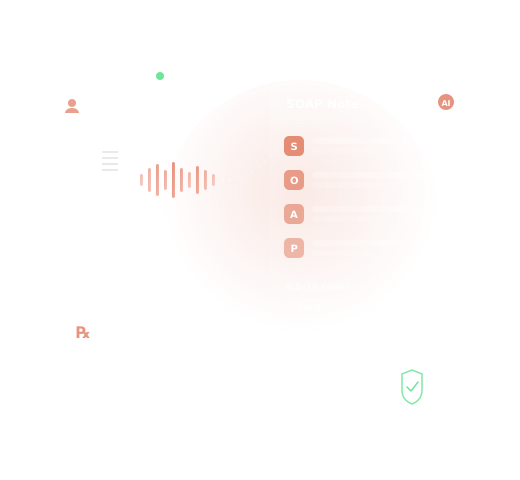
- Structure the encounter into a draft SOAP note: The transcript is organized into a draft clinical note with sections such as subjective history, objective observations, assessment themes, and plan. The goal is to create a usable first draft that reflects the consultation flow.
- Generate coding support: Based on the documented encounter, the system can surface ICD-10 and CPT suggestions for review. These suggestions support administrative workflows but still require clinician or billing validation before use.
- Review, edit, and sign off: The clinician reviews the draft note, corrects terminology, adds genetics-specific nuance, verifies counselling points, and confirms the final record. Human review is the operational checkpoint before any note is finalized.
For organisations comparing deployment models, the same workflow can be adapted to private or on-premise environments where needed. This should be viewed as a governance and implementation choice rather than a blanket compliance claim. The practical objective is to support documentation workflows aligned with hospital policies and IT preferences.
- Route into downstream workflows: After sign-off, the finalized note can be used within the clinic or hospital record workflow, and teams can explore related product pages for features, integrations, and pricing based on their setup needs.
Local context
For providers evaluating an AI medical scribe in India, local practicality matters more than generic automation language. Indian hospitals and clinics often manage variable OPD loads, mixed digital maturity, and multilingual patient interactions. In medical genetics, this can be even more pronounced because consultations may be longer and involve counselling-heavy discussions. A useful solution should therefore support flexible deployment, practical review steps, and note structures that clinicians can adapt to their own templates.
Another local consideration is implementation simplicity. Teams may want to start with documentation support in a focused department before expanding to other specialties. That makes a modular product approach valuable, especially when related feature and integration pathways are available for phased rollout.
Use cases
Initial genetics consultations: Capture detailed history, family narrative, and assessment planning without relying entirely on manual typing during the visit.
Follow-up counselling visits: Draft structured notes for result discussions, risk explanation, and next-step planning while preserving clinician review.
Multidisciplinary coordination: Create clearer summaries that can support communication across genetics, paediatrics, obstetrics, oncology, or neurology teams.
Private clinics and hospital OPDs: Use an AI medical scribe in India to reduce after-hours documentation burden and improve note consistency across clinicians.
Mixed-language consultations: Support encounters where patients and families switch between English and regional languages during explanation and counselling.
FAQ
Can this be used for long genetics consultations?
Yes. The workflow is suited to discussion-heavy visits where history, counselling, and planning need to be captured and turned into a structured draft for clinician review.
Does the product replace clinician documentation review?
No. The draft note and coding suggestions are meant to support the clinician. Final edits, validation, and sign-off remain human responsibilities before the record is completed.
Is multilingual use relevant in India?
Yes. Many consultations involve a mix of English and regional languages. Multilingual support can help teams document more naturally in real-world OPD settings.
Can hospitals choose how the product is deployed?
Yes. Private or on-premise deployment options may be considered based on workflow, governance, and IT preferences.
CTA
If your genetics department is exploring a practical AI medical scribe in India, start with the documentation workflow: capture the consultation, generate a structured draft, review it carefully, and finalize the note with clinician oversight. MedScribe is designed to support this process for clinics and hospitals that want more efficient documentation without losing control over clinical quality. Explore the product, features, integrations, and pricing paths to assess fit for your organisation's daily workflow.