Introduction
Medical oncology consultations often involve dense histories, treatment planning, symptom review, medication changes, and careful follow-up documentation. An AI medical scribe in India can help oncology teams reduce manual note-taking by turning consultation conversations into structured draft documentation that clinicians can review and finalize. For hospitals, cancer centres, and specialty clinics, the goal is practical: support faster documentation, improve note consistency, and reduce after-hours charting without changing how doctors make decisions.
MedScribe is designed as an AI documentation copilot for real outpatient and follow-up workflows. It converts clinician-patient conversations into usable clinical notes, supports SOAP formatting, and provides coding suggestions that can be reviewed before use. In medical oncology, where each encounter may include diagnosis context, prior treatment history, adverse effects, performance status, and next-cycle planning, a documentation layer that stays close to the consultation flow can be valuable. This is why many teams evaluating an AI medical scribe in India look for practical workflow fit, multilingual support, and deployment options that align with internal governance preferences.
Department workflow
Medical oncology documentation is rarely a simple summary. A typical OPD visit may include review of pathology and imaging, current regimen details, toxicity assessment, supportive medications, lab trends, counselling, and scheduling of the next visit or infusion. Follow-up visits may also require quick comparison with prior cycles, symptom progression, and treatment tolerance. In busy departments, clinicians often need to balance patient interaction with detailed note creation.
An AI scribe can fit into this workflow by capturing the conversation during the consultation, separating speakers, structuring the transcript, and drafting a note that reflects the encounter. Instead of typing throughout the visit or dictating long summaries later, the clinician can focus on the patient and then review a draft note for accuracy. For oncology teams in India, this can be especially useful in settings where consultations may shift between English and regional languages, or where multiple clinicians contribute to the same care pathway.
The value is not limited to note generation. Oncology workflows also benefit from coding support, standardized note sections, and a clear review checkpoint before the record is finalized. A well-designed AI medical scribe in India should support these operational needs while remaining adaptable to each hospital or clinic's documentation style.
Features mapped to workflow
Conversation capture and transcription: The system listens to the consultation and converts speech into text, helping reduce manual typing during or after the visit.
Speaker diarization: By distinguishing clinician and patient voices, the draft note can better reflect who said what, which is useful in symptom review, counselling, and treatment discussions.
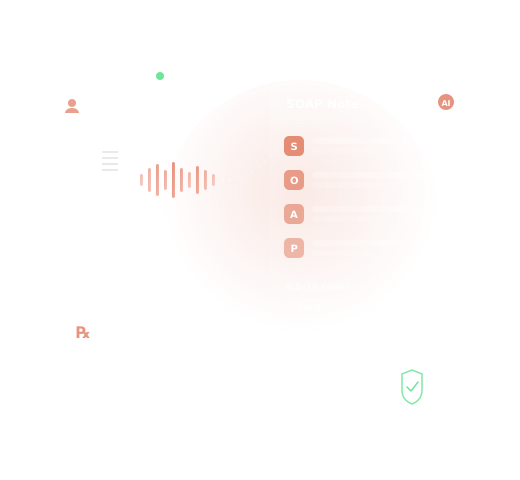
Automatic SOAP note generation: Oncology teams can use structured draft notes that organize subjective complaints, objective findings, assessment, and plan into a familiar format.
ICD-10 and CPT suggestions: Coding support can help staff and clinicians review likely codes associated with the documented encounter, while keeping final selection under human control.
Multilingual support: In Indian care settings, consultations may include mixed-language conversations. Multilingual capability supports more natural documentation workflows.
On-premise or private deployment options: Some organizations prefer deployment choices based on internal IT, data handling, and governance requirements. These options are workflow and infrastructure decisions rather than blanket compliance claims.
Clinician review before finalization: Drafts are meant to be checked, edited, and signed off by the treating clinician before becoming part of the final record.
How It Works
The workflow for an AI medical scribe in India should be clear, reviewable, and easy to adopt in daily oncology practice. MedScribe follows a practical sequence from conversation capture to clinician-approved documentation.
- Capture the consultation conversation: During an oncology OPD visit, follow-up review, or treatment counselling session, the consultation audio is captured through the configured workflow. This may include history, symptom updates, treatment tolerance, medication review, and next-step planning.
- Transcribe and structure the interaction: The system converts speech into text and applies speaker diarization to separate clinician and patient dialogue. It then organizes the content into a structured clinical draft, helping preserve the flow of the encounter without requiring continuous manual typing.
- Generate a SOAP draft note: Based on the conversation, MedScribe prepares a draft SOAP note with relevant sections for subjective concerns, objective findings discussed in the visit, clinical assessment, and plan. In oncology, this can support documentation of adverse effects, treatment response, counselling, and follow-up instructions.
- Suggest coding for review: The platform can surface ICD-10 and CPT suggestions linked to the documented encounter. These are intended as review aids for clinicians or billing teams, not automatic final coding decisions.
- Review, edit, and sign off: The clinician checks the draft note, makes corrections or additions, confirms coding where appropriate, and completes final sign-off before the record is finalized. This human review checkpoint is essential for clinical accuracy and workflow trust.
- Choose deployment posture to match operations: Depending on organizational needs, teams may evaluate on-premise or private deployment approaches. This supports workflows aligned with internal governance, IT architecture, and documentation processes.
Local context
In India, oncology departments often manage high documentation load across consultations, day care coordination, treatment counselling, and follow-up visits. Teams may work across mixed digital maturity levels, from fully integrated hospital systems to partially manual workflows. That makes flexibility important. An AI medical scribe in India should support practical adoption rather than force a rigid process.
Hospitals and clinics may also prefer solutions that can fit multilingual consultations and different infrastructure models. Some organizations may evaluate private or on-premise deployment as part of their internal data handling strategy. The key consideration is whether the tool supports day-to-day documentation quality, clinician review, and operational fit for Indian healthcare settings. For buyers researching AI medical scribe India healthcare options, the most useful evaluation criteria are workflow alignment, review controls, note quality, and ease of implementation.
Use cases
New patient oncology consultations: Capture detailed history, diagnosis discussion, treatment options, and counselling into a structured draft note.
Chemotherapy follow-up visits: Document symptom review, toxicity assessment, medication adjustments, and next-cycle planning more efficiently.
Second opinion consultations: Summarize prior treatment history, current concerns, and clinician assessment in a consistent format.
High-volume OPD sessions: Reduce the burden of manual note creation while preserving a clinician review step.
Multilingual patient interactions: Support consultations where English and local languages are used together during history-taking and counselling.
Coding review support: Help teams review likely ICD-10 and CPT suggestions alongside the drafted note.
FAQ
Can this be used for oncology follow-up visits?
Yes. It is suited to follow-up encounters where clinicians need to document symptoms, treatment tolerance, medication changes, and next steps in a structured way.
Does the system replace clinician judgment?
No. It creates draft documentation and coding suggestions, but the clinician reviews, edits, and signs off before finalization.
Can it support multilingual consultations in India?
Yes. Multilingual support is useful for Indian care settings where consultations may move between English and regional languages.
Is deployment limited to one model?
No. Teams may evaluate on-premise or private deployment options based on workflow, IT, and governance preferences.
CTA
If your oncology department is evaluating ways to reduce documentation burden without disrupting clinical review, MedScribe offers a practical path. Explore how an AI medical scribe in India can support consultation capture, SOAP drafting, coding review, and clinician sign-off for daily oncology workflows. Review the product overview, feature details, integrations, and pricing to assess fit for your hospital or clinic.