Introduction
An AI medical scribe in India can help clinics and hospitals reduce documentation burden while keeping medication-related workflows clearer and easier to review. In medication safety settings, the quality of clinical notes matters because prescribing decisions, allergy history, dose changes, and follow-up instructions often depend on what was captured during the consultation. A practical AI scribe should support doctors during busy OPD hours, convert conversation into structured notes, and leave the clinician in control of edits and final sign-off.
MedScribe is designed as an AI documentation copilot for everyday care delivery. It converts consultation conversations into draft clinical notes, supports SOAP formatting, and provides coding suggestions that clinicians can review before finalizing the record. For organisations evaluating an AI medical scribe in India, the value is not just faster note creation. It is also about making medication histories easier to trace, improving consistency in documentation, and supporting workflows aligned with safer prescribing and follow-up communication.
This page focuses on how the product fits medication safety workflows in Indian healthcare environments, where multilingual consultations, variable documentation styles, and high patient volumes are common.
Department workflow
Medication safety work often spans the consultation room, nursing handoff, pharmacy coordination, and follow-up review. In many OPD and hospital settings, clinicians must capture current medicines, prior adverse reactions, dose adjustments, refill instructions, and patient counselling points while also managing time pressure. When documentation is delayed or incomplete, teams may need to reconstruct the encounter later from memory, handwritten notes, or fragmented system entries.
An AI medical scribe in India is most useful when it fits this real workflow rather than adding another layer of admin work. During the consultation, the system listens to the doctor-patient conversation and identifies speakers. After the encounter, it structures the transcript into a draft note that can reflect symptoms, assessment, medication plan, and instructions. The clinician then reviews the draft, corrects any medication names, strengths, frequencies, or route details, and signs off before the record is finalized.
For medication safety teams, this workflow can support clearer documentation of allergies, previous medication exposure, counselling on adherence, and reasons for changing therapy. It can also help standardize note quality across clinicians without forcing a rigid template on every specialty.
Features mapped to workflow
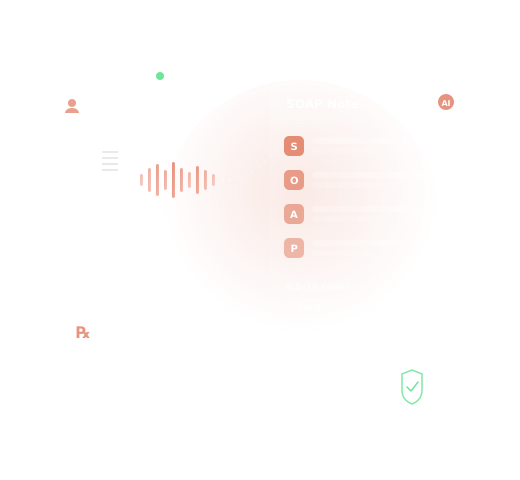
Automatic SOAP note generation: Consultation conversations are converted into structured draft notes, helping clinicians move from raw dialogue to a usable clinical summary quickly.
Speaker diarization: The system separates doctor and patient speech, which is useful when documenting medication history, symptom progression, and counselling instructions with better context.
ICD-10 and CPT suggestions: Coding support can help teams prepare more complete records for review. Suggestions remain clinician-reviewed rather than automatically finalized.
Multilingual support: Indian care settings often involve mixed-language consultations. Multilingual capability can help capture clinically relevant details from natural conversations more effectively.
On-premise or private deployment options: Organisations with stricter governance preferences may choose deployment models designed to align with internal IT and data-handling workflows.
Human review before finalization: Medication safety depends on accuracy. Drafts are intended to support clinicians, not replace their judgment. Review, edits, and sign-off remain essential checkpoints.
How It Works
The workflow below reflects how MedScribe supports day-to-day documentation for medication safety use cases.
- Capture the consultation conversation: During an OPD or inpatient review, the clinician starts the documentation session. The product captures the consultation audio and prepares it for transcription while preserving speaker separation between doctor and patient.
- Transcribe and structure the encounter: The conversation is transcribed and organized into clinically relevant sections. This helps surface medication history, current complaints, allergies, prior treatment response, and patient instructions from the raw dialogue.
- Draft a SOAP note automatically: MedScribe converts the structured transcript into a draft SOAP note. In medication safety workflows, this can make it easier to review subjective complaints, objective findings, assessment, and the treatment plan in one place.
- Generate coding support for review: The system provides ICD-10 and CPT suggestions based on the documented encounter. These suggestions are intended to support clinician and admin review, not replace coding judgment.
- Review, edit, and verify medication details: Before finalization, the clinician checks medicine names, dose, frequency, route, duration, counselling points, and follow-up instructions. This human review step is critical for safe documentation and record quality.
- Finalize the note based on governance preferences: After edits and sign-off, the note can move into the organisation's documentation workflow. Teams can evaluate on-premise or private deployment choices as operational decisions based on infrastructure, access control, and internal governance needs.
Local context
In India, documentation workflows often need to adapt to high patient throughput, mixed digital maturity, and multilingual communication. A practical AI medical scribe in India should therefore support everyday OPD realities rather than assume ideal conditions. Doctors may switch between English and regional languages, summarize medication plans verbally, and rely on quick review cycles between patients. The product should help convert these interactions into structured notes without disrupting the consultation.
For hospitals and clinics comparing options for AI medical scribe India healthcare use, deployment posture also matters. Some organisations may prefer private or on-premise setups to align with internal governance and infrastructure choices. Others may focus first on note quality, clinician adoption, and workflow fit across departments such as internal medicine, paediatrics, and chronic care follow-up where medication documentation is frequent.
The strongest use case for an AI medical scribe in India is often not replacing existing systems, but improving the quality and speed of documentation that feeds them.
Use cases
Medication reconciliation during follow-up visits: Capture what the patient is actually taking, compare it with the prior plan, and document changes clearly.
Chronic disease management: Support consistent notes for diabetes, hypertension, respiratory disease, and other long-term conditions where dose titration and adherence counselling are common.
Adverse drug reaction documentation: Record patient-reported reactions, timing, and prior exposure in a more structured way for clinician review.
Discharge and transition summaries: Help clinicians draft clearer medication instructions and follow-up plans before handoff.
Busy OPD clinics: Reduce after-hours note writing by creating a draft during or immediately after the consultation.
FAQ
Can this replace clinician judgment?
No. The product is designed to assist with documentation. Clinicians still review, edit, and approve notes before they become part of the final record.
Does it support multilingual consultations?
Yes, multilingual support is part of the product design, which is useful for Indian healthcare settings where consultations may shift across languages.
How does it help medication safety?
It helps create more structured draft notes from the consultation, making medication history, dose changes, counselling, and follow-up instructions easier to review.
Can organisations choose different deployment models?
Yes. On-premise and private deployment options can be evaluated based on workflow, infrastructure, and governance preferences.
CTA
If your team is evaluating an AI medical scribe in India for medication safety workflows, focus on practical fit: consultation capture, SOAP drafting, coding support, multilingual use, and reliable clinician review before sign-off. Explore how MedScribe supports daily documentation across OPD and hospital settings, and review related product details on features, integrations, and pricing to assess operational fit for your organisation.