Introduction
An AI medical scribe in India can help healthcare teams reduce time spent on repetitive documentation and improve the consistency of clinical records. For microbiology lab environments, documentation often sits between clinician requests, specimen-related discussions, infection workups, antimicrobial context, and reporting coordination. While many labs already use LIS and hospital systems, note creation and communication summaries may still depend on manual typing, fragmented handoffs, or delayed updates. An AI medical documentation copilot is designed to support these workflows by turning consultation conversations and review discussions into structured drafts that clinicians can verify and finalize.
For hospitals, diagnostic centres, and multispecialty clinics, the value is practical: faster note preparation, clearer summaries, and support for workflows aligned with existing documentation standards. MedScribe is built to convert spoken interactions into usable clinical notes, generate SOAP-style drafts, suggest ICD-10 and CPT codes where relevant, and support multilingual conversations. In a department that interacts closely with infectious disease, internal medicine, critical care, and pathology, an AI medical scribe in India can help standardize documentation without replacing clinician judgment.
This page focuses on how the product fits microbiology lab-linked workflows in India, where teams often need concise, reviewable records that can move quickly from discussion to sign-off.
Department workflow
Microbiology lab workflows are not limited to test processing alone. Documentation may begin when a clinician discusses suspected infection, sample collection context, prior antibiotic exposure, or interpretation needs. It may continue during case reviews, telephonic updates, ward rounds, OPD follow-ups, or multidisciplinary discussions. In many settings, the challenge is not the absence of data but the effort required to convert conversations into structured notes that are easy to review later.
Typical workflow points include documenting the reason for microbiology evaluation, relevant symptoms or history, specimen details discussed during consultation, preliminary interpretation notes, treatment-related context, and communication summaries for the treating team. When these steps are handled manually, records can become inconsistent across doctors, units, or shifts. An AI medical scribe India healthcare workflow is useful here because it supports capture, structuring, and review in a way that fits daily OPD and hospital operations.
For microbiology-linked care pathways, the goal is not to automate final clinical decisions. The goal is to reduce clerical load, improve note completeness, and make it easier for clinicians to review and sign off on records before they are stored or shared downstream.
Features mapped to workflow
MedScribe is designed around practical documentation tasks that occur during and after patient interactions. Automatic SOAP note generation helps convert free-flowing conversations into a familiar structure for assessment and follow-up. Speaker diarization helps distinguish between clinician and patient voices, which is useful when consultations include multiple participants or when case discussions involve more than one speaker. Multilingual support can help in Indian care settings where conversations may shift between English and regional languages.
For microbiology lab-adjacent workflows, these capabilities support clearer summaries of infection-related history, specimen discussion, treatment context, and follow-up planning. Coding suggestions for ICD-10 and CPT can assist administrative and billing workflows where applicable, while still requiring clinician review. On-premise or private deployment options support organizations that prefer tighter control over infrastructure and data handling as part of their governance approach.
An AI medical scribe in India is most useful when it complements existing systems rather than forcing teams to change how they work. That is why the product is suited to clinics and hospitals that want documentation support while continuing to use their current EHR, HIS, or LIS environment.
How It Works
The workflow is designed to move from live conversation to clinician-approved documentation in a controlled sequence:
- Capture the consultation or case discussion: During an OPD visit, inpatient review, teleconsult, or microbiology-related discussion, the audio conversation is captured with the appropriate workflow setup. This may include multilingual speech and multiple speakers in the same interaction.
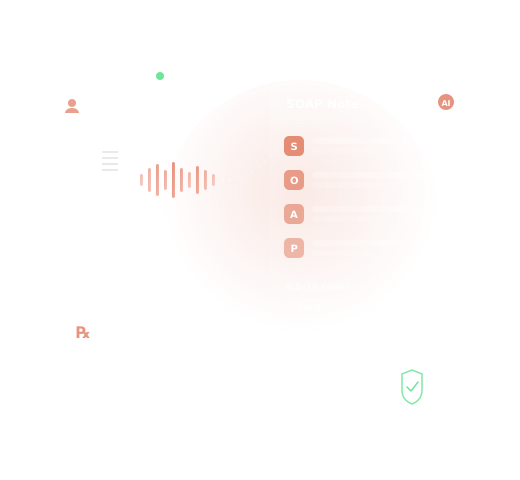
- Transcribe and structure the conversation: The system converts speech into text and applies speaker diarization to separate participants. It then organizes the content into clinically useful sections so the raw transcript becomes easier to review.
- Draft SOAP notes automatically: Based on the structured transcript, MedScribe prepares a SOAP-style draft that can include history, assessment context, and plan-oriented documentation relevant to the encounter. This is especially useful when infection-related discussions need concise summaries.
- Suggest coding support: The platform can surface ICD-10 and CPT suggestions to support downstream documentation and administrative workflows. These are suggestions only and are intended for clinician or authorized staff review before use.
- Review, edit, and sign off: The clinician checks the draft, makes edits, confirms accuracy, and finalizes the note. Human review is an operational checkpoint, ensuring the final record reflects clinical intent before it is stored or shared.
- Choose deployment posture for operations: Organizations can evaluate on-premise or private deployment options based on workflow, IT preferences, and governance needs. This is a practical implementation decision rather than a compliance claim.
Local context
In India, healthcare teams often work across high patient volumes, mixed digital maturity, and multilingual communication. These realities make documentation support especially relevant. An AI medical scribe in India should be practical for busy OPDs, hospital rounds, and specialist discussions rather than built only for idealized workflows. For microbiology lab-linked departments, that means helping clinicians summarize relevant findings and communication points without adding extra administrative burden.
Hospitals and clinics may also have different infrastructure preferences. Some may want cloud-based convenience, while others may prefer private or on-premise deployment due to internal governance choices. A useful solution for Indian healthcare settings should support these operational differences and fit into existing documentation habits with minimal disruption.
Use cases
Microbiology lab teams and associated clinicians can use the product in several practical scenarios. During infectious disease consultations, the system can help draft structured notes from patient-clinician conversations. In inpatient settings, it can support documentation of review discussions related to culture findings, antimicrobial history, and follow-up plans. In multispecialty hospitals, it can help create concise summaries after cross-department case reviews involving microbiology input.
It is also useful for outpatient follow-ups where prior reports, symptom progression, and treatment response need to be documented quickly. Diagnostic centres that coordinate with referring doctors may use it to prepare cleaner communication summaries. Across these scenarios, the value of an AI medical scribe in India is not just speed; it is the ability to create more consistent drafts that clinicians can review and finalize with less manual effort.
FAQ
Below are common implementation questions from clinics and hospitals evaluating documentation support for microbiology-related workflows.
Can this be used only by microbiologists?
No. It can support documentation for clinicians, specialists, and care teams who interact with microbiology-related cases, including OPD, inpatient, and multidisciplinary workflows.
Does the product replace clinician review?
No. Drafts and coding suggestions are intended to support documentation. Clinician review, edits, and final sign-off remain essential before record finalization.
Can it work in multilingual consultations?
Yes. Multilingual support is designed for real-world healthcare conversations where English and regional languages may be used in the same encounter.
Is deployment flexible for hospitals with internal IT requirements?
Yes. On-premise and private deployment options can be evaluated based on workflow, infrastructure, and governance preferences.
CTA
If your hospital, clinic, or diagnostic centre is evaluating an AI medical scribe in India for microbiology lab-linked workflows, MedScribe offers a practical path from conversation capture to clinician-reviewed documentation. Explore the core product at /medscribe, review capabilities at /medscribe/features, and assess how the workflow can fit your OPD, inpatient, or specialist documentation process.