Introduction
Minimal Access Surgery teams work in fast, detail-heavy environments where accurate documentation matters before consultation, during evaluation, and after procedures. An AI medical scribe in India can help surgeons, assistants, and clinic staff reduce time spent turning conversations into structured notes while keeping the clinician in control of the final record. For laparoscopic, endoscopic, and other minimally invasive surgery practices, documentation often includes symptoms, prior treatment history, imaging references, procedure planning, consent discussions, follow-up instructions, and coding-related details. A practical documentation copilot supports these steps by converting consultation conversations into draft clinical notes that are easier to review and finalize.
This page focuses on how an AI medical scribe can support Minimal Access Surgery OPD and hospital workflows in India. The goal is not to replace clinical judgment, but to reduce repetitive typing, improve note consistency, and help teams move from conversation to usable documentation faster. MedScribe is designed for day-to-day clinical use, with capabilities such as automatic SOAP note generation, speaker diarization, multilingual support, coding suggestions, and deployment options that can support workflows aligned with internal governance needs.
Department workflow
Minimal Access Surgery documentation usually spans multiple touchpoints. In OPD, the surgeon may evaluate abdominal pain, hernia, gallbladder disease, reflux, piles, fissure, fistula, obesity-related surgical indications, or post-operative recovery concerns. The consultation often includes symptom duration, previous medications, prior surgeries, imaging findings, co-morbidities, and discussion of operative versus conservative management. In procedure-focused settings, the team may also need to capture pre-op advice, risk discussion, discharge planning, and follow-up instructions.
These workflows create a documentation burden because the surgeon must listen, assess, explain, and document at the same time. An AI medical scribe in India can fit into this workflow by capturing the consultation conversation, separating speakers, structuring the transcript into clinically relevant sections, and drafting notes for review. For Minimal Access Surgery, this is especially useful when the same clinic session includes new evaluations, second opinions, pre-procedure counseling, and post-op reviews. Instead of starting every note from a blank screen, the clinician gets a draft that reflects the encounter and can be edited before sign-off.
Features mapped to workflow
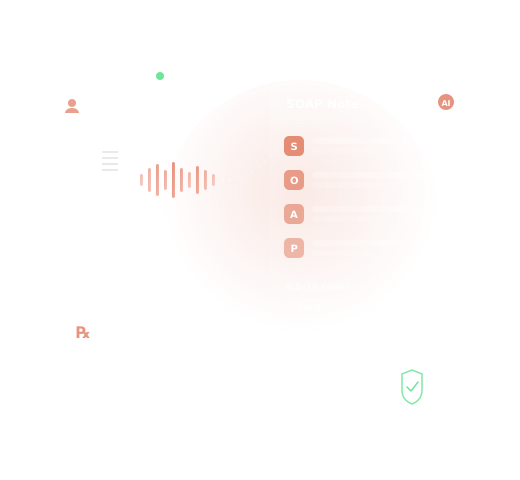
Automatic SOAP note generation: Consultation conversations can be converted into draft Subjective, Objective, Assessment, and Plan notes. This helps surgeons document symptoms, examination findings, probable diagnosis, treatment options, and next steps in a familiar format.
Speaker diarization: In a surgical consultation, both doctor and patient contribute important details. Speaker separation helps distinguish patient history from clinician advice, making the draft easier to review.
ICD-10 and CPT suggestions: Coding support can help teams identify likely documentation-linked coding references based on the encounter. These suggestions are useful as a review aid and should be validated by the clinician or billing team.
Multilingual support: Many clinics in India handle consultations that move between English and regional languages. Multilingual capture can support more natural doctor-patient conversations without forcing rigid language use.
On-premise or private deployment options: Hospitals and larger surgical centers may prefer deployment choices based on internal IT, governance, and workflow needs. These options should be viewed as operational decisions that support documentation processes.
Review-first workflow: Drafts are not the final record. The clinician reviews, edits, and signs off before the note is finalized, which is important for surgical decision-making and continuity of care.
How It Works
The product workflow is designed around real consultation documentation rather than generic transcription alone.
- Capture the consultation conversation: During an OPD visit or follow-up, the system records the doctor-patient interaction through the configured setup. This may include mixed-language discussion, symptom narration, prior treatment history, and surgical counseling relevant to Minimal Access Surgery.
- Transcribe and structure the encounter: The audio is converted into text with speaker diarization so the system can distinguish who said what. The transcript is then organized into clinically meaningful sections instead of remaining as raw conversation text.
- Draft a SOAP note automatically: Based on the structured transcript, the platform generates a draft SOAP note covering history, findings, assessment, and plan. For a surgical clinic, this may include suspected diagnosis, investigations discussed, conservative management advice, or procedure planning points.
- Surface coding support: The system can suggest ICD-10 and CPT references linked to the documented encounter. These are intended to support review workflows and should be checked by the clinician or authorized team member before use.
- Clinician review and edits: Before anything becomes part of the final record, the surgeon reviews the draft, corrects wording, adds missing clinical nuance, and confirms that the note reflects the actual encounter. Human review is a required checkpoint in the workflow.
- Finalize based on deployment workflow: After sign-off, the note can move into the clinic or hospital documentation process. Depending on operational preference, teams may choose private or on-premise deployment posture to support internal governance and integration decisions.
Local context
In India, Minimal Access Surgery practices often balance high patient volumes, multilingual consultations, and varied documentation expectations across standalone clinics, day-care centers, and hospitals. A practical AI medical scribe in India should therefore support everyday OPD realities rather than assume a single workflow. Some teams may want a lightweight documentation copilot for consultations, while others may need deployment choices that fit internal IT preferences. The value comes from helping clinicians spend less time on repetitive note creation and more time on patient communication, review, and decision-making.
For India healthcare settings, flexibility matters. Surgical consultations may involve family members, prior paper records, imaging summaries, and mixed-language explanations of procedure risks and recovery. An AI medical scribe India healthcare solution is most useful when it adapts to these practical conditions and keeps the clinician responsible for final validation.
Use cases
New surgical consultation: Capture history, symptoms, prior treatment, examination discussion, and plan for investigations or surgery.
Pre-procedure counseling: Document discussion around diagnosis, treatment options, expected recovery, and follow-up instructions.
Post-operative review: Draft notes for wound review, symptom progression, medication advice, and next visit planning.
High-volume OPD sessions: Reduce repetitive typing across multiple consultations while maintaining a review-first workflow.
Multi-location surgical groups: Standardize note structure across clinicians while allowing edits based on individual practice style.
For these scenarios, an AI medical scribe in India can support more consistent documentation without changing the clinician’s responsibility for assessment and sign-off.
FAQ
Can this be used in a Minimal Access Surgery OPD?
Yes. It is suited to consultation-heavy workflows where surgeons need help converting conversations into structured draft notes for review.
Does it replace the surgeon’s documentation responsibility?
No. The platform assists with drafting and coding support, but the clinician reviews, edits, and approves the final note.
Can it handle multilingual consultations?
Yes. Multilingual support is useful for clinics where doctor-patient conversations move between English and regional languages.
Is deployment flexible for hospitals?
Yes. Private or on-premise deployment options can support workflow and governance preferences, depending on operational requirements.
CTA
If your surgical clinic or hospital wants a more efficient way to document consultations, explore how an AI medical scribe in India can support Minimal Access Surgery workflows. Review the core product at /medscribe, learn more about capabilities at /medscribe/features, and assess whether the workflow fits your OPD, follow-up, and procedure counseling needs.