Introduction
Movement disorders consultations often involve detailed history taking, medication review, symptom progression, examination findings, and longitudinal follow-up. An AI medical scribe in India can help clinicians reduce manual documentation load by turning consultation conversations into structured draft notes that are ready for review. For neurology teams managing Parkinsonism, tremor, dystonia, chorea, gait issues, and related conditions, the value is practical: less time spent typing, more time available for patient interaction, and more consistent note structure across OPD workflows.
This page focuses on how an AI medical documentation copilot can support movement disorders departments in Indian clinics and hospitals. The goal is not to replace clinical judgment. Instead, it supports doctors by capturing the consultation, organizing the discussion into usable clinical documentation, and presenting coding suggestions for clinician review. For organizations evaluating an AI medical scribe in India, the most useful lens is workflow fit: how well the tool supports daily OPD volume, multilingual conversations, and the need for final clinician sign-off before records are completed.
Department workflow
Movement disorders care is documentation-heavy because symptoms evolve over time and treatment decisions depend on nuanced changes. A typical visit may include prior diagnosis review, current complaints, medication timing, response fluctuations, dyskinesia discussion, sleep and autonomic symptoms, falls history, caregiver observations, and focused examination findings. Follow-up visits also require comparison with prior notes and clear documentation of treatment adjustments.
In many Indian healthcare settings, these visits happen in busy OPD schedules where doctors must balance patient throughput with detailed records. That creates friction: clinicians may document after the visit, rely on shorthand, or spend extra time completing notes at the end of the day. An AI medical scribe in India is useful in this context because it supports a more consistent documentation flow during or immediately after the consultation. Instead of starting from a blank screen, the clinician receives a structured draft that reflects the conversation and can be edited quickly.
For movement disorders teams, this is especially relevant when consultations include mixed language use, caregiver participation, and repeated follow-up patterns. The documentation process benefits from speaker separation, multilingual transcription support, and a SOAP-style output that can be reviewed and finalized by the treating doctor.
Features mapped to workflow
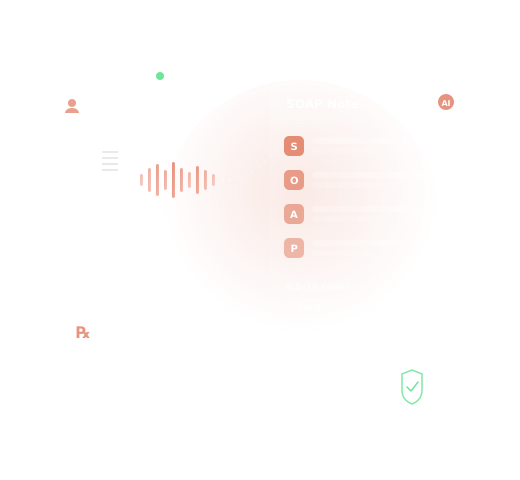
The product value is strongest when features map directly to real clinical steps. Automatic SOAP note generation helps convert a long consultation into a familiar structure: subjective history, objective findings, assessment, and plan. This is useful for both new and follow-up movement disorders visits where consistency matters.
Speaker diarization supports workflows where the doctor, patient, and caregiver all contribute to the conversation. In movement disorders clinics, caregiver input can be important for symptom timing, falls, freezing episodes, medication adherence, and functional decline. Separating speakers helps the draft note remain easier to review.
Multilingual support matters in Indian OPD settings where consultations may shift between English and regional languages. This can improve usability for clinicians who want documentation support without forcing a single-language interaction style.
ICD-10 and CPT suggestions can support downstream documentation and billing workflows by surfacing likely coding options based on the drafted note. These suggestions are not a substitute for clinician or administrative review, but they can reduce repetitive lookup work.
On-premise deployment and private deployment options are relevant for hospitals that prefer tighter control over infrastructure and data handling decisions. These choices should be evaluated as workflow and governance preferences, based on internal IT and operational requirements.
How It Works
The workflow is designed to move from consultation capture to clinician-approved documentation in a clear sequence.
- Capture the consultation conversation: During the OPD visit, the system records the doctor-patient interaction, including caregiver participation where relevant. This supports movement disorders visits that involve symptom timelines, medication schedules, and functional observations.
- Transcribe and structure the discussion: The audio is converted into text with multilingual support and speaker diarization. The system separates who said what and organizes the conversation into clinically relevant segments for easier review.
- Draft a SOAP note automatically: Based on the structured transcript, the product generates a draft SOAP note. For movement disorders workflows, this can include symptom history, examination-related observations discussed during the visit, assessment themes, and treatment planning points.
- Surface coding suggestions: The drafted note is used to suggest relevant ICD-10 and CPT options. These are presented as support for documentation workflows and should be checked by the clinician or billing team before use.
- Review, edit, and sign off: The clinician reviews the draft, corrects details, adds missing findings, and confirms the final note before it becomes part of the record. Human review is the operational checkpoint that keeps the workflow clinically accountable.
- Choose deployment posture for operations: Clinics and hospitals can evaluate cloud, private, or on-premise deployment approaches based on internal workflow, IT preferences, and governance needs. This helps teams align implementation with their operating environment.
Local context
In India, movement disorders services may operate across standalone neurology clinics, multispecialty hospitals, and academic centers. Documentation needs vary, but common operational themes include high OPD volume, mixed digital maturity, multilingual consultations, and the need to keep records usable for follow-up continuity. An AI medical scribe in India should therefore be evaluated for practical fit: how quickly clinicians can review notes, whether the output matches existing documentation habits, and how deployment options align with institutional preferences.
For many organizations, the best starting point is not a full workflow redesign but a focused implementation around consultation documentation. This keeps adoption practical and allows teams to assess note quality, review time, and usability in real clinical settings. The product can complement broader information systems rather than forcing a disruptive change in how doctors conduct consultations.
Use cases
Movement disorders specialists can use the tool during new patient evaluations where long histories are common and note completeness matters. It is also useful in follow-up visits that require comparison of symptom progression, medication response, and treatment adjustments over time.
General neurology clinics with movement disorders caseloads may use it to standardize documentation across consultants. Hospitals can use it to support OPD efficiency while keeping clinician review at the center of the process. Teaching institutions may find value in consistent note structure for supervised clinics, while still requiring final approval from the treating physician.
Another common use case is caregiver-heavy consultations. When family members provide much of the history, speaker diarization and structured drafting can make the final note easier to interpret. For organizations seeking an AI medical scribe in India, these practical use cases often matter more than broad feature lists because they show how the tool fits into daily care delivery.
FAQ
Below are common implementation questions from clinics and hospitals evaluating documentation support for neurology and movement disorders workflows.
Can this replace clinician documentation entirely?
No. The system is designed to create draft notes and coding suggestions that support the clinician. Final review, edits, and sign-off remain essential before the record is completed.
Is it suitable for multilingual consultations?
Yes. Multilingual support is useful for Indian healthcare settings where consultations may move between English and regional languages during the same visit.
How does it help movement disorders clinics specifically?
It supports long, detail-rich consultations by converting conversation into structured SOAP drafts, which can be especially helpful for follow-up-heavy care and caregiver-informed histories.
Can hospitals choose how it is deployed?
Yes. Deployment options can include private or on-premise approaches, depending on workflow, IT, and governance preferences. These choices should be assessed operationally by the organization.
CTA
If your team is exploring an AI medical scribe in India for movement disorders workflows, start with a practical evaluation: review how consultation capture, SOAP drafting, coding support, and clinician sign-off fit your OPD process. Compare note quality, review effort, and deployment preferences against your current documentation burden. For broader product details, teams can also explore the main MedScribe pages for features, integrations, and pricing.