Introduction
MRI services often involve more than image acquisition alone. Teams manage referrals, patient history, indication capture, protocol notes, contrast-related details, follow-up communication, and coordination with radiologists and referring clinicians. An AI medical scribe in India can support this documentation load by turning spoken clinical conversations into structured draft notes that are easier to review, edit, and finalize. For hospitals, diagnostic centres, and multispecialty clinics, the goal is practical: reduce repetitive typing, improve note consistency, and help clinicians focus on patient interaction and imaging workflow.
This page is designed for MRI departments and imaging-led practices that want documentation support without changing how clinicians make decisions. The product acts as a documentation copilot, helping convert consultation or pre-scan discussions into usable clinical summaries, SOAP-style drafts where relevant, and coding suggestions for downstream workflows. It is designed to align with operational preferences such as private or on-premise deployment, multilingual conversations, and clinician review before any record is finalized.
Department workflow
In MRI services, documentation usually starts before the scan. A patient may arrive with a referral note, prior reports, symptoms, and questions about the procedure. Front-desk and clinical staff collect history, while the radiologist or supervising clinician may confirm the indication, review contraindications, and document the plan. After the scan, findings may be discussed with the patient or referring team, and internal notes may need to be updated for continuity.
An AI medical scribe in India fits into this workflow by supporting the moments where spoken information is rich but manual note-taking is time-consuming. During pre-scan assessment, it can help capture symptoms, prior imaging history, implant or contrast-related discussion, and the reason for the study. During clinician interaction, it can structure the conversation into a draft note. For imaging centres handling high OPD volumes, this can help standardize documentation across shifts and locations while keeping the clinician in control of edits and sign-off.
For MRI teams in India, multilingual interactions are common. Patients may describe symptoms in one language while the clinician documents in English. This is where an AI medical scribe India healthcare workflow becomes useful: it supports multilingual capture and structured drafting so teams can move from conversation to documentation with fewer manual steps.
Features mapped to workflow
Conversation capture: Supports documentation from live or recorded consultation conversations related to MRI referrals, symptom review, and pre-procedure discussions.
Speaker diarization: Helps separate clinician and patient speech, which is useful when history-taking includes multiple participants such as attendants or technicians.
Automatic SOAP note generation: Drafts structured notes from the interaction, giving clinicians a starting point instead of a blank screen.
ICD-10 and CPT suggestions: Provides coding support for downstream administrative workflows, subject to clinician and billing review.
Multilingual support: Useful for Indian imaging settings where patient conversations may shift across English, Hindi, and regional languages.
On-premise or private deployment options: Supports workflow choices for organizations that prefer tighter control over data handling and internal governance.
Human review before finalization: Keeps the clinician responsible for checking, editing, and approving the final note.
How It Works
The workflow is built around documentation assistance, not autonomous clinical decision-making. In MRI services, the product supports the path from conversation capture to reviewed draft note and coding support.
- Capture the interaction: During a referral review, pre-scan assessment, or clinician-patient discussion, the system captures the conversation audio through the configured workflow. This may include symptom history, indication for MRI, prior imaging references, and relevant procedural discussion.
- Transcribe and identify speakers: The audio is converted into text, and speaker diarization helps distinguish patient, clinician, and other participants where applicable. This creates a cleaner base for documentation in busy imaging environments.
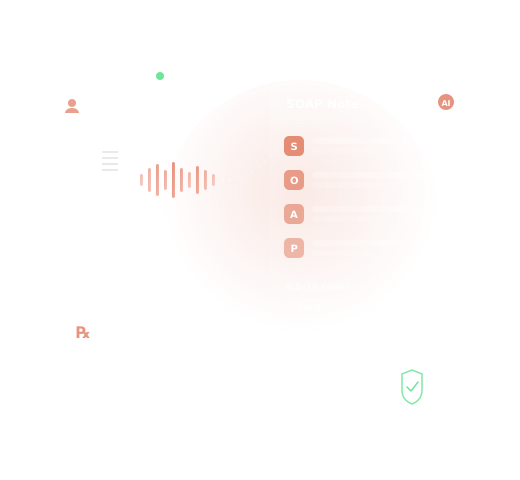
- Structure the transcript into clinical sections: The system organizes the conversation into a usable draft, including SOAP-style sections where appropriate. For MRI-related encounters, this can help summarize history, indication, assessment context, and next-step planning in a consistent format.
- Generate coding suggestions: Based on the drafted note, the product can surface ICD-10 and CPT suggestions to support administrative review. These are suggestions only and should be checked by the clinician or billing team before use.
- Review, edit, and sign off: The clinician reviews the draft note, corrects details, adds imaging-specific context if needed, and approves the final version before it becomes part of the record. This human checkpoint is essential for accuracy and workflow trust.
Deployment posture is handled as an operational choice. Organizations can evaluate private or on-premise setups based on internal IT preferences, workflow design, and governance requirements. The product is designed to support workflows aligned with institutional documentation practices rather than replace them.
- Route into the broader documentation workflow: After sign-off, the finalized note can support internal records, coding review, and continuity across OPD, radiology, and referring clinician communication, depending on the organization’s setup.
Local context
Imaging centres and hospitals in India often manage high patient throughput, mixed payer workflows, and multilingual communication. MRI departments may also coordinate with orthopaedics, neurology, oncology, emergency care, and general practice. In this setting, an AI medical scribe in India is most useful when it stays practical: capture the conversation, draft the note, support coding review, and leave final judgment to the clinician.
For organizations comparing documentation tools, the key question is not whether software can write a note, but whether it can fit real OPD and imaging operations. That includes handling variable consultation styles, supporting English-first documentation from multilingual speech, and allowing deployment choices that match internal infrastructure. This is why many teams evaluating an AI medical scribe in India look for workflow flexibility rather than generic automation claims.
Use cases
Pre-MRI assessment: Draft notes from conversations about symptoms, prior scans, implants, contrast history, and referral indication.
Radiology OPD support: Help clinicians summarize patient history before imaging interpretation or follow-up discussion.
Multispecialty coordination: Create cleaner documentation that can support communication between MRI services and referring departments.
Coding assistance: Surface ICD-10 and CPT suggestions for review after the note is drafted.
Private deployment preference: Support organizations that want documentation workflows aligned with internal hosting or governance decisions.
For many providers, the value of an AI medical scribe in India is not limited to one specialty. However, MRI services benefit when the tool reduces repetitive documentation around referrals, history capture, and post-consultation summaries without disrupting imaging operations.
FAQ
Can this be used in MRI departments and diagnostic imaging centres?
Yes. It is suitable for documentation support around MRI-related consultations, pre-scan assessments, referral reviews, and follow-up discussions where spoken clinical information needs to be converted into structured notes.
Does it replace clinician review?
No. The draft output should always be reviewed, edited where needed, and approved by the clinician before finalization.
Does it support multilingual conversations common in India?
Yes. Multilingual support is part of the workflow, which can help when patient conversations happen in regional languages while documentation is maintained in English.
Can it support coding workflows?
It can provide ICD-10 and CPT suggestions based on the drafted note. These suggestions should be checked by the relevant clinician or billing team.
CTA
If your MRI service is exploring ways to reduce manual documentation and improve note consistency, an AI medical scribe in India can be a practical next step. Review how conversation capture, SOAP drafting, coding support, multilingual handling, and deployment options fit your current workflow. Explore the product overview, features, integrations, and pricing paths to assess whether it matches your imaging operations and documentation goals.