Introduction
Neonatal ICU documentation is detailed, time-sensitive, and often repetitive across admission notes, progress updates, handover summaries, and discharge preparation. An AI medical scribe in India can help NICU teams reduce manual note-taking by turning clinician-patient-family conversations and care discussions into structured draft documentation. For hospitals and clinics looking to improve documentation consistency without changing how clinicians think, MedScribe is designed as a practical documentation copilot rather than a replacement for clinical judgment.
In neonatal care, every entry matters: maternal history, birth details, respiratory support, feeding tolerance, medication changes, and daily assessments all need to be captured clearly. MedScribe supports workflows aligned with routine hospital documentation by generating SOAP-style drafts, identifying speakers in conversations, and suggesting coding options for clinician review. The goal is simple: help doctors and care teams spend less time typing and more time focusing on newborn care, communication, and decision-making.
For organisations evaluating an AI medical scribe in India, the most useful question is not whether AI can write notes on its own, but whether it can fit safely into existing review and sign-off workflows. That is where a documentation copilot model is often more practical for NICU settings.
Department workflow
Neonatal ICU workflows involve multiple documentation moments across the day. A newborn may move from admission assessment to ventilatory review, feeding review, medication adjustment, family counselling, and shift handover within a short period. Clinicians often document from memory after the interaction, which can create delays and variation in note quality.
In a typical NICU workflow, documentation may include admission summaries, daily progress notes, procedure-related notes, counselling records, and discharge planning updates. These notes often pull from the same core data points: gestational age, birth weight, APGAR context, maternal risk factors, sepsis evaluation, respiratory support, fluid and nutrition plans, and response to treatment. MedScribe is built to support this pattern by converting captured conversations into structured drafts that clinicians can edit quickly.
Because NICU care is collaborative, documentation also needs to reflect who said what during rounds or counselling. Speaker diarization helps separate clinician and caregiver speech, while multilingual support can be useful in Indian hospital environments where English may be mixed with Hindi or regional languages during care discussions. This makes an AI medical scribe in India relevant not only for note creation, but also for smoother communication capture in real-world hospital settings.
Features mapped to workflow
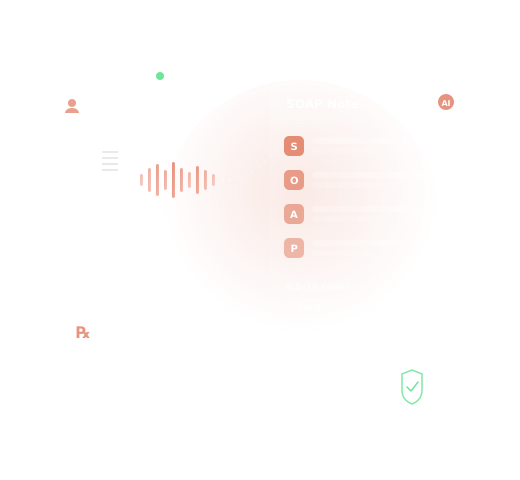
Automatic SOAP note generation: Useful for daily progress notes, follow-up assessments, and structured summaries after rounds. Instead of starting from a blank page, clinicians receive a draft with subjective context, objective findings, assessment themes, and plan elements.
Speaker diarization: Helps distinguish clinician, nurse, and family speech during counselling or bedside discussions, making transcripts easier to review before final documentation.
ICD-10 and CPT suggestions: Supports coding workflows by surfacing likely code options based on the documented encounter. These are suggestions for review, not automatic final coding.
Multilingual support: Helpful in Indian healthcare environments where conversations may shift between English and local languages during rounds or family interactions.
On-premise or private deployment options: Supports organisations that prefer tighter control over where documentation workflows run, based on internal governance and IT preferences.
Human review before finalization: Drafts are intended for clinician editing and sign-off, which is especially important in NICU care where subtle wording can affect continuity of care.
How It Works
MedScribe follows a practical end-to-end documentation flow designed for clinical use.
- Capture the encounter: During NICU rounds, counselling, or review discussions, the conversation is captured through the chosen workflow. This may include bedside updates, family counselling, or clinician dictation after the interaction.
- Transcribe and structure the conversation: The system converts speech into text, separates speakers where possible, and organizes the content into clinically relevant sections. This helps reduce the effort needed to reconstruct the encounter later.
- Draft a SOAP-style note: Based on the transcript, MedScribe generates a structured draft note that can reflect history, observations, assessment points, and care plan items. For NICU teams, this can support progress notes, counselling summaries, and follow-up documentation.
- Surface coding suggestions: The platform can suggest ICD-10 and CPT options linked to the documented encounter. These suggestions are meant to support coding review and should be validated by the clinician or coding team.
- Review, edit, and sign off: The clinician checks the draft, corrects terminology, adds missing clinical nuance, and approves the final version before it becomes part of the record. This human checkpoint is central to safe documentation workflows.
- Choose the deployment posture: Hospitals can evaluate whether a private or on-premise setup better fits their operational and governance needs. This is a workflow and infrastructure decision that can support internal data handling preferences.
Local context
Hospitals evaluating an AI medical scribe in India often need tools that fit mixed-language communication, variable documentation maturity, and busy specialist workflows. In NICU settings, the challenge is not just speed; it is maintaining clarity across high-acuity care, family communication, and shift-based teams. A practical documentation copilot can help standardize note structure while still leaving final control with the clinician.
For Indian healthcare organisations, deployment flexibility can also matter. Some institutions may prefer private environments or on-premise deployment to align with internal IT policies and data handling practices. Others may focus first on reducing documentation burden in daily rounds and then expand usage across departments. In either case, an AI medical scribe India healthcare solution should be evaluated on workflow fit, review controls, and ease of adoption by clinicians.
Use cases
Admission documentation: Convert initial case discussions into structured admission drafts covering maternal history, delivery details, neonatal status, and immediate care plan.
Daily progress notes: Support recurring NICU documentation for respiratory status, feeding, infection monitoring, medication changes, and response to treatment.
Family counselling summaries: Capture and structure counselling conversations so key explanations and next steps are easier to document consistently.
Procedure and intervention follow-up: Create draft notes after line placement discussions, respiratory support changes, or escalation reviews.
Discharge preparation: Help organize the final documentation trail by summarizing course of stay, feeding plans, follow-up needs, and caregiver instructions for clinician review.
These are the kinds of practical scenarios where an AI medical scribe in India can support NICU teams without forcing major workflow changes.
FAQ
Below are common implementation questions from hospitals and clinics considering documentation automation for neonatal care.
Can this replace clinician documentation entirely?
No. MedScribe is intended to create draft documentation and support coding review. Clinicians should review, edit, and sign off before finalizing records.
Is it useful for multilingual hospital environments?
Yes, multilingual support can help in settings where conversations move between English and Indian languages during rounds or counselling.
Does it support coding workflows?
It can suggest ICD-10 and CPT options based on the documented encounter, which may help coding teams work faster after clinician validation.
Can hospitals choose how it is deployed?
Yes. Private or on-premise deployment options can be considered based on workflow, infrastructure, and governance preferences.
CTA
If your NICU team is exploring ways to reduce documentation burden while keeping clinicians in control, MedScribe offers a practical starting point. Review the core product at /medscribe, explore capabilities at /medscribe/features, and assess whether this AI medical scribe in India fits your neonatal documentation workflow. The best implementations start with a clear use case: daily progress notes, counselling summaries, or admission documentation that needs to be faster, more structured, and easier to review.