Introduction
Neuro ICU teams work in a high-acuity environment where documentation must keep pace with rapid assessments, handovers, ventilator updates, neurological observations, medication changes, and family discussions. An AI medical scribe in India can support this workload by turning clinician-patient or clinician-caregiver conversations into structured draft notes that are easier to review and finalize. For hospitals and specialty units looking to reduce repetitive typing, the goal is not to replace clinical judgment, but to support faster note preparation, clearer documentation flow, and more consistent capture of key details.
MedScribe is designed as an AI documentation copilot for doctors and care teams. It converts consultation or bedside discussion audio into usable clinical drafts, including SOAP-style notes and coding suggestions, while keeping the clinician in control of edits and sign-off. For Neuro ICU settings in India, this is especially relevant where documentation often spans admission summaries, progress notes, procedure-related updates, neurological status tracking, and discharge planning. An AI medical scribe in India can help teams spend less time on repetitive note assembly and more time on patient care coordination.
Department workflow
Neuro ICU documentation is different from a routine outpatient encounter. The workflow may include emergency admission intake, neurological examination findings, sedation status, ventilator support notes, seizure monitoring updates, post-operative observations, family counseling, and multidisciplinary rounds. Clinicians often need to document evolving status across shifts while preserving clarity for intensivists, neurologists, neurosurgeons, nursing teams, and billing staff.
In practice, the documentation burden appears in several moments: capturing the initial history from relatives, summarizing bedside assessments, recording interval changes during rounds, preparing procedure-related notes, and converting spoken updates into structured records. An AI medical scribe in India fits into this workflow by helping convert spoken clinical interactions into organized drafts that can then be reviewed, corrected, and finalized by the treating clinician. This is useful when teams need support for consistency without changing the core clinical process.
Features mapped to workflow
Automatic SOAP note generation: Neuro ICU teams often need a repeatable structure for daily progress documentation. Automatic SOAP drafting helps organize subjective history from caregivers, objective findings, assessment summaries, and plan items into a format clinicians can quickly review.
Speaker diarization: In critical care conversations, multiple voices may be involved, including doctor, resident, nurse, patient attendant, or family member. Speaker separation helps distinguish who said what, improving the usability of the draft note.
Multilingual support: In India, Neuro ICU interactions may move between English, Hindi, and regional languages. Multilingual capture can support more natural conversations while still producing structured documentation for review.
ICD-10 and CPT suggestions: Coding support can help teams prepare more complete documentation for downstream administrative workflows. Suggestions should always be reviewed by the clinician or coding team before final use.
On-premise or private deployment posture: Hospitals may prefer deployment choices that align with internal governance, IT architecture, and data handling preferences. This is best treated as an operational decision based on workflow and infrastructure needs.
These capabilities make AI medical scribe India healthcare adoption practical when the objective is to support documentation quality without adding friction to bedside care.
How It Works
The workflow below reflects how the product supports real clinical documentation from conversation capture to final sign-off.
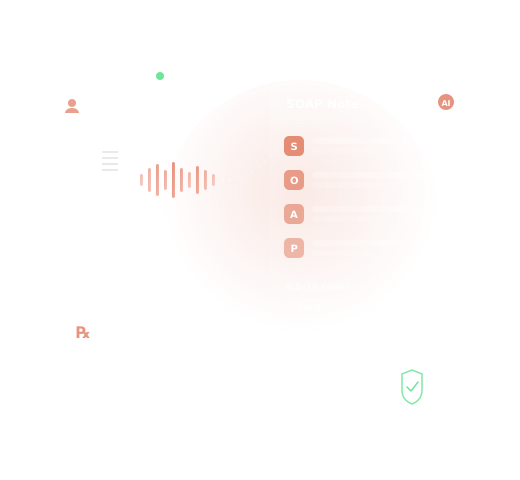
- Capture the clinical conversation: During admission, rounds, family counseling, or bedside review, the clinician records the interaction through the documentation workflow. The system captures spoken input from relevant participants and prepares it for transcription.
- Transcribe and structure the encounter: The audio is converted into text with speaker diarization to separate clinician and caregiver or team inputs. The transcript is then organized into clinically relevant sections so the raw conversation is easier to work with.
- Draft a SOAP-style note: Based on the structured transcript, the system generates a draft note that can include history, neurological findings discussed during the encounter, assessment points, and plan items. This gives the clinician a usable starting point rather than a blank screen.
- Add coding support: The workflow can surface ICD-10 and CPT suggestions linked to the documented encounter. These are assistive prompts only and should be checked against the final clinical record and coding requirements.
- Review, edit, and sign off: The clinician reviews the draft, corrects terminology, adds missing Neuro ICU details, and confirms the final note before record completion. Human review is the operational checkpoint that ensures the documentation reflects actual clinical judgment.
For hospitals evaluating deployment options, the same workflow can be adapted to on-premise or private environments depending on internal IT and governance preferences. The key point is that deployment posture should support the documentation process, review controls, and operational needs of the institution.
Local context
Hospitals in India often manage mixed documentation environments, with some teams using structured digital records and others relying on partial dictation, manual typing, or retrospective note completion. In Neuro ICU, where patient status can change quickly, delayed documentation can create extra work during handovers and discharge preparation. An AI medical scribe in India is useful when organizations want a practical layer between live clinical conversations and final records.
Local relevance also comes from multilingual communication and variable staffing patterns across shifts. Family discussions may happen in one language while records are maintained in another. A practical AI medical scribe in India should therefore support multilingual workflows, clinician review, and deployment choices that fit hospital operations rather than forcing a one-size-fits-all setup.
Use cases
Admission documentation: Convert initial history from relatives and emergency team discussions into a structured draft for faster completion.
Daily progress notes: Support intensivists and neurologists during rounds by turning spoken updates into organized SOAP drafts.
Post-procedure updates: Help prepare notes after neurosurgical intervention, line placement, or ventilation changes, with clinician review before finalization.
Family counseling summaries: Capture key discussion points from prognosis or treatment planning conversations for clearer records.
Coding preparation: Surface assistive ICD-10 and CPT suggestions from the documented encounter to support downstream administrative workflows.
These use cases show how an AI medical scribe in India can support both tertiary hospitals and specialty centers that need more efficient documentation in critical care settings.
FAQ
Can this be used in a Neuro ICU and not just OPD?
Yes. While many AI documentation tools are discussed in outpatient settings, the workflow can also support high-acuity departments where conversations, assessments, and family updates need to be converted into structured draft notes for clinician review.
Does the tool replace clinician documentation responsibility?
No. The system prepares draft notes and coding suggestions, but the treating clinician remains responsible for review, edits, and final sign-off before the record is completed.
How does multilingual support help in India?
It helps when bedside conversations happen in English, Hindi, or regional languages. This can make documentation capture more practical while still allowing the final note to be reviewed in the required clinical format.
Can hospitals choose how the system is deployed?
Yes. Deployment can be planned based on hospital IT and governance preferences, including on-premise or private setups where appropriate. These choices are operational and should be evaluated by the organization.
CTA
If your hospital is evaluating documentation support for critical care, MedScribe offers a practical path from conversation capture to clinician-reviewed notes. Explore the product overview at /medscribe, review capabilities at /medscribe/features, and assess whether an AI medical scribe in India fits your Neuro ICU workflow, staffing model, and documentation goals.