Introduction
Neuropsychology consultations often involve long patient narratives, cognitive observations, behavioural details, test context, and careful documentation of history over multiple visits. For clinics and hospitals that want to reduce manual note-taking pressure, an AI medical scribe in India can support more consistent documentation without changing the clinician’s core decision-making role. Instead of relying on fragmented handwritten notes or delayed typing after OPD hours, teams can use AI-assisted documentation to capture consultation conversations, structure them into usable drafts, and prepare records for clinician review.
For neuropsychology departments, the value is practical: less time spent reconstructing sessions, better continuity across follow-ups, and a more standard way to document assessments, impressions, and care plans. An AI medical scribe is not a replacement for clinical judgment. It is a documentation copilot designed to help convert spoken interactions into structured notes, with human review and sign-off remaining central. In India, where workflows can vary across private clinics, multispecialty hospitals, and academic centres, this model supports day-to-day documentation needs while allowing teams to choose deployment approaches that fit their operational preferences.
Department workflow
Neuropsychology workflows are documentation-heavy by nature. A typical visit may include referral context, presenting complaints, developmental or neurological history, caregiver input, behavioural observations, test administration notes, interpretation summaries, and recommendations for follow-up. In many settings, clinicians also need to coordinate with neurology, psychiatry, rehabilitation, paediatrics, or psychology teams. This creates repeated documentation tasks across intake, assessment, review, and reporting.
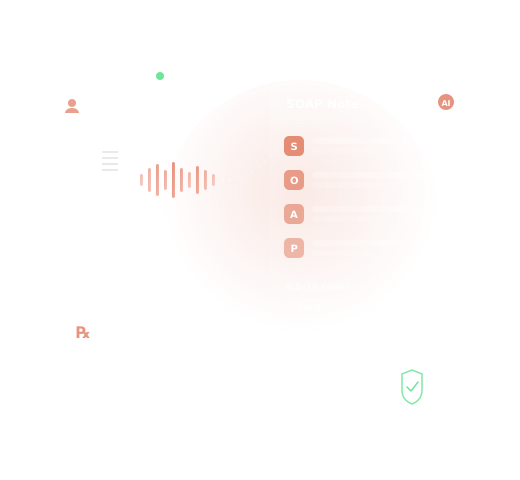
An AI medical scribe in India can fit into this workflow by helping capture the consultation conversation and turning it into a structured draft that reflects the sequence of the encounter. During OPD or scheduled assessment sessions, the system can support transcription, identify speakers, and organise content into clinically useful sections. After the session, the clinician reviews, edits, and finalises the note before it becomes part of the record. This is especially useful when neuropsychology teams need to preserve nuance while reducing repetitive typing.
In practical terms, the workflow support is strongest in three areas: documenting detailed histories, drafting structured notes from long conversations, and preparing coding suggestions for downstream administrative workflows. The result is not just faster note creation, but a more repeatable process for documentation quality across clinicians and locations.
Features mapped to workflow
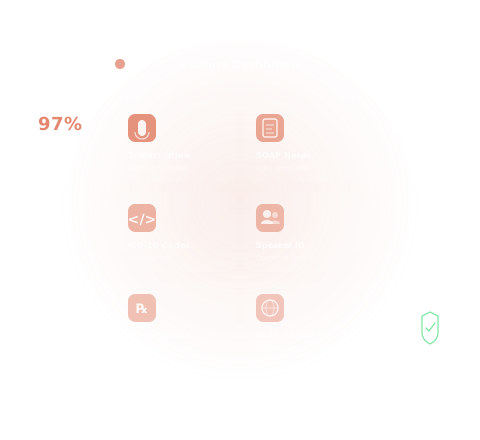
For neuropsychology teams, product value should map directly to what happens in the consultation room and after it. Automatic SOAP note generation helps convert a conversation into a familiar clinical format, giving clinicians a draft that can be refined rather than written from scratch. Speaker diarization is useful when both patient and caregiver contribute, or when multiple participants are involved in the session. Multilingual support matters in India because consultations may move between English, Hindi, and regional languages depending on patient comfort and caregiver participation.
ICD-10 and CPT suggestions can support coding workflows by surfacing likely options based on the documented encounter, while still leaving the final choice to the clinician or authorised staff. For organisations with stricter governance preferences, on-premise or private deployment options can be considered as part of infrastructure planning. These choices are best understood as workflow and data-handling decisions rather than blanket guarantees.
For neuropsychology specifically, these capabilities help with documenting cognitive complaints, behavioural observations, symptom progression, test-related context, and follow-up plans in a more standardised way. An AI medical scribe in India is most effective when it reduces clerical load while preserving the clinician’s ability to review wording, add interpretation, and confirm the final record.
How It Works
The workflow below reflects how the product is designed to support real clinical documentation from start to finish.
- Capture the consultation conversation: During the neuropsychology visit, the system records or ingests the consultation audio from the approved workflow. This may include patient history, caregiver input, symptom descriptions, and clinician questions. Speaker diarization helps separate who said what, which is useful in sessions with multiple participants.
- Transcribe and structure the interaction: The audio is converted into text and organised into clinically relevant segments. Instead of leaving the team with a raw transcript alone, the system prepares structured content that can be used for note drafting. Multilingual support can help when the conversation includes more than one language commonly used in Indian care settings.
- Draft a SOAP note automatically: Based on the structured transcript, the product generates a SOAP-style draft note. This gives the clinician a starting point for documenting subjective history, objective observations, assessment, and plan. In neuropsychology, this can help preserve detail from longer consultations while reducing after-hours documentation effort.
- Surface coding suggestions: The system can present ICD-10 and CPT suggestions linked to the documented encounter. These suggestions are intended to support administrative and billing workflows, not replace clinician judgment. Teams can use them as prompts during review before final coding decisions are made.
- Review, edit, and sign off: The clinician checks the draft, corrects wording, adds interpretation, removes irrelevant content, and confirms the final note. Human review is the operational checkpoint that ensures the record reflects the actual encounter before finalisation.
- Choose deployment posture for operations: Depending on organisational needs, teams may evaluate private or on-premise deployment approaches. This is a governance and workflow decision that can support internal preferences around infrastructure, access, and record handling.
Local context
In India, neuropsychology services may operate across standalone clinics, hospital OPDs, rehabilitation centres, and multidisciplinary practices. Documentation expectations can differ by setting, but the operational challenge is similar: clinicians need complete notes without losing time to repetitive clerical work. An AI medical scribe in India is relevant here because it supports practical OPD workflows rather than requiring teams to redesign care delivery around technology.
Local relevance also includes multilingual consultations, variable staffing patterns, and the need to coordinate across departments. Some organisations may prefer cloud-based workflows, while others may evaluate private or on-premise setups based on internal IT and governance preferences. The right approach depends on how the department wants to manage documentation operations, review checkpoints, and system access.
Use cases
Neuropsychology teams can use this product across several recurring scenarios. In initial consultations, it can help capture long-form histories and convert them into structured drafts. In follow-up visits, it can support faster documentation of symptom changes, behavioural observations, and updated plans. In multidisciplinary settings, it can help create clearer records that are easier to share internally with referring teams.
It is also useful for clinics that want more standard note structure across clinicians, especially when patient volumes increase. For departments handling paediatric, adult, geriatric, or rehabilitation-linked neuropsychology cases, the ability to document nuanced conversations without relying entirely on manual typing can improve workflow consistency. An AI medical scribe in India can therefore support both individual practitioners and larger institutions looking for a more repeatable documentation process.
FAQ
Can this work for long neuropsychology consultations?
Yes. It is designed to support documentation from extended clinical conversations by converting captured audio into structured drafts that clinicians can review and refine.
Does it replace clinician documentation responsibility?
No. The system assists with drafting and coding suggestions, but the clinician remains responsible for review, edits, and final sign-off before the record is completed.
Is multilingual use relevant for India?
Yes. Multilingual support can be useful when consultations move between English and other languages during patient or caregiver interactions.
Can hospitals choose different deployment models?
Yes. Teams may evaluate private or on-premise deployment options based on workflow, IT, and governance preferences.
CTA
If your neuropsychology department wants to reduce documentation burden while keeping clinicians in control of the final record, explore a practical AI medical scribe in India workflow for daily OPD use. Review how conversation capture, SOAP drafting, coding support, and clinician sign-off can fit your current process, then compare feature details on the related product and features pages before planning rollout.