Introduction
Nuclear oncology documentation often spans referral history, imaging context, treatment intent, follow-up planning, and multidisciplinary communication. For hospitals and specialty clinics, this creates a steady documentation burden around consultations, review visits, and care coordination. An AI medical scribe in India can help reduce manual note-taking by turning clinician-patient conversations into structured draft notes that are ready for review. Instead of replacing clinical judgment, the tool supports doctors with faster documentation, clearer summaries, and more consistent record preparation.
For nuclear oncology departments, the value is practical: less time spent typing during or after OPD sessions, better continuity across repeat visits, and easier handoff of information to administrative and clinical teams. MedScribe is designed as an AI documentation copilot that converts consultation audio into usable clinical notes and coding suggestions. It supports SOAP note generation, speaker diarization, multilingual conversations, and deployment choices such as on-premise or private environments based on operational needs. For providers evaluating an AI medical scribe in India, the focus should be on workflow fit, clinician review controls, and ease of adoption in daily practice.
Department workflow
In nuclear oncology, documentation usually begins before the patient enters the room. Clinicians may review prior imaging, pathology summaries, referral notes, treatment history, and current symptoms. During the consultation, the doctor discusses disease status, response to prior therapy, scan findings, symptom burden, medication tolerance, and next-step planning. After the encounter, the team often needs a structured note, diagnosis coding support, and a clear plan for follow-up, additional imaging, or coordination with medical, surgical, or radiation oncology.
This workflow is repetitive but detail-heavy. A missed symptom update, incomplete assessment summary, or delayed note can affect downstream coordination. An AI medical scribe in India is useful here because it supports the consultation lifecycle rather than only transcription. It can capture the conversation, distinguish speakers, organize content into clinical sections, and prepare a draft SOAP note for clinician review. In a busy Indian hospital or specialty center, that means the doctor can stay more focused on the patient while still maintaining a structured documentation process.
Features mapped to workflow
Conversation capture: The product supports consultation audio capture for in-person workflows, helping clinicians document without relying entirely on manual typing. This is especially useful in review-heavy OPD settings.
Speaker diarization: By separating clinician and patient speech, the draft note becomes easier to interpret and edit. In nuclear oncology, where symptom descriptions and physician assessments both matter, this separation improves note clarity.
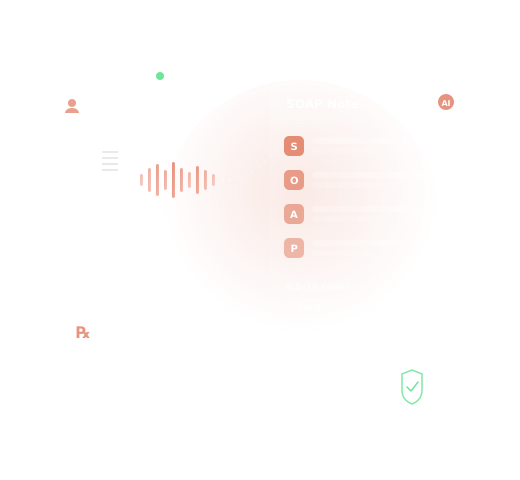
Automatic SOAP note generation: The system converts the conversation into a structured draft with subjective, objective, assessment, and plan sections. This helps standardize records across first visits and follow-ups.
ICD-10 and CPT suggestions: Coding support can help administrative and clinical teams prepare records more efficiently. Suggestions should always be reviewed by the clinician or authorized staff before final use.
Multilingual support: Many consultations in India move between English and regional languages. Multilingual capability supports more natural doctor-patient interaction while still producing usable documentation.
On-premise or private deployment options: Some hospitals prefer infrastructure choices that support internal governance and IT preferences. Deployment posture can be selected as an operational decision based on workflow, security review, and integration planning.
How It Works
The workflow for MedScribe is designed to follow the real sequence of a clinical encounter in nuclear oncology, from conversation capture to clinician-approved documentation.
- Capture the consultation conversation: During the OPD visit, the clinician starts the documentation session so the system can process the doctor-patient discussion. This may include history updates, scan review discussion, symptom assessment, and treatment planning.
- Transcribe and structure the interaction: The platform converts speech into text and uses speaker diarization to separate patient and clinician statements. It then organizes the transcript into clinically relevant segments rather than leaving the team with raw text alone.
- Draft a SOAP note automatically: Based on the structured transcript, MedScribe prepares a draft SOAP note. For nuclear oncology, this can help summarize presenting concerns, relevant prior context, current assessment, and the planned next steps for imaging, therapy, or follow-up.
- Suggest coding support: The system can surface ICD-10 and CPT suggestions linked to the documented encounter. These are intended as workflow aids and should be checked by the clinician or billing team before finalization.
- Review, edit, and sign off: The clinician reviews the draft note, corrects details, refines the assessment and plan, and confirms the final version before it becomes part of the patient record. Human review is the operational checkpoint that keeps the documentation clinically usable.
- Choose deployment posture for governance needs: Depending on hospital policy and IT preferences, teams can evaluate on-premise or private deployment approaches. This supports workflows aligned with internal governance decisions without changing the core documentation flow.
Local context
In India, nuclear oncology teams often manage high patient volumes, multilingual consultations, and documentation expectations across clinicians, front-office staff, and billing teams. That makes workflow efficiency important, especially in OPD settings where doctors need to move quickly between review visits and new consultations. An AI medical scribe in India should therefore be practical, easy to review, and adaptable to mixed-language interactions rather than overly complex.
Hospitals and clinics may also differ in how they prefer to deploy software. Some organizations prioritize private infrastructure or on-premise setups to align with internal IT and governance processes. Others may focus first on ease of rollout and clinician adoption. In either case, the right AI medical scribe in India should support documentation quality while fitting existing operational realities in Indian healthcare environments.
Use cases
New patient consultations: Capture detailed history, prior treatment context, symptom burden, and initial assessment into a structured draft note.
Follow-up visits: Summarize interval changes, scan discussions, treatment tolerance, and next-step planning without requiring extensive after-hours typing.
Multidisciplinary coordination: Create clearer notes that can be reviewed by referring physicians and related oncology teams.
Busy OPD sessions: Reduce documentation friction when clinicians need to maintain pace across multiple appointments.
Coding preparation: Support teams with ICD-10 and CPT suggestions linked to the documented encounter, subject to human verification.
Multilingual consultations: Help document encounters where the conversation shifts between English and regional languages common in India healthcare settings.
FAQ
Can this be used in nuclear oncology OPD workflows?
Yes. The product is suited to consultation-based workflows where clinicians need structured notes from patient conversations, including first visits, review appointments, and treatment planning discussions.
Does it replace clinician documentation review?
No. The system prepares draft notes and coding suggestions, but clinician review, edits, and final sign-off remain essential before record finalization.
Can it handle multilingual consultations?
It is designed to support multilingual interactions, which is useful for Indian healthcare settings where doctors and patients may switch between English and regional languages.
What kind of notes does it generate?
It emphasizes structured clinical documentation such as SOAP notes, along with transcript organization and coding support features.
CTA
If your hospital or specialty clinic is evaluating an AI medical scribe India healthcare solution for nuclear oncology, start with the day-to-day workflow: consultation capture, note drafting, coding support, and clinician review. MedScribe is built to support these steps in a practical way for Indian OPD environments. Explore how an AI medical scribe in India can help your team reduce documentation burden, improve note consistency, and keep clinicians focused on patient care. Review the product pages for overview and features to assess fit for your department.