Introduction
AI medical scribe in India is becoming a practical option for hospitals and clinics that want to reduce documentation burden without disrupting patient care. For Nursing Services, documentation often spans triage notes, bedside observations, handover summaries, care coordination updates, and support for clinician records. An AI medical documentation copilot can help convert spoken interactions and care discussions into structured drafts that are easier to review, edit, and finalize.
MedScribe is designed for real clinical environments where speed, clarity, and human oversight matter. Instead of replacing nursing judgment, it supports teams by turning consultation or care conversations into usable note drafts, including SOAP-style structure and coding support where relevant. For organisations evaluating an AI medical scribe in India, the value is usually operational: less repetitive typing, more consistent note formatting, and smoother coordination across OPD and inpatient workflows.
This page focuses on Nursing Services in India, where multilingual communication, variable documentation habits, and busy shift-based workflows make practical tools more useful than generic automation promises. The goal is simple: help teams document faster while keeping clinician and nursing review at the centre of the process.
Department workflow
Nursing Services sit at the intersection of patient intake, ongoing monitoring, clinician coordination, and discharge readiness. In many facilities, nurses capture vital observations, symptom updates, medication administration context, escalation notes, and handover details across multiple points in the day. These tasks are essential, but they also create a heavy documentation load.
Typical workflow pressure points include incomplete note capture during peak OPD hours, repeated manual entry after verbal updates, inconsistent structure between shifts, and delays in preparing summaries for doctors or administrators. In Indian healthcare settings, teams may also work across English and regional languages, which adds another layer of complexity when notes need to be standardized for records.
An AI medical scribe in India can support this workflow by helping convert spoken interactions into structured drafts that fit day-to-day care delivery. For Nursing Services, that means less time spent reconstructing conversations from memory and more time available for patient-facing tasks. It also helps create a clearer path from bedside communication to reviewed documentation.
Features mapped to workflow
MedScribe is built around practical documentation tasks rather than abstract AI outputs. For Nursing Services, the feature set maps well to common workflow needs:
- Automatic SOAP note generation: Helps convert consultation or care discussions into structured drafts that are easier for clinicians and nursing teams to review.
- Speaker diarization: Distinguishes between speakers in a conversation, which is useful when a nurse, doctor, patient, and attendant all contribute to the interaction.
- Multilingual support: Supports workflows where conversations may shift between English and Indian languages before being organized into a more standardized note.
- ICD-10 and CPT suggestions: Provides coding support as a draft aid for downstream documentation and billing workflows, with human review before use.
- On-premise deployment options: Supports organisations that prefer private or on-premise setups as part of their internal governance and IT workflow decisions.
These capabilities are relevant for hospitals, nursing-led OPD support teams, day-care centres, and multispecialty clinics that want documentation assistance without adding more manual steps. The emphasis remains on draft creation, review, and final sign-off by the responsible clinician or authorised team member.
How It Works
The workflow for MedScribe is designed to follow the natural path of a patient interaction and turn it into a usable clinical draft. For teams considering an AI medical scribe in India, the process should feel operationally clear rather than experimental.
- Capture the conversation: During a consultation, bedside interaction, or nursing assessment, the relevant conversation is captured through the approved workflow. This may include doctor-patient discussion, nurse-patient updates, or care coordination exchanges depending on the setting.
- Transcribe and identify speakers: The system converts speech into text and uses speaker diarization to separate participants. This is especially useful in Nursing Services where multiple voices may contribute to the same encounter.
- Structure the clinical draft: The transcript is organized into a structured note, including SOAP-style drafting where appropriate. Instead of leaving teams with raw text, the product prepares a more usable documentation format for review.
- Add coding support: Based on the documented encounter, the system can surface ICD-10 and CPT suggestions as draft support. These are intended to assist workflows, not replace professional review.
- Review, edit, and sign off: A clinician or authorised user reviews the draft, makes edits, confirms accuracy, and completes final sign-off before the record is finalized. Human review is a required operational checkpoint.
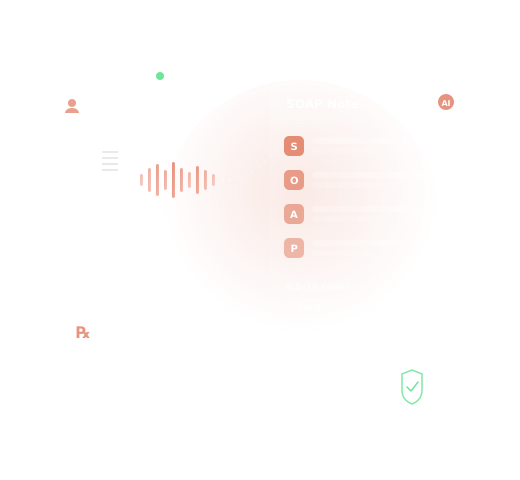
Deployment posture can also be chosen based on organisational needs. Some providers may prefer private infrastructure or on-premise deployment to support workflows aligned with internal governance, IT controls, and data handling preferences.
- Route into broader workflows: Once reviewed, the finalized note can support downstream clinical records, coding review, handovers, and operational reporting depending on the organisation's setup and integrations.
Local context
In India, Nursing Services often operate in high-volume environments where documentation quality must be balanced with speed. OPD rush, multilingual patient interactions, and varying digital maturity across facilities mean that documentation tools need to be practical and adaptable. An AI medical scribe in India is most useful when it fits existing routines instead of forcing teams into a new process.
For example, a nursing team in a multispecialty hospital may need quick summaries for doctor review, while a clinic may need support for consultation notes and coding preparation. In both cases, the product value comes from reducing repetitive documentation effort and improving note consistency. The contextual need in India is not just automation; it is usable documentation support that works across busy care settings.
Because healthcare organisations differ in infrastructure preferences, deployment choices matter too. Some may evaluate private or on-premise options to support workflows aligned with internal governance requirements. That makes the conversation about implementation practical: where the system runs, who reviews drafts, and how final records are approved.
Use cases
- OPD nursing support: Drafting structured notes from consultation conversations and nursing observations during busy outpatient sessions.
- Inpatient handovers: Summarising shift updates into clearer drafts that support continuity of care.
- Care coordination: Capturing multidisciplinary discussions where nurses relay updates between doctors, patients, and attendants.
- Procedure and day-care workflows: Supporting pre-procedure and post-procedure documentation with more consistent note structure.
- Coding preparation: Assisting teams with draft ICD-10 and CPT suggestions for review in documentation-heavy environments.
These use cases are relevant for hospitals, nursing homes, specialty clinics, and group practices looking for an AI medical scribe in India that supports real documentation tasks rather than generic transcription alone.
FAQ
Below are common implementation questions from healthcare teams evaluating this workflow.
Can nursing teams use the product directly?
Yes, nursing teams can use it as part of documentation workflows, but final review and sign-off should follow the organisation's clinical governance process.
Does it only create transcripts?
No. It goes beyond transcription by structuring drafts into usable clinical notes, including SOAP-style formatting and coding support where relevant.
Is multilingual use supported?
Yes. Multilingual support is useful for Indian care settings where conversations may include English and regional languages.
Can hospitals choose private deployment?
Yes. On-premise or private deployment options can be considered as workflow and governance decisions based on organisational needs.
CTA
If your hospital or clinic is exploring documentation support for Nursing Services, MedScribe offers a practical path from conversation capture to reviewed clinical notes. Explore the product overview at /medscribe, review capabilities at /medscribe/features, and assess how an AI medical scribe in India can fit your daily workflow with human review and final sign-off built into the process.