Introduction
Occupational health teams manage a distinct mix of consultations: pre-employment assessments, periodic medical reviews, fitness-for-duty evaluations, exposure-related follow-ups, vaccination visits, and return-to-work documentation. In these settings, clinicians often need to balance patient interaction with structured note-taking, coding support, and clear records for internal care workflows. An AI medical scribe in India can help reduce manual documentation effort by turning consultation conversations into draft clinical notes that are easier to review, edit, and finalize.
For occupational health clinics, the value is practical rather than promotional. The goal is to support doctors, nurses, and care coordinators with faster documentation, more consistent note structure, and a smoother path from consultation to record completion. MedScribe is designed as an AI documentation copilot that converts spoken interactions into usable clinical notes, with support for SOAP drafting, speaker diarization, multilingual conversations, and coding suggestions. This makes it relevant for clinics that want to improve throughput without compromising clinician oversight.
Because occupational health documentation can involve repeat visits, employer-linked workflows, and standardized assessments, teams often benefit from tools that help keep records organized while still allowing clinician judgment at every step. An AI medical scribe in India is most useful when it fits naturally into OPD routines and supports review before any note becomes part of the final record.
Department workflow
Occupational health clinics usually run on high-volume, process-driven workflows. A typical day may include registration, history capture, symptom review, examination, test recommendations, fitness assessment, counseling, and follow-up planning. Documentation needs can vary from brief encounter notes to more structured summaries that capture work exposure history, medication use, restrictions, and next review dates.
In many clinics, clinicians still spend valuable time typing or dictating after the visit. That can slow patient flow, create note backlogs, and increase the burden of after-hours charting. An AI documentation layer helps by capturing the consultation, separating speakers, structuring the transcript, and preparing a draft note that reflects the encounter. For occupational health teams, this can be especially useful during repetitive assessments where consistency matters, but every patient still needs an individualized clinical review.
Where clinics handle multilingual interactions, the ability to process mixed-language conversations can also improve usability. This is relevant in India, where occupational health consultations may involve English, Hindi, or regional language exchanges depending on the workforce served.
Features mapped to workflow
MedScribe is built around the daily documentation needs of outpatient care and can be mapped to occupational health workflows in a practical way:
- Conversation capture: Supports recording or ingesting consultation audio so the clinical interaction can be documented without relying only on manual typing.
- Speaker diarization: Distinguishes between clinician and patient speech, which helps create clearer transcripts and more usable draft notes.
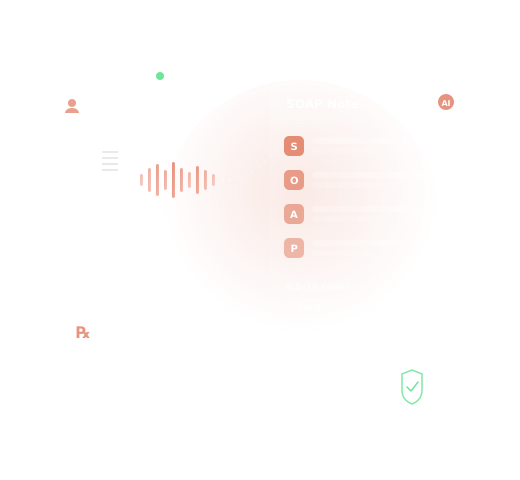
- Automatic SOAP note generation: Converts the consultation into a structured draft that clinicians can quickly review and refine.
- ICD-10 and CPT suggestions: Provides coding support to help teams move from narrative documentation toward more standardized records.
- Multilingual support: Useful for clinics serving diverse employee populations across India.
- On-premise or private deployment options: Supports organizations that prefer tighter control over data handling and infrastructure decisions.
These capabilities are not meant to replace clinical judgment. Instead, they support workflows aligned with better documentation discipline, especially in settings where repeat evaluations and standardized forms are common. For teams exploring an AI medical scribe in India, the key question is whether the tool reduces friction at the point of care while preserving clinician review and sign-off.
How It Works
The workflow below reflects how this product is typically used in a real consultation environment for occupational health documentation:
- Capture the consultation conversation: During a visit such as a pre-employment exam, periodic health review, or return-to-work consultation, the clinician uses the system to capture the conversation audio. This can include history, symptoms, work exposure details, examination findings, and advice discussed during the encounter.
- Transcribe and structure the interaction: The system converts speech into text and applies speaker diarization to separate clinician and patient dialogue. It then organizes the transcript into clinically relevant segments so the encounter is easier to interpret than a raw transcript.
- Draft a SOAP note automatically: Based on the structured conversation, MedScribe generates a draft SOAP note. For occupational health clinics, this can help summarize subjective complaints, objective findings, assessment points, and the plan for follow-up, restrictions, referrals, or tests.
- Suggest coding support: The platform surfaces ICD-10 and CPT suggestions based on the documented encounter. These suggestions are intended to assist the clinician or documentation team, not to replace review. The user can accept, modify, or ignore them depending on the case.
- Review, edit, and finalize: The clinician reviews the draft note, corrects details, adds missing context, and confirms the final version before it becomes part of the patient record. This human review checkpoint is essential for accuracy and workflow accountability.
- Choose deployment posture for governance needs: Depending on organizational preferences, clinics may evaluate on-premise or private deployment approaches. This is a workflow and governance decision that can support internal data handling preferences without implying any guaranteed compliance outcome.
Local context
In India, occupational health services may be delivered inside hospitals, standalone clinics, industrial medical units, or employer-linked health programs. Documentation expectations can differ by organization, but the operational challenge is similar: clinicians need to complete records quickly while maintaining clarity and consistency. An AI medical scribe in India can be useful in this context because it supports practical OPD documentation rather than adding another complex layer to the visit.
Local relevance also comes from language diversity, variable digital maturity, and different infrastructure preferences across organizations. Some teams may want a cloud-based workflow, while others may prefer private or on-premise deployment discussions as part of their governance planning. For buyers evaluating AI medical scribe India healthcare solutions, it is sensible to focus on workflow fit, review controls, and ease of adoption by clinicians.
Use cases
- Pre-employment medical assessments: Draft structured notes from routine history-taking and examination conversations.
- Periodic employee health reviews: Support consistent documentation across repeat visits and surveillance programs.
- Return-to-work consultations: Capture symptoms, recovery status, restrictions, and follow-up plans in a clear note format.
- Exposure-related evaluations: Organize work history, symptom progression, and clinical findings into a usable draft record.
- Vaccination and preventive visits: Reduce manual note-writing for high-volume, protocol-driven encounters.
- Multilingual OPD settings: Help clinicians document mixed-language consultations more efficiently.
Across these scenarios, an AI medical scribe in India is most effective when it shortens documentation time, supports note consistency, and keeps the clinician in control of the final record.
FAQ
Below are common implementation questions from occupational health clinics considering documentation automation.
CTA
If your occupational health clinic is looking to reduce documentation burden and improve note consistency, MedScribe offers a practical path from consultation audio to clinician-reviewed records. Explore how an AI medical scribe in India can fit your OPD workflow, support multilingual encounters, and help your team complete notes with less manual effort. Review the product overview, features, integrations, and pricing to assess fit for your organization.