Introduction
Occupational medicine teams manage high-volume documentation across pre-employment assessments, periodic health checks, injury reviews, fitness-for-duty visits, exposure follow-ups, and return-to-work consultations. An AI medical scribe in India can help reduce manual note-taking by turning clinician-patient conversations into structured draft documentation that is ready for review. For hospitals, industrial clinics, and corporate health programs, the goal is practical: spend less time typing, keep records more consistent, and support smoother handoffs between doctors, nurses, and administrative staff.
MedScribe is designed as an AI documentation copilot for everyday OPD and occupational health workflows. It converts consultation audio into structured notes, supports SOAP drafting, suggests ICD-10 and CPT codes for clinician review, and helps organize visit details in a usable format. Rather than replacing clinical judgment, it supports the doctor with a draft-first workflow that still depends on human review, edits, and final sign-off before the record is completed.
For organisations evaluating an AI medical scribe in India, the most useful question is not whether AI can generate text, but whether it fits the realities of occupational medicine: repeat assessments, employer-linked documentation, multilingual interactions, and the need for clear summaries that can be reviewed quickly. This page focuses on those practical needs.
Department workflow
Occupational medicine documentation often follows a repeatable but detail-heavy pattern. A clinician may begin with the reason for visit, job role, work environment, exposure history, symptoms, prior incidents, medication use, and relevant medical history. The encounter may then move into examination findings, risk assessment, work restrictions, treatment advice, referrals, and follow-up planning. In many settings, the doctor also needs to capture information that supports internal reporting, billing, or employer communication workflows.
These visits can be short, but the documentation burden is not. Doctors may switch between walk-in injury cases, scheduled surveillance visits, and fitness assessments in the same session. That creates pressure to document quickly without losing important context. An AI medical scribe in India is especially useful here because it can help standardise note structure across repetitive visit types while still preserving the specifics of each consultation.
In occupational medicine, documentation quality matters for continuity of care and operational clarity. Teams often need concise notes that can be reviewed by another clinician later, shared internally, or used to support downstream coding and record management. A tool that drafts notes from the conversation can reduce after-hours charting and help clinicians focus more on the patient interaction.
Features mapped to workflow
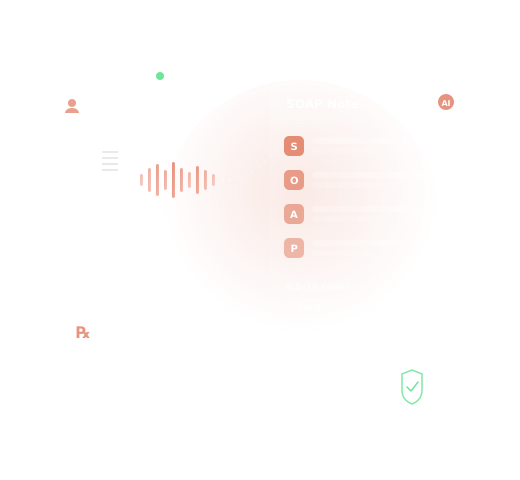
Automatic SOAP note generation: Occupational health visits often map well to SOAP formatting because the consultation naturally includes history, observations, assessment, and plan. MedScribe can draft SOAP-style notes from the encounter, giving clinicians a structured starting point instead of a blank screen.
Speaker diarization: In a busy clinic, it is important to distinguish between clinician and patient speech. Speaker diarization helps separate who said what, which supports clearer draft notes and more reliable summaries.
Multilingual support: Occupational medicine in India may involve English mixed with Hindi or regional languages during the same visit. Multilingual support helps capture the conversation more naturally and reduces the need to force the interaction into one language.
ICD-10 and CPT suggestions: Coding suggestions can support downstream documentation and billing workflows. These are suggestions for clinician review, not automatic coding decisions, which keeps the workflow practical and review-led.
On-premise or private deployment posture: Some hospitals and enterprise health programs prefer deployment choices that fit internal governance requirements. MedScribe supports workflow-aligned deployment decisions such as on-premise or private environments, depending on operational needs.
Usable drafts for review: The value of an AI medical scribe in India is not just transcription. It is the ability to turn a conversation into a clinically usable draft that can be edited quickly before final sign-off.
How It Works
The workflow is designed to support real consultation documentation from start to finish:
- Capture the consultation conversation: During an occupational medicine visit, the clinician starts the encounter capture process. The system records the consultation audio and prepares it for structured transcription. This can support routine assessments, injury evaluations, and follow-up visits without requiring the doctor to type continuously.
- Transcribe and structure the interaction: The audio is converted into text with speaker separation so the draft can distinguish clinician prompts from patient responses. This is useful when documenting symptom history, exposure details, work role context, and return-to-work discussions.
- Generate a SOAP draft automatically: Based on the conversation, the system creates a structured SOAP note draft. Subjective details may include symptoms, occupational exposure history, and prior incidents; objective content may include examination findings or recorded observations; assessment and plan sections are drafted for clinician review.
- Suggest coding support: The platform can surface ICD-10 and CPT suggestions related to the documented encounter. These suggestions are intended to support the clinician or coding team, who can accept, edit, or ignore them based on the final clinical record.
- Review, edit, and sign off: The clinician checks the draft note, corrects details, adds missing context such as work restrictions or follow-up instructions, and finalises the record. Human review is the operational checkpoint before documentation is completed.
- Choose a deployment posture that fits operations: For organisations with specific IT or governance preferences, deployment can be planned in a way that supports workflows aligned with internal data handling practices, including on-premise or private setup options where appropriate.
Local context
In India, occupational medicine teams often work across hospitals, factory clinics, corporate health centres, and multispecialty setups that also run general OPD services. Documentation needs can vary by employer program, internal reporting format, and language preference. That is why an AI medical scribe in India should be practical, flexible, and easy to fit into existing routines rather than forcing a rigid template.
Many organisations also prefer technology choices that align with internal governance and infrastructure planning. In that context, deployment posture matters as much as note quality. Teams may evaluate whether a private or on-premise approach better supports their workflow, IT environment, and review process. The product conversation is therefore not only about AI output, but also about operational fit for India healthcare settings.
For buyers comparing options in AI medical scribe India healthcare, the strongest use case is often simple: reduce documentation friction in high-volume clinics while keeping the clinician in control of the final note.
Use cases
Pre-employment medical assessments: Draft structured notes from standardised screening conversations and examination findings.
Periodic occupational health check-ups: Support repeat documentation across surveillance programs with more consistent note formatting.
Workplace injury evaluations: Capture incident history, symptoms, examination details, and treatment plans in a reviewable draft.
Fitness-for-duty and return-to-work visits: Help document restrictions, recovery progress, and follow-up recommendations clearly.
Exposure-related consultations: Organise symptom history, exposure context, and clinician assessment into a structured note.
Mixed-language OPD interactions: Support multilingual conversations common in Indian clinics and hospitals.
FAQ
Can this be used for routine occupational health visits?
Yes. It is designed to support recurring consultation types such as pre-employment checks, periodic exams, injury follow-ups, and fitness assessments by creating draft notes from the conversation.
Does the system replace clinician documentation review?
No. The workflow is review-led. The clinician reviews, edits, and signs off on the draft before the record is finalised.
How does coding support work?
The platform can suggest ICD-10 and CPT codes based on the documented encounter. These are suggestions to support review, not automatic final coding decisions.
Can it support multilingual consultations in India?
Yes. Multilingual support is useful for clinics where consultations may include English mixed with Hindi or regional languages.
What deployment options are available?
Teams can evaluate deployment approaches such as on-premise or private environments based on workflow, IT, and governance preferences.
CTA
If your occupational medicine team is looking for a practical way to reduce note-writing time, improve documentation consistency, and keep clinicians focused on the consultation, MedScribe offers a workflow-oriented approach. Explore how an AI medical scribe in India can support occupational health documentation, then review related product details on features, integrations, and pricing to assess fit for your clinic or hospital.