Introduction
Operation Theatre teams work in a high-focus environment where documentation must stay clear, timely, and clinically useful without distracting surgeons, anaesthetists, and nursing staff from patient care. An AI medical scribe in India can support this need by turning spoken clinical interactions and perioperative discussions into structured draft notes that clinicians can review, edit, and sign off. For hospitals and surgical centres, the value is practical: less manual note preparation, more consistent documentation structure, and better continuity between pre-op, intra-op, and post-op records.
This page focuses on how an AI medical scribe can fit Operation Theatre workflows in India healthcare settings. The goal is not to replace clinical judgment or final documentation responsibility. Instead, it is designed to support workflows aligned with existing hospital processes by helping teams capture conversations, draft SOAP-style notes, and surface coding suggestions for clinician review. For organisations evaluating medical scribe software, the OT context requires careful attention to handoffs, role-based review, and deployment choices such as private or on-premise setups.
Department workflow
Operation Theatre documentation often spans multiple touchpoints rather than a single encounter. A patient may move from pre-anaesthesia assessment to surgical briefing, procedure documentation, recovery notes, and discharge planning. In many hospitals, these details are recorded across separate systems or by different team members, which can create duplication and delays. An AI medical scribe in India is useful here because it can help structure spoken inputs into a consistent draft record while preserving the need for clinician validation.
Typical OT workflow stages include pre-operative discussion, consent-related communication, anaesthesia planning, intra-operative event capture, immediate post-operative instructions, and transfer summaries. Each stage has different documentation needs. Surgeons may need concise operative summaries, anaesthesia teams may need structured observations, and nursing teams may need handoff-ready notes. In this environment, documentation support should be fast, multilingual where needed, and adaptable to hospital-specific templates.
Features mapped to workflow
For Operation Theatre teams, product value comes from how features map to real tasks. Conversation capture and transcription help convert spoken exchanges into usable text. Speaker diarization helps distinguish between participants such as surgeon, anaesthetist, and assistant during case discussions. Automatic SOAP note drafting can support pre-op and post-op summaries, while coding suggestions can help administrative and billing workflows after clinician review. Multilingual support is relevant in India because perioperative communication may involve English plus regional languages across staff and patient interactions.
Deployment posture also matters. Some hospitals may prefer private infrastructure or on-premise deployment to fit internal governance and IT preferences. That decision is operational, not just technical, because it affects where audio is processed, how records move between departments, and how teams manage access. For organisations comparing options, feature details should be assessed against actual OT handoffs, review checkpoints, and documentation turnaround expectations.
How It Works
The workflow below describes how the product supports Operation Theatre documentation from conversation capture to final clinician sign-off.
- Capture the clinical conversation: During relevant perioperative interactions such as pre-op review, procedure discussion, or post-op handoff, the system captures the spoken conversation through an approved device or workflow setup. This creates the source input for documentation support without requiring the clinician to type in real time.
- Transcribe and structure the interaction: The audio is converted into text, and speaker diarization helps separate who said what. The system then organises the transcript into clinically relevant sections so the raw conversation becomes easier to review for OT use cases.
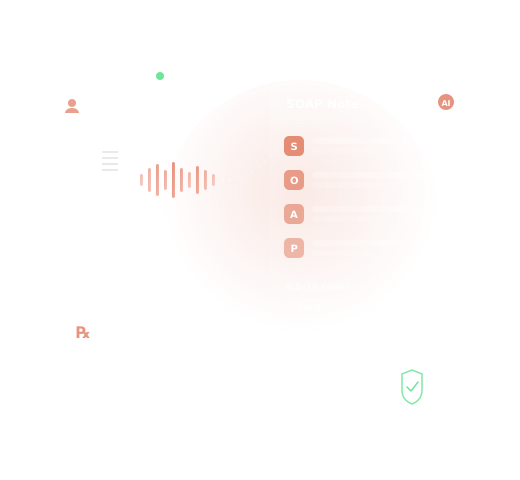
- Draft SOAP-style notes automatically: Based on the structured transcript, the product prepares draft clinical notes in a SOAP-oriented format where appropriate. This can help teams create pre-op summaries, post-op notes, or handoff-ready documentation faster than starting from a blank screen.
- Surface coding suggestions for review: The system can provide ICD-10 and CPT suggestions linked to the documented encounter. These are support outputs only and should be checked by the clinician or authorised coding team before use in records or billing workflows.
- Enable clinician edits and final sign-off: A human review checkpoint is built into the workflow. The surgeon, anaesthetist, or designated clinician reviews the draft, makes edits, confirms accuracy, and finalises the note before it becomes part of the patient record.
For hospitals that need tighter infrastructure control, deployment can be planned as a private or on-premise workflow decision. This can support internal governance preferences, integration planning, and operational control over how documentation moves between departments.
- Route outputs into existing systems and teams: Once reviewed, the finalised note can be shared into the hospital's documentation workflow, with integration planning aligned to existing systems and departmental processes. This helps OT teams reduce duplicate entry while keeping final approval with clinicians.
Local context
In India, Operation Theatre environments often balance high patient volumes, mixed digital maturity, and multilingual communication across clinicians, staff, and patients. That makes documentation support especially relevant when teams want to improve consistency without adding more typing during critical workflows. An AI medical scribe in India should therefore be evaluated for practical fit: can it support multilingual interactions, can it adapt to hospital templates, and can it work within private or on-premise deployment preferences where needed?
Hospitals and surgical centres may also look for tools that complement existing HIS, EMR, or billing processes rather than forcing a full workflow redesign. In that context, AI medical scribe India healthcare adoption is often less about novelty and more about reducing friction in daily documentation. For OT teams, the best fit is usually a system that supports structured drafting, clear review checkpoints, and flexible deployment choices.
Use cases
Common Operation Theatre use cases include drafting pre-operative assessment summaries, documenting procedure discussions, preparing post-operative notes, supporting transfer and recovery handoffs, and generating coding support for reviewed records. Multi-specialty hospitals may use the same core workflow across general surgery, orthopaedics, ENT, obstetrics, and other surgical departments while adapting templates to each specialty.
An AI medical scribe in India can also help where documentation quality varies between shifts or teams. By starting from a structured draft instead of free-text entry, clinicians may find it easier to maintain consistency in note format. This is especially useful when multiple stakeholders need to read the same record quickly, such as surgeons, anaesthesia teams, nursing staff, and administrative teams.
Another practical use case is reducing after-hours documentation burden. OT clinicians often complete notes after procedures when time is limited. Draft generation from captured conversations can shorten the path to a complete record, while still preserving the requirement for human review and final sign-off.
FAQ
Below are common questions from hospitals and clinics evaluating an AI medical scribe in India for Operation Theatre workflows.
Can this be used for OT documentation only?
Yes. The workflow can be configured around perioperative documentation needs such as pre-op, intra-op summary support, post-op notes, and handoff documentation, while still fitting broader hospital workflows.
Does the system replace clinician review?
No. The product is designed to create draft documentation and coding suggestions, but clinicians remain responsible for reviewing, editing, and signing off before finalisation.
Can it support multilingual conversations in India?
The product supports multilingual use cases, which can be helpful in Indian healthcare settings where staff and patient communication may span English and regional languages.
What deployment options are relevant for hospitals?
Hospitals may evaluate private or on-premise deployment options based on IT architecture, governance preferences, and workflow design. These choices support operational control but should be assessed against each organisation's internal requirements.
CTA
If your hospital or surgical centre is exploring documentation support for perioperative care, an AI medical scribe in India can help streamline note drafting, coding support, and review workflows for Operation Theatre teams. Explore the core product at /medscribe, review capabilities at /medscribe/features, and assess how the workflow can fit your OT documentation process with clinician oversight built in.