Introduction
Oral and maxillofacial surgery teams manage detailed consultations, procedure planning, imaging discussions, consent conversations, follow-up instructions, and referral communication. That creates a heavy documentation load across OPD visits, day-care procedures, inpatient rounds, and post-operative reviews. An AI medical scribe in India can help reduce manual note-taking by turning clinician-patient conversations into structured draft documentation that is ready for review. For oral maxillofacial surgery departments, this is especially useful when visits include trauma history, facial pain assessment, oral lesions, dentoalveolar findings, TMJ symptoms, implant planning, and surgical follow-up details.
MedScribe is designed as an AI documentation copilot for clinics and hospitals that want faster note creation without removing clinician oversight. It supports automatic SOAP note drafting, coding suggestions, speaker diarization, multilingual conversations, and deployment choices such as private or on-premise setups depending on workflow and governance needs. The goal is practical support for daily documentation, not replacing clinical judgment. For teams evaluating an AI medical scribe in India, the value is straightforward: less time spent typing, more consistent note structure, and a clearer review path before the record is finalized.
Department workflow
In oral maxillofacial surgery, documentation often starts before the procedure itself. A typical workflow may include registration details, referral reason, chief complaint, history of present illness, dental and medical history, medication review, examination findings, imaging discussion, diagnosis, treatment options, procedure planning, and post-operative advice. In trauma and emergency-linked cases, the pace is faster and the note still needs to capture mechanism of injury, soft tissue findings, occlusion changes, airway concerns, and immediate management decisions. In elective cases, the note may need to reflect implant planning, pathology review, lesion description, or orthognathic surgery counselling.
These workflows create repeated documentation tasks across first consults, second opinions, procedure counselling, operative follow-up, and interdisciplinary coordination with dentistry, ENT, oncology, anaesthesia, and radiology. An AI scribe is most useful when it fits this real sequence of work: listening during the consultation, separating speakers, structuring the conversation into clinical sections, and presenting a draft that the surgeon can quickly edit and sign off. This makes an AI medical scribe in India relevant not only for large hospitals but also for specialty clinics that want more consistent records across busy OPD sessions.
Features mapped to workflow
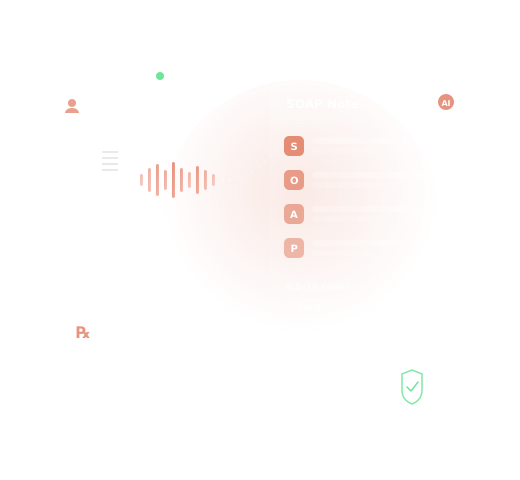
Automatic SOAP note generation: Consultation conversations can be converted into draft subjective, objective, assessment, and plan sections. For oral maxillofacial surgery, this helps organize symptoms, examination findings, imaging references, and treatment planning into a familiar format.
Speaker diarization: The system distinguishes between clinician and patient speech, which is useful when history taking includes pain description, prior dental treatment, trauma sequence, or family concerns. Cleaner attribution supports better draft notes and easier review.
Multilingual support: Many clinics in India switch between English and regional languages during the same consultation. Multilingual capture can support more natural conversations while still producing structured documentation for the record.
Coding suggestions: ICD-10 and CPT-style suggestions can support downstream documentation workflows. These are suggestions for clinician review, not automatic billing decisions, which is important in specialty surgical settings.
Private or on-premise deployment options: Some hospitals prefer deployment choices that align with internal IT and governance requirements. This can be evaluated as an operational decision based on infrastructure, access control, and record handling preferences.
Review-first workflow: Draft notes are meant to be checked, edited, and approved by the clinician before finalization. That is especially important in OMFS where procedure details, laterality, lesion description, and surgical planning language must be precise.
How It Works
The product workflow is designed around real consultation documentation rather than generic voice dictation. For oral maxillofacial surgery teams, the process typically follows these steps:
- Capture the consultation conversation: During the OPD visit, counselling session, or follow-up, the system captures the interaction through the configured workflow. It can handle multi-speaker conversations and supports multilingual exchanges common in India-based practice settings.
- Transcribe and structure the encounter: The audio is converted into text and organized using speaker diarization so the draft can distinguish patient history from clinician questions, examination narration, and treatment discussion.
- Generate a SOAP draft: The transcript is transformed into a structured clinical note with sections such as subjective history, objective findings, assessment, and plan. In OMFS, this may include pain history, swelling, trismus, occlusion changes, lesion description, imaging discussion, and next-step planning.
- Suggest coding support: Based on the documented encounter, the system can surface ICD-10 and CPT-oriented suggestions to support documentation workflows. These remain editable and should be reviewed by the clinician or authorized staff.
- Clinician review and edits: The surgeon or care team reviews the draft, corrects terminology, adds missing findings, confirms procedure details, and adjusts the plan. Human review is the checkpoint before any note becomes part of the record.
- Finalize according to deployment workflow: After sign-off, the note can move into the clinic or hospital documentation process. Teams may choose private or on-premise deployment models based on operational preferences and internal governance requirements.
Local context
In India, oral maxillofacial surgery practices often work across mixed payer environments, variable documentation maturity, and multilingual patient interactions. Some departments need support for high-volume OPD documentation, while others focus on complex surgical planning and referral communication. An AI medical scribe in India should therefore be practical: easy to fit into existing consultation habits, flexible enough for clinic and hospital settings, and supportive of clinician review rather than forcing rigid templates.
Teams also differ in infrastructure expectations. A standalone specialty clinic may prioritize quick note turnaround and simple workflows, while a hospital group may evaluate private hosting or on-premise deployment as part of broader IT planning. In this context, AI medical scribe India healthcare adoption is less about novelty and more about reducing repetitive documentation effort while keeping the surgeon in control of the final record.
Use cases
New patient consultations: Capture history, examination, provisional diagnosis, and treatment options for facial swelling, impacted teeth, oral lesions, TMJ complaints, or trauma review.
Procedure counselling: Draft notes for extraction planning, implant discussions, biopsy counselling, fracture management explanation, or orthognathic surgery planning.
Post-operative follow-up: Document pain, swelling, wound status, mouth opening, diet advice, medication continuation, and next review timing.
Referral and interdisciplinary care: Support clearer records when coordinating with dentists, oncologists, radiologists, anaesthetists, or ENT teams.
High-volume OPD sessions: Help standardize note structure across repeated consult types without relying entirely on manual typing.
For these scenarios, an AI medical scribe in India can support more consistent documentation while preserving the need for surgeon edits and final approval.
FAQ
Can this work for both clinics and hospitals?
Yes. The workflow is suitable for specialty clinics, day-care centres, and hospital departments, with deployment choices evaluated based on operational needs.
Does it replace clinician documentation review?
No. The system creates draft notes and coding suggestions, but the clinician should review, edit, and sign off before finalization.
Can it handle multilingual consultations?
Yes. Multilingual support is useful for consultations where English and regional languages are used in the same encounter.
Is it relevant for surgical specialties like OMFS?
Yes. It is designed to support structured documentation for detailed consultations, procedure planning, and follow-up workflows common in surgical practice.
CTA
If your oral maxillofacial surgery team wants to reduce manual note-writing and improve documentation consistency, explore how an AI medical scribe in India can fit your OPD and surgical workflow. Review the core product at /medscribe, compare capabilities at /medscribe/features, and assess workflow fit based on your consultation volume, language mix, and review process. A practical evaluation should focus on note quality, edit effort, coding support, and how well the system aligns with your existing documentation pathway.