Introduction
Patient experience depends on more than front-desk efficiency. In busy OPD settings, patients notice whether the doctor is focused on the conversation, whether follow-up instructions are clear, and whether documentation slows the visit. An AI medical scribe in India can support this experience by reducing manual note-taking during consultations and helping clinicians turn conversations into structured clinical documentation. For clinics, multispecialty centres, and hospitals, the goal is practical: spend less time typing, maintain note quality, and keep the consultation centred on the patient.
MedScribe is designed as an AI documentation copilot for day-to-day care delivery. It converts consultation conversations into draft SOAP notes, supports coding suggestions such as ICD-10 and CPT, identifies speakers through diarization, and supports multilingual interactions common in Indian healthcare settings. Rather than replacing clinician judgment, it supports a review-first workflow where doctors edit, verify, and sign off before the record is finalized. This makes an AI medical scribe in India useful not only for documentation efficiency, but also for a more attentive and consistent patient journey.
Department workflow
Within patient experience functions, documentation quality affects several touchpoints. When notes are delayed, patients may wait longer for prescriptions, discharge summaries, referrals, or billing completion. When doctors are occupied with typing, eye contact and conversational flow can suffer. A practical documentation copilot fits into the existing workflow without forcing major process changes.
In a typical outpatient workflow, the patient arrives, is registered, and enters the consultation. During the visit, the clinician gathers history, reviews symptoms, discusses findings, and explains next steps. After the consultation, the doctor or support staff often spend additional time preparing notes, updating the record, and aligning diagnosis or procedure coding. An AI medical scribe in India helps compress this documentation cycle by capturing the conversation, structuring it into a usable draft, and presenting it for clinician review while the encounter is still fresh.
For patient experience teams, this can support smoother handoffs between consultation, billing, and follow-up communication. It can also help standardize note structure across providers, which is useful when patients return for repeat visits or move between departments.
Features mapped to workflow
Conversation capture and transcription: The product supports consultation audio capture and converts speech into text for downstream documentation. This is useful in OPD environments where clinicians want to reduce manual typing during the visit.
Speaker diarization: By separating clinician and patient speech, the draft note can better reflect who said what. This improves readability and helps create more organized clinical summaries.
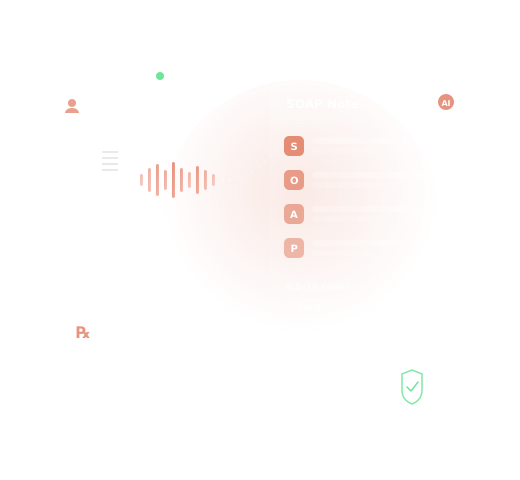
Automatic SOAP note generation: The system structures the encounter into Subjective, Objective, Assessment, and Plan sections, giving clinicians a practical starting point instead of a blank screen.
ICD-10 and CPT suggestions: Coding support can help teams review likely diagnosis and procedure codes alongside the note. Suggestions remain reviewable and should be validated by the clinician or authorized staff.
Multilingual support: Many consultations in India move between English and regional languages. Multilingual support is valuable for preserving clinical meaning in mixed-language conversations.
On-premise or private deployment options: Organizations with specific governance preferences may choose deployment postures that support workflows aligned with internal IT and data handling requirements.
How It Works
The workflow is designed to be concrete and review-driven, so clinicians stay in control of the final record.
- Capture the consultation conversation: During the OPD visit, the consultation audio is captured through the configured workflow. The system is designed to support real clinical conversations without requiring the doctor to manually type every detail in real time.
- Transcribe and separate speakers: The audio is converted into text, and speaker diarization helps distinguish patient and clinician contributions. This creates a cleaner base for documentation, especially in back-and-forth consultations.
- Structure the encounter into a draft SOAP note: The transcript is organized into a draft clinical note with SOAP sections. Relevant details from history, symptoms, findings, and plan are arranged into a format clinicians can quickly review and edit.
- Generate coding support: Based on the documented encounter, the system can surface ICD-10 and CPT suggestions to support coding review. These are intended as workflow aids, not automatic final coding decisions.
- Review, edit, and finalize: The clinician reviews the draft note, makes corrections, confirms the assessment and plan, and signs off before the record is finalized. This human review checkpoint is central to safe and practical use.
- Choose the right deployment posture: Depending on organizational needs, teams may evaluate on-premise or private deployment options as part of their documentation and governance workflow. This is a practical implementation choice based on infrastructure, access, and operational preferences.
Local context
Healthcare teams in India often manage high patient volumes, mixed digital maturity, and multilingual consultations across urban and semi-urban settings. In this environment, documentation tools need to be practical rather than theoretical. An AI medical scribe in India should support fast-moving OPD workflows, variable consultation styles, and the need for clinicians to maintain patient attention while still producing complete records.
For hospitals and clinics evaluating an AI medical scribe in India, deployment flexibility matters. Some organizations may prefer private or on-premise setups based on internal governance decisions, while others may prioritize faster rollout and easier operational adoption. The key is to align the implementation with existing clinical, IT, and administrative workflows instead of forcing teams into a rigid model.
Use cases
Busy outpatient clinics: Reduce after-visit documentation load and help doctors complete notes faster after each consultation.
Multispecialty hospitals: Support more standardized note structures across departments while preserving clinician review and specialty-specific edits.
Patient-centred consultations: Help clinicians spend more time listening and explaining, with less interruption from manual typing.
Follow-up and continuity of care: Create clearer records that support repeat visits, referrals, and internal care coordination.
Coding review workflows: Surface likely ICD-10 and CPT suggestions alongside the note to support downstream administrative processes.
These use cases make AI medical scribe India healthcare adoption relevant not only for documentation teams, but also for patient experience leaders who want smoother visits and more consistent communication.
FAQ
Can this replace clinician judgment?
No. The tool is intended to draft and organize documentation, while the clinician reviews, edits, and signs off on the final note.
Is it suitable for multilingual consultations?
Yes. Multilingual support is useful for consultations where English and regional languages are used together, which is common in India.
How does it help patient experience?
By reducing manual note-taking during the visit, clinicians can focus more on the patient conversation and complete documentation with less delay.
Does it support coding workflows?
It can provide ICD-10 and CPT suggestions to support review. Final coding decisions should still be validated by the appropriate clinician or staff member.
CTA
If your team is evaluating documentation tools for OPD efficiency and better patient interactions, MedScribe offers a practical path to structured notes, coding support, and review-first workflows. Explore how an AI medical scribe in India can fit your clinic or hospital operations, and review related product details on /medscribe and /medscribe/features.