Introduction
Pediatric cardiology consultations often involve detailed history taking, symptom timelines, prior imaging, medication review, growth context, and careful communication with parents or caregivers. An AI medical scribe in India can help hospitals and clinics reduce manual documentation load by turning consultation conversations into structured draft notes that clinicians can review and finalize. For pediatric cardiology teams, this is especially useful when visits include congenital heart disease follow-up, murmur evaluation, post-procedure review, medication titration, and repeated longitudinal documentation across OPD encounters.
This page explains how an AI medical documentation copilot can support practical day-to-day workflows in pediatric cardiology settings. The focus is not on replacing clinical judgment. Instead, the goal is to help clinicians capture the encounter more efficiently, organize information into usable SOAP notes, and support coding review before final sign-off. For organizations evaluating an AI medical scribe in India, the most important questions are usually workflow fit, review controls, multilingual usability, and deployment options that match internal governance preferences.
Because pediatric cardiology visits can be information-dense and emotionally sensitive, documentation tools need to be practical, fast, and easy to verify. That is where a well-designed AI medical scribe can support clinicians without disrupting the consultation itself.
Department workflow
Pediatric cardiology documentation differs from many general OPD workflows. A typical visit may include referral context, antenatal or birth history, developmental milestones, feeding concerns, cyanosis or breathlessness history, prior echo findings, medication adherence, and family counseling. In follow-up visits, clinicians may also compare current symptoms with prior interventions, surgeries, catheter-based procedures, or serial imaging.
In many Indian hospitals and specialty clinics, the workflow includes registration, consultation, discussion with parents, review of prior reports, note preparation, coding or billing support, and record finalization. Manual note entry during or after the visit can slow throughput and increase after-hours documentation. An AI medical scribe in India is useful here because it can capture the conversation, separate speakers, structure the transcript, and draft a note that reflects the clinical flow of the encounter.
For pediatric cardiology, the documentation burden is not only about speed. It is also about consistency. Teams often need clear records of symptoms, examination findings, medication changes, follow-up plans, and parent instructions. A documentation copilot can support this by producing a structured draft that the clinician edits and approves.
Features mapped to workflow
For pediatric cardiology departments, the value of an AI medical scribe comes from how well product capabilities map to real consultation steps:
- Conversation capture and transcription: Supports recording of the consultation discussion so the clinician does not need to type every detail in real time.
- Speaker diarization: Helps distinguish clinician and caregiver speech, which is useful when parent concerns, symptom descriptions, and doctor recommendations need to be separated clearly.
- Automatic SOAP note generation: Converts the encounter into a structured draft note that can be reviewed quickly and adapted for first visits or follow-up visits.
- ICD-10 and CPT suggestions: Provides coding support based on the documented encounter, helping teams review likely codes before final submission.
- Multilingual support: Useful in Indian care settings where consultations may shift between English and regional languages during the same visit.
- On-premise or private deployment options: Supports organizations that prefer deployment choices aligned with internal IT, data handling, and governance workflows.
These features are relevant across specialties, but in pediatric cardiology they are particularly helpful when clinicians need to focus on the child, the caregiver conversation, and the interpretation of prior reports rather than on continuous manual typing.
How It Works
The workflow below reflects how an AI medical scribe can be used in a practical pediatric cardiology OPD setting:
- Capture the consultation conversation: During the visit, the system records the clinician-caregiver discussion, including symptom history, prior diagnosis context, medication review, and follow-up concerns. In pediatric cardiology, this may include feeding difficulty, exercise intolerance, cyanotic episodes, prior surgery history, or echo follow-up discussion.
- Transcribe and structure the encounter: The audio is converted into text, with speaker diarization used to separate the clinician from the parent or caregiver. The transcript is then organized into clinically relevant sections so the encounter is easier to review.
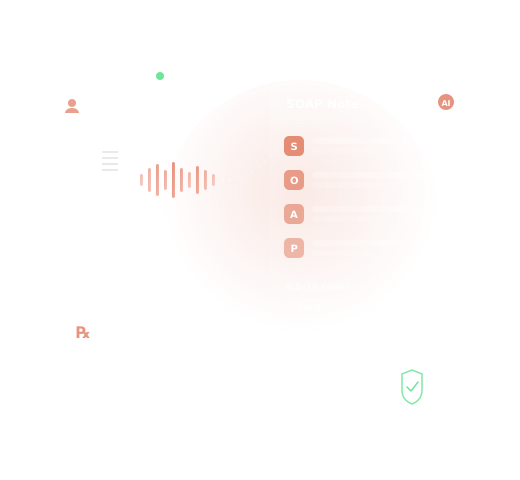
- Draft a SOAP note automatically: Based on the structured transcript, the system prepares a draft SOAP note. This can include subjective history, objective findings discussed during the visit, assessment framing, and the care plan. The draft is intended for clinician review, not automatic finalization.
- Suggest coding for review: The platform can surface ICD-10 and CPT suggestions based on the documented encounter. These suggestions support coding workflows but still require human validation before use in billing or records.
- Review, edit, and sign off: The clinician checks the draft note, corrects any missing or unclear details, updates the assessment if needed, and confirms the final plan. Human review is the operational checkpoint before the record is finalized.
- Choose deployment posture for workflow governance: Hospitals and clinics can evaluate on-premise or private deployment approaches depending on internal infrastructure, access controls, and documentation governance preferences. This is a workflow and IT decision, not a guarantee of compliance.
Local context
In India, pediatric cardiology teams often work across high-volume OPD schedules, referral-based consultations, and mixed-language interactions with families. This makes documentation support especially relevant. An AI medical scribe in India can help clinicians maintain attention on the consultation while still producing structured records for follow-up care.
For hospitals, the practical evaluation criteria usually include whether the tool fits existing documentation habits, whether it supports multilingual conversations, and whether deployment can be aligned with internal IT preferences. For specialty clinics, the focus may be on reducing after-hours note completion and improving consistency across repeat visits. In both cases, the best fit is usually a system that supports workflows already in place rather than forcing a new documentation style.
Teams exploring AI medical scribe India healthcare solutions should look for clear review checkpoints, flexible deployment options, and note outputs that are easy for clinicians to verify quickly in routine practice.
Use cases
- New pediatric cardiology consultations: Capture detailed history from parents and convert it into a structured first-visit note.
- Congenital heart disease follow-up: Document interval symptoms, medication changes, prior procedure history, and next review plans.
- Murmur evaluation clinics: Organize referral history, symptom screening, examination discussion, and counseling points.
- Post-procedure or post-surgery review: Summarize recovery progress, current concerns, medications, and follow-up instructions.
- Multilingual family interactions: Support consultations where clinicians and caregivers switch between English and local languages.
- Documentation and coding support: Prepare draft notes and coding suggestions for clinician and administrative review.
Across these scenarios, an AI medical scribe in India is most useful when it helps clinicians document faster while preserving review control and clinical accuracy.
FAQ
Can this be used during pediatric cardiology OPD visits?
Yes. It is designed to support routine consultation workflows by capturing the conversation, drafting structured notes, and allowing clinician review before finalization.
Does it replace the doctor's documentation responsibility?
No. The draft note and coding suggestions are support tools. The clinician remains responsible for review, edits, and final sign-off.
Can it handle caregiver conversations and multiple speakers?
Yes. Speaker diarization helps separate clinician and caregiver speech, which is useful in pediatric consultations where parents provide much of the history.
Is it suitable for Indian hospitals and clinics?
It is designed for practical OPD workflows in India, including multilingual consultations and deployment choices that can align with internal governance preferences.
CTA
If your pediatric cardiology team is evaluating documentation tools, an AI medical scribe in India can be a practical way to reduce manual note burden, improve note consistency, and support coding review without removing clinician oversight. Explore workflow fit, feature details, and deployment options through the product overview, review deeper capabilities on the features page, and assess how the solution may fit your OPD and specialty documentation processes.