Introduction
For pediatric nephrology teams, documentation often has to keep pace with detailed conversations about growth, fluid balance, blood pressure, lab trends, dialysis planning, medication changes, and family counselling. An AI medical scribe in India can support this work by turning consultation conversations into structured draft notes that clinicians can review, edit, and finalize. Instead of replacing clinical judgment, the tool is designed to reduce repetitive typing and help doctors focus on the child and caregiver interaction during OPD visits, follow-ups, and inpatient reviews.
In pediatric nephrology, the note is rarely just a summary of symptoms. It may need to capture history from parents, prior admissions, urine output concerns, edema, growth parameters, medication adherence, and discussion around investigations or long-term monitoring. MedScribe is built as an AI documentation copilot that converts consultation audio into usable clinical documentation, including SOAP-style drafts and coding suggestions, while keeping the clinician in control of review and sign-off.
This page focuses on practical use in India healthcare settings where departments may manage high OPD volumes, multilingual conversations, and mixed digital maturity across clinics and hospitals. The goal is simple: help pediatric nephrology teams document faster, more consistently, and with less administrative burden.
Department workflow
Pediatric nephrology workflows are distinct because the consultation often involves more than one speaker, longitudinal disease tracking, and careful explanation to families. A typical workflow may include registration, review of previous records, discussion with parent and child, examination, interpretation of labs or imaging, treatment planning, and follow-up instructions. Documentation can become time-consuming when the clinician must capture both medical detail and caregiver counselling.
An AI medical scribe in India is especially relevant in this setting because speaker diarization can help separate clinician and caregiver speech, while multilingual support can assist when parts of the conversation happen in English, Hindi, or other Indian languages. For pediatric nephrology, this matters in visits related to nephrotic syndrome, recurrent urinary issues, congenital kidney concerns, chronic kidney disease monitoring, hypertension evaluation, and dialysis-related follow-up. The documentation burden is not only about volume; it is also about clarity, continuity, and making sure the final note is useful for future visits.
In many hospitals and specialty clinics, doctors also need coding support, structured notes for internal systems, and flexibility in deployment. Some organizations may prefer private or on-premise deployment options as part of their governance approach. That makes workflow fit just as important as AI capability.
Features mapped to workflow
MedScribe supports pediatric nephrology documentation by mapping product capabilities to the actual consultation flow:
- Conversation capture: Records the consultation discussion so the doctor does not need to type every detail in real time.
- Speaker diarization: Helps distinguish clinician and caregiver voices, useful when parents provide most of the history.
- Multilingual support: Supports mixed-language consultations common in India healthcare environments.
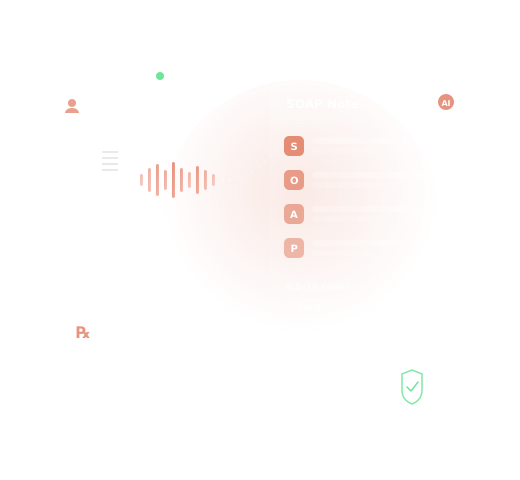
- Automatic SOAP note generation: Converts the interaction into a structured draft note that can be refined by the clinician.
- ICD-10 and CPT suggestions: Provides coding support to assist administrative workflows, subject to clinician review.
- Review and edit controls: Keeps the doctor responsible for checking the draft before finalizing the record.
- Deployment flexibility: On-premise or private deployment options can support workflows aligned with internal IT and data governance preferences.
These features are useful across first consultations, chronic follow-up visits, counselling-heavy appointments, and documentation after ward rounds or procedure discussions.
How It Works
The workflow for MedScribe is designed around real clinical documentation steps rather than generic transcription alone.
- Capture the consultation conversation: During the pediatric nephrology visit, the consultation audio is captured from the doctor-patient-caregiver interaction. This is useful when history comes from a parent while the clinician asks focused questions on edema, urine changes, appetite, growth, medication use, or prior admissions.
- Transcribe and structure the encounter: The system converts speech to text and applies speaker diarization to separate participants where possible. It then organizes the content into clinically relevant sections so the raw transcript becomes easier to use in documentation.
- Draft a SOAP note automatically: Based on the structured conversation, MedScribe generates a draft SOAP note. For pediatric nephrology, this may include subjective history from caregivers, objective findings discussed during the visit, assessment themes, and the initial plan for tests, medicines, monitoring, or follow-up.
- Suggest coding support: The platform can surface ICD-10 and CPT suggestions to support downstream billing or administrative workflows. These are suggestions only and should be checked by the clinician or authorized team before use.
- Clinician review, edits, and sign-off: The doctor reviews the draft note, corrects details, adds missing clinical nuance, and confirms the final version before it becomes part of the record. This human review checkpoint is essential for accuracy and workflow trust.
- Finalize within the chosen deployment model: Depending on organizational needs, teams may use deployment approaches such as private or on-premise setups. This is a workflow and governance decision that can support internal preferences for system control and integration planning.
Local context
In India, pediatric nephrology teams may work across tertiary hospitals, specialty centers, and growing multi-specialty clinics. Documentation needs can vary widely depending on whether the setting is fully digital, partly digital, or transitioning from manual notes. An AI medical scribe in India should therefore be practical for everyday OPD use, not just for idealized workflows. That means supporting multilingual conversations, helping with structured note creation, and fitting into existing documentation habits without forcing major process change on day one.
For hospitals evaluating technology, the discussion often includes deployment posture, review controls, and how the tool complements current systems. MedScribe is positioned as a documentation copilot for India healthcare teams that want to reduce note-writing time while maintaining clinician oversight. The emphasis is on operational usefulness rather than broad claims.
Use cases
- New pediatric nephrology consultation: Capture detailed parent history, prior treatment context, and initial assessment in a structured draft note.
- Chronic kidney disease follow-up: Support repeat documentation for longitudinal visits where trends and medication adjustments matter.
- Nephrotic syndrome review: Summarize relapse history, edema discussion, steroid use, and follow-up planning.
- Hypertension evaluation: Help document symptom review, family history, investigations, and counselling points.
- Dialysis counselling or follow-up: Capture complex caregiver discussions and convert them into usable notes for review.
- Mixed-language OPD visits: Assist clinicians when consultations shift between English and local languages.
Across these scenarios, AI medical scribe in India workflows are most effective when they reduce repetitive documentation while preserving the clinician's final authority over the record.
FAQ
Below are common implementation questions from clinics and hospitals considering an AI medical scribe India healthcare workflow for pediatric nephrology.
Can it handle parent-led consultations?
Yes. Pediatric visits often involve caregivers providing most of the history. Speaker diarization and structured drafting can help organize these conversations into a more usable note for clinician review.
Does it replace the doctor's documentation responsibility?
No. The system creates draft notes and coding suggestions, but the clinician should review, edit, and sign off before finalizing the record.
Is it useful only for large hospitals?
No. It can be relevant for specialty clinics, OPD-heavy departments, and hospitals that want more consistent documentation support.
Can teams choose different deployment approaches?
Yes. Private or on-premise deployment options may be considered based on workflow, IT environment, and internal governance preferences.
CTA
If your pediatric nephrology department wants a more efficient way to turn consultations into structured clinical notes, MedScribe offers a practical starting point. Explore how an AI medical scribe in India can support OPD documentation, SOAP drafting, coding assistance, and clinician-reviewed record finalization. For implementation details, teams can also review the broader product, features, integrations, and pricing pathways based on their workflow needs.