Introduction
Pediatric pulmonology consultations often involve detailed symptom histories, caregiver inputs, prior treatment review, inhaler technique discussions, growth context, and follow-up planning. In busy OPD settings, clinicians need documentation that is fast, structured, and easy to verify without interrupting the conversation. An AI medical scribe in India can support this need by turning consultation audio into draft clinical documentation that the doctor reviews and finalizes. For hospitals and clinics managing asthma, recurrent wheeze, chronic cough, sleep-related breathing concerns, and respiratory infections in children, the goal is not to replace clinical judgment. The goal is to reduce manual note-taking, improve consistency in records, and help teams stay focused on the child and caregiver during the visit.
MedScribe is designed as an AI documentation copilot for daily care delivery. It converts consultation conversations into structured notes, supports SOAP drafting, and provides coding suggestions for clinician review. For pediatric pulmonology teams, this means a more practical way to capture history, examination findings, assessment, and plan while preserving the final sign-off with the treating clinician. If your organization is evaluating an AI medical scribe in India, the most useful lens is workflow fit: how well it supports OPD speed, note quality, multilingual conversations, and governance preferences such as private or on-premise deployment.
Department workflow
Pediatric pulmonology workflows are documentation-heavy because each visit may combine parent-reported symptoms, child-specific observations, medication adherence review, trigger assessment, and longitudinal follow-up. A typical visit may include cough duration, wheeze frequency, nocturnal symptoms, school absenteeism, nebulization history, allergy background, prior admissions, oxygen support history, and response to inhaled therapy. In many Indian care settings, the conversation may shift between English, Hindi, and regional languages, with both caregiver and clinician contributing important details.
Documentation challenges usually appear in four places: capturing complete history without slowing the consultation, converting free conversation into a usable clinical structure, maintaining consistency across follow-up visits, and preparing coding-ready summaries without extra administrative effort. An AI medical scribe in India is most valuable when it fits these realities and supports the clinician with draft outputs that are easy to edit rather than forcing a rigid template during the encounter.
Features mapped to workflow
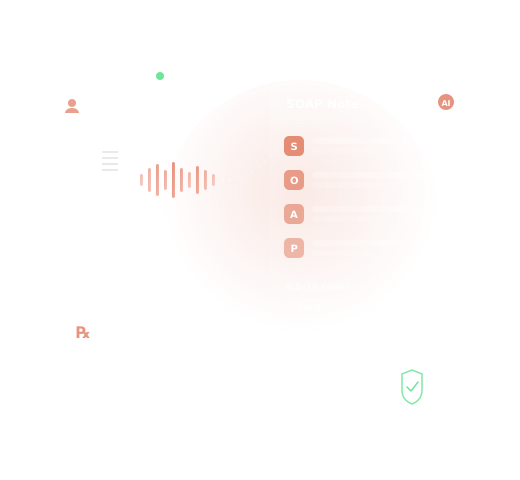
Automatic SOAP note generation: Consultation conversations can be converted into draft Subjective, Objective, Assessment, and Plan notes. For pediatric pulmonology, this helps organize symptom chronology, examination findings, likely diagnosis, and treatment or follow-up instructions into a familiar format.
Speaker diarization: In visits where both caregiver and clinician speak extensively, speaker separation helps preserve context. This is useful when parent concerns, child symptoms, and clinician recommendations need to be clearly distinguished in the draft note.
Multilingual support: Many pediatric visits in India involve mixed-language communication. Multilingual transcription support can help teams document conversations more naturally without requiring the entire visit to happen in a single language.
ICD-10 and CPT suggestions: Coding support can help staff prepare more complete documentation for downstream workflows. Suggestions remain reviewable, so clinicians and billing teams can confirm what is appropriate for the encounter.
On-premise or private deployment options: Some hospitals prefer deployment choices aligned with internal IT and governance requirements. MedScribe supports workflow decisions around private environments and on-premise setups where needed.
Clinician review before finalization: Draft generation is only one part of the process. The doctor reviews, edits, and signs off before the record is finalized, which keeps the workflow practical and clinically accountable.
How It Works
The product workflow is designed around real consultation flow rather than post-visit dictation alone. For pediatric pulmonology teams, the sequence typically looks like this:
- Capture the consultation conversation: During the visit, the system captures the interaction between clinician and caregiver or patient. This may include symptom history, prior treatment response, examination discussion, and follow-up planning. Speaker diarization helps separate who said what, which is useful in family-led pediatric consultations.
- Transcribe and structure the encounter: The captured audio is transcribed with support for multilingual conversations common in Indian OPDs. The transcript is then organized into clinically relevant sections so the raw conversation becomes easier to review and use.
- Draft a SOAP note automatically: Based on the structured transcript, the system prepares a draft SOAP note. In pediatric pulmonology, this can help summarize wheeze episodes, cough pattern, trigger history, examination findings, assessment, and treatment plan in a format clinicians already use.
- Add coding support for review: The platform can surface ICD-10 and CPT suggestions linked to the documented encounter. These are suggestions, not final decisions, and can support administrative workflows after clinician review.
- Review, edit, and sign off: The clinician checks the draft note, makes corrections, adds nuance where needed, and approves the final version before it becomes part of the record. This human review checkpoint is essential for safe and practical use.
- Choose deployment posture based on workflow needs: Hospitals and clinics can evaluate whether a private or on-premise deployment model better supports their operational and governance preferences. This is a workflow and infrastructure decision, not a blanket compliance claim.
Local context
In India, pediatric specialty clinics and hospital OPDs often balance high patient volumes with variable documentation practices across consultants, fellows, and support staff. This makes consistency and speed especially important. An AI medical scribe in India should therefore be evaluated for practical fit: can it support mixed-language consultations, adapt to specialty note patterns, and reduce after-hours documentation burden without disrupting the visit?
For pediatric pulmonology, local workflow realities may include caregiver-heavy histories, repeat follow-ups for asthma control, seasonal surges in respiratory complaints, and the need to document education around inhaler use or trigger avoidance. An AI medical scribe India healthcare solution is most useful when it supports these recurring tasks in a way that clinicians can verify quickly and adopt without major process change.
Use cases
Asthma follow-up visits: Draft notes can capture symptom control, rescue inhaler use, night symptoms, school impact, and medication adjustments.
Chronic cough evaluation: The system can help organize duration, associated symptoms, prior treatments, environmental triggers, and next diagnostic steps.
Recurrent wheeze consultations: Structured documentation can support longitudinal comparison across visits and improve clarity in assessment and plan.
Sleep-related breathing concerns: Notes can summarize caregiver observations, sleep symptoms, examination context, and referral or testing plans.
Inpatient or specialty review documentation: Teams can use draft generation to reduce repetitive note-writing while preserving clinician review and final approval.
Across these scenarios, an AI medical scribe in India helps by reducing manual transcription effort and making documentation more usable for both clinical and administrative workflows.
FAQ
Can this work for multilingual pediatric consultations?
Yes. Multilingual support is useful for consultations where clinicians and caregivers switch between English, Hindi, or other regional languages during the same visit.
Does the system replace clinician documentation review?
No. The draft note is meant to support the clinician, who still reviews, edits, and signs off before the record is finalized.
Is it useful only for large hospitals?
No. Specialty clinics, group practices, and hospitals can all evaluate whether the workflow benefits fit their consultation volume and documentation needs.
Can coding suggestions be reviewed before use?
Yes. ICD-10 and CPT suggestions are intended as support for review, not automatic final coding decisions.
CTA
If your team is exploring an AI medical scribe in India for pediatric pulmonology, focus on day-to-day usability: consultation capture, SOAP drafting, coding support, multilingual handling, and clinician review. MedScribe is designed to support practical OPD and specialty workflows in clinics and hospitals across India. Explore the product pathways through /medscribe, feature details at /medscribe/features, integration context, and pricing discussions based on your deployment and workflow needs.