Introduction
Pediatric surgery teams manage consultations that often involve anxious families, detailed histories, growth and developmental context, pre-operative planning, and careful post-operative follow-up. Documentation can become time-consuming when clinicians need to balance patient interaction with note completion. An AI medical scribe in India can support this workflow by turning consultation conversations into structured draft notes that clinicians review and finalize. For hospitals, specialty clinics, and pediatric surgical OPDs, the goal is practical: reduce manual typing, improve note consistency, and help teams keep attention on the child and caregiver during the visit.
This product is designed as an AI medical documentation copilot for daily care delivery. It converts consultation audio into structured clinical content, supports SOAP note drafting, and provides coding suggestions that clinicians can validate before final sign-off. For pediatric surgery settings, that means support across new evaluations, procedure counseling, inpatient follow-up, discharge planning, and post-op reviews. Rather than replacing clinical judgment, an AI medical scribe in India helps clinicians move faster from conversation to usable documentation while keeping human review at the center.
The value is especially relevant in India healthcare environments where multilingual communication, variable documentation styles, and high OPD volumes are common. Teams looking for an AI medical scribe India healthcare solution often need something practical, adaptable, and aligned with real-world workflows rather than generic transcription alone.
Department workflow
Pediatric surgery documentation has a distinct rhythm. A typical visit may begin with parent-reported symptoms, antenatal or neonatal history, prior imaging, referral notes, and current concerns such as abdominal pain, swelling, congenital anomalies, trauma, or post-surgical recovery. The surgeon then performs an examination, discusses differential considerations, explains investigations or procedures, and outlines next steps. In many cases, the note must capture both the child’s condition and the caregiver discussion clearly.
In this setting, documentation support needs to reflect the department workflow: intake and history capture, examination findings, assessment, operative planning, counseling, and follow-up instructions. An AI medical scribe in India can help structure these interactions into draft notes that are easier to review and complete. It can also support continuity when multiple clinicians contribute to care, such as consultants, residents, and nursing teams. For pediatric surgery departments, this is useful not because every case is identical, but because the documentation framework is repeatable even when the clinical details vary.
Features mapped to workflow
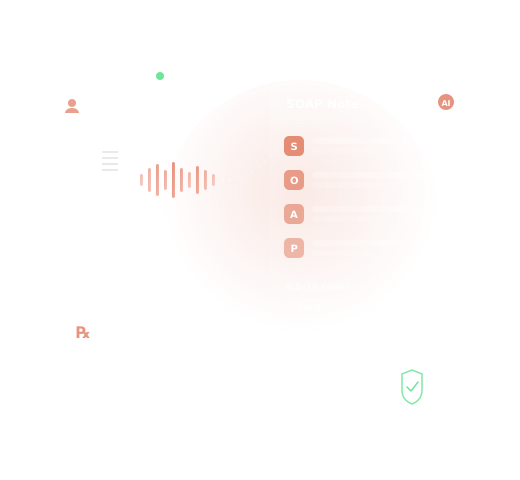
Automatic SOAP note generation: Consultation conversations can be converted into draft Subjective, Objective, Assessment, and Plan sections. This is useful for OPD visits, pre-op assessments, and follow-up reviews where note structure matters.
Speaker diarization: In pediatric surgery, both caregiver and clinician voices are important. Speaker separation helps distinguish parent-reported history from clinician counseling and recommendations, making the draft easier to validate.
Multilingual support: Many consultations in India move between English and regional languages. Multilingual capture supports more natural conversations without forcing clinicians or families into a single language pattern.
ICD-10 and CPT suggestions: The platform can surface coding suggestions based on the documented encounter. These remain support tools for clinician or billing-team review, not automatic final coding.
On-premise or private deployment options: Organizations with specific governance preferences may choose deployment postures that support workflows aligned with internal IT and data handling requirements.
Review-first workflow: Drafts are meant to be edited, corrected, and signed off by the clinician before the record is finalized. This is especially important in pediatric surgery, where operative decisions and family counseling details must be precise.
How It Works
The workflow is designed around real consultation documentation rather than standalone transcription.
- Capture the consultation conversation: During a pediatric surgery visit, the system records or ingests the consultation audio, including history from caregivers, clinician questions, examination narration, and treatment discussion. Speaker diarization helps separate who said what so the draft reflects the encounter more clearly.
- Transcribe and structure the encounter: The audio is converted into text and organized into clinically relevant sections. Instead of leaving the team with a raw transcript, the system prepares structured content that can support pediatric surgery documentation patterns such as presenting complaint, examination findings, assessment, and plan.
- Draft SOAP notes automatically: Based on the structured conversation, the platform generates a SOAP-style draft note. This can include history details, observed findings, likely assessment framing, and next-step planning such as investigations, admission advice, procedure counseling, or follow-up instructions.
- Surface coding suggestions: The system can suggest ICD-10 and CPT codes linked to the documented encounter. These suggestions are intended to support clinician or administrative review and can help teams move from note completion toward billing-ready documentation more efficiently.
- Clinician review, edit, and sign-off: Before anything becomes part of the final record, the clinician reviews the draft, corrects wording, adds missing details, and confirms the final note. This human checkpoint is essential for accuracy, especially in pediatric surgery cases involving operative planning or post-operative decisions.
- Choose deployment posture for operations: Depending on organizational needs, teams may use on-premise or private deployment approaches. This is a workflow and governance decision that can support internal preferences for infrastructure, access control, and system integration.
Local context
For providers evaluating an AI medical scribe in India, operational fit matters as much as feature lists. Pediatric surgery clinics may run high-volume OPDs, combine scheduled and urgent cases, and work across English plus regional languages. Documentation support should therefore be practical for mixed workflows: outpatient consultations, inpatient rounds, procedure discussions, and follow-up visits. It should also fit into existing documentation habits rather than forcing a complete process redesign on day one.
Hospitals and specialty centers in India may also differ in infrastructure preferences. Some teams prioritize private deployment models, while others focus on ease of rollout across departments. A useful AI medical scribe India healthcare solution should support these decisions as operational choices, while helping clinicians maintain control over review and final sign-off.
Use cases
New pediatric surgery consultations: Capture detailed caregiver history, examination discussion, and initial management planning in a structured draft note.
Pre-operative counseling: Document diagnosis explanation, procedure discussion, risks, preparation instructions, and caregiver questions in a more consistent format.
Post-operative follow-up: Support notes for wound review, symptom updates, medication changes, recovery milestones, and next follow-up plans.
Inpatient rounds: Help clinicians summarize interval events, examination findings, and treatment plans while preserving a review-first workflow.
Coding support for completed encounters: Surface ICD-10 and CPT suggestions after note drafting so teams can validate documentation and coding together.
FAQ
Can this be used for pediatric surgery OPD visits?
Yes. The workflow is well suited to consultations where history, examination, counseling, and follow-up planning need to be documented quickly and reviewed by the clinician.
Does it replace clinician documentation review?
No. The system creates draft notes and coding suggestions, but the clinician remains responsible for reviewing, editing, and signing off before finalization.
Can it handle multilingual consultations?
It is designed with multilingual support, which is useful for India healthcare settings where conversations may shift between English and regional languages.
Is deployment flexible?
Yes. On-premise or private deployment options can be considered based on workflow, infrastructure, and governance preferences.
CTA
If your pediatric surgery team wants faster documentation without losing clinical oversight, an AI medical scribe in India can help streamline the path from consultation to finalized note. Explore how structured SOAP drafting, speaker diarization, multilingual support, and coding suggestions can fit your OPD and hospital workflows. Review the product pathways for MedScribe overview, features, integrations, and pricing to assess fit for your department.