Introduction
AI medical scribe in India is becoming a practical option for hospitals and diagnostic centres that want to reduce documentation load without disrupting clinical routines. In PET CT settings, teams often manage referrals, indication summaries, prior history, scan preparation notes, reporting inputs, and follow-up communication across busy schedules. An AI medical documentation copilot can help convert consultation and care conversations into structured drafts that clinicians can review, edit, and finalize. For organisations looking at an AI medical scribe in India, the value is not only faster note creation but also more consistent documentation, clearer handoffs, and better support for daily OPD and imaging workflows.
MedScribe is designed as an AI documentation copilot for doctors, clinics, and hospitals. It captures consultation conversations, structures the transcript, drafts usable clinical notes such as SOAP format, and supports coding suggestions including ICD-10 and CPT where relevant to the workflow. For PET CT departments in India, this can be useful when clinicians need a reliable first draft from patient interactions, referral discussions, or pre-scan consultations while keeping human review at the centre of the process.
The goal is practical assistance, not replacement of clinical judgment. Teams can use the system to reduce repetitive typing, standardize note structure, and support workflows aligned with internal governance choices, including private or on-premise deployment where needed.
Department workflow
PET CT departments operate at the intersection of imaging, oncology, nuclear medicine, and coordinated follow-up. Documentation often starts before the scan, with referral intake, indication capture, prior treatment history, and preparation instructions. It continues during patient interaction, where clinicians or staff may discuss symptoms, treatment timelines, contrast or tracer considerations, and relevant precautions. After imaging, the workflow may include note drafting, coding support, communication with referring physicians, and preparation for multidisciplinary review.
In many centres, these steps are spread across multiple people and systems. Doctors may dictate or type summaries after the interaction. Staff may re-enter details into hospital systems. Important context can remain buried in free text or fragmented across notes. An AI medical scribe in India can help by turning spoken clinical conversations into structured drafts that are easier to review and carry forward into the record. For PET CT teams, this means less time spent reconstructing the encounter and more time validating the clinical picture.
This is especially relevant in high-volume OPD-linked imaging environments where clinicians need concise, usable notes rather than long transcripts. A documentation copilot can support consistency in history capture, assessment framing, and next-step planning while still leaving final approval with the clinician.
Features mapped to workflow
Conversation capture and transcription: MedScribe supports capture of consultation audio and converts it into structured transcription. This is useful for pre-scan consultations, referral reviews, and patient counselling conversations where details matter.
Speaker diarization: The system can distinguish speakers, helping separate clinician and patient inputs. In PET CT workflows, this can improve clarity when documenting symptoms, prior treatment details, and clinician recommendations.
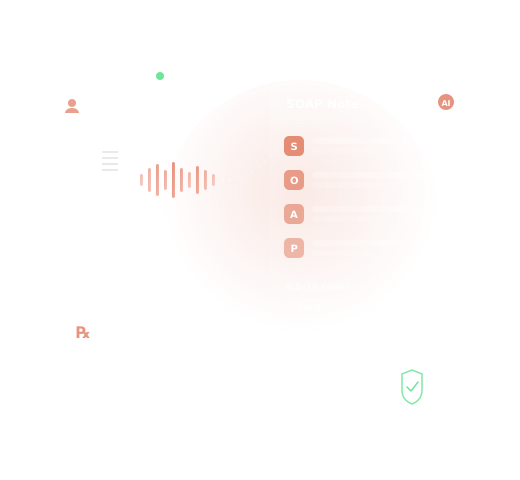
Automatic SOAP note generation: Instead of leaving teams with raw transcript text, the product drafts structured notes in a clinically usable format. This helps clinicians move from conversation to documentation faster.
ICD-10 and CPT suggestions: Coding support can assist teams during review by surfacing likely coding options based on the documented encounter. These remain suggestions for clinician or authorised staff validation.
Multilingual support: Indian healthcare settings often involve mixed-language conversations. Multilingual capability can help when patient interactions shift between English and regional language usage.
On-premise deployment options: Some hospitals prefer private infrastructure choices for workflow and governance reasons. MedScribe supports deployment posture decisions such as on-premise environments based on organisational needs.
Together, these features make an AI medical scribe India healthcare teams can evaluate for practical documentation improvement rather than a generic transcription tool.
How It Works
The workflow below reflects how MedScribe is designed to support real clinical documentation from conversation capture to final sign-off.
- Capture the consultation conversation: During a PET CT-related consultation, referral discussion, or pre-scan review, the clinician or team records the interaction through the documentation workflow. The system is built to capture spoken content in a way that can later be structured for clinical use.
- Transcribe and organize the encounter: MedScribe converts the audio into text and applies speaker diarization to separate patient and clinician contributions. This helps preserve context such as presenting concerns, prior treatment history, and preparation instructions.
- Draft a structured clinical note: The platform then turns the conversation into a SOAP-style draft. Instead of a long transcript, the clinician gets a more usable note with subjective details, objective context, assessment framing, and plan-oriented content that can fit daily documentation routines.
- Add coding support cues: Based on the drafted note, the system can surface ICD-10 and CPT suggestions to support downstream documentation and billing workflows. These are prompts for review, not automatic final coding decisions.
- Review, edit, and approve: The clinician checks the draft, corrects details, refines wording, and confirms the final note before record finalization. Human review is an operational checkpoint in the workflow and remains essential for accuracy and completeness.
- Finalize within the chosen deployment model: Organisations can use the product in a setup that fits their workflow and governance preferences, including private or on-premise deployment choices where appropriate. This is a practical infrastructure decision that supports internal processes.
Local context
In India, PET CT services are often delivered in environments where specialists, referring doctors, and diagnostic teams need quick access to clear documentation. Workflows may involve mixed OPD and imaging coordination, multilingual patient communication, and varying levels of digital maturity across centres. An AI medical scribe in India should therefore be practical, adaptable, and easy to review rather than overly complex.
For hospitals and clinics evaluating an AI medical scribe in India, the key question is whether it helps clinicians document faster while preserving oversight. MedScribe is positioned as a copilot for this purpose. It supports workflows aligned with local operational realities such as high patient throughput, variable documentation styles, and the need for concise summaries that can be shared across teams. Because deployment posture can matter, some organisations may also prefer private infrastructure options as part of their internal governance approach.
Use cases
Pre-scan consultation notes: Draft structured summaries from patient discussions about indication, symptoms, prior treatment, and preparation requirements.
Referral intake support: Convert referral-related conversations into usable documentation that helps the imaging team understand the clinical question.
Follow-up visit documentation: Capture post-scan or treatment follow-up discussions and turn them into clinician-ready notes.
Multidisciplinary coordination: Create clearer summaries that can support communication between imaging, oncology, and referring teams.
Documentation standardization: Use consistent SOAP-style drafting to reduce variation in note structure across clinicians and sites.
These are the kinds of day-to-day scenarios where an AI medical scribe India healthcare organisations may consider can add value without changing the clinician's responsibility for final documentation.
FAQ
Can this replace clinician documentation review?
No. The product is designed to create draft documentation and support review. Clinicians should edit, validate, and approve the final note before it becomes part of the record.
Is it useful only for long consultations?
No. It can also help with shorter PET CT-related interactions where teams still need structured notes, such as referral reviews, preparation counselling, or follow-up discussions.
Does it support coding workflows?
Yes. MedScribe can provide ICD-10 and CPT suggestions based on the drafted note, which staff or clinicians can review as part of their workflow.
Can hospitals choose a private deployment approach?
Yes. Deployment posture can be considered as a workflow and governance decision, including private or on-premise options depending on organisational needs.
CTA
If your PET CT department wants more consistent documentation with less manual typing, MedScribe offers a practical starting point. Explore how an AI medical scribe in India can support consultation capture, SOAP drafting, coding support, and clinician-led review for everyday imaging workflows. Review the product pathways for MedScribe, compare capabilities on features, and assess fit for your hospital or clinic workflow.