Introduction
An AI medical scribe in India can help clinics and hospitals reduce the time spent turning consultations into usable documentation. For Pharmacy OP environments, the challenge is not only capturing what happened during the visit, but also making the note clear enough for downstream dispensing, coding support, and follow-up coordination. MedScribe is designed as an AI documentation copilot that converts consultation conversations into structured clinical notes, while keeping the clinician in control of review and sign-off.
In practical OP settings, teams often work across high patient volumes, mixed digital maturity, and multilingual conversations. That makes documentation consistency difficult. An AI medical scribe in India is useful when it supports daily workflows rather than adding another layer of admin. MedScribe focuses on conversation capture, structured transcription, SOAP note drafting, coding suggestions, and clinician review so records can move forward with fewer manual steps. For hospitals and clinics looking at AI medical scribe India healthcare use cases, the value is operational: clearer notes, faster turnaround, and better continuity across departments.
Department workflow
In Pharmacy OP operations, documentation quality affects more than the doctor’s note. It influences medication interpretation, handoff clarity, and the ability of front-office or pharmacy-linked teams to act on the visit summary. A typical workflow starts with the consultation, where symptoms, medication history, allergies, prior treatment, and follow-up instructions are discussed. The next step is converting that conversation into a structured record that can be reviewed quickly.
Without a documentation copilot, clinicians or support staff may need to type notes after the encounter, summarize from memory, or switch between systems. This can create delays and variation in note quality. An AI medical scribe in India is most effective when it fits into the OP rhythm: capture the encounter, identify speakers, organize the transcript, draft a SOAP note, suggest relevant ICD-10 or CPT codes for review, and leave the final decision to the clinician. In Pharmacy OP settings, this can support cleaner medication-related documentation and more reliable communication for the next step in care delivery.
Features mapped to workflow
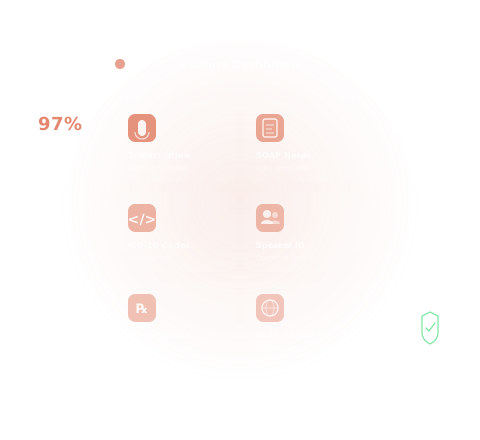
MedScribe is built around the real sequence of outpatient documentation work. Automatic SOAP note generation helps convert raw consultation dialogue into a familiar clinical format. This reduces the effort needed to create a usable first draft and gives clinicians a structured starting point instead of a blank screen.
Speaker diarization helps distinguish between clinician and patient voices during the encounter. In busy OP environments, this matters because the note should reflect who said what, especially when discussing symptoms, medication adherence, side effects, or prior prescriptions.
Multilingual support is relevant for Indian healthcare settings where consultations may move between English and regional languages. Rather than forcing a single-language workflow, the system is designed to support practical documentation needs in mixed-language conversations.
ICD-10 and CPT suggestions provide coding support after the note is drafted. These suggestions are intended to assist review, not replace clinical judgment. Teams evaluating an AI medical scribe India healthcare solution often want this step because it can reduce repetitive lookup work while keeping coding decisions under human supervision.
On-premise or private deployment options support organizations that want tighter control over infrastructure choices. This should be viewed as a workflow and governance decision based on internal IT and operational preferences, not as a blanket compliance claim.
How It Works
Below is the typical end-to-end workflow for using MedScribe in an outpatient setting.
- Capture the consultation conversation: During the OP visit, the clinician-patient interaction is recorded through the configured workflow. The system is designed to ingest the conversation as the source material for documentation, reducing the need for manual note-taking during the encounter.
- Transcribe and structure the interaction: MedScribe converts the audio into text and applies speaker diarization to separate clinician and patient contributions. This creates a more readable transcript that can be checked quickly before note drafting begins.
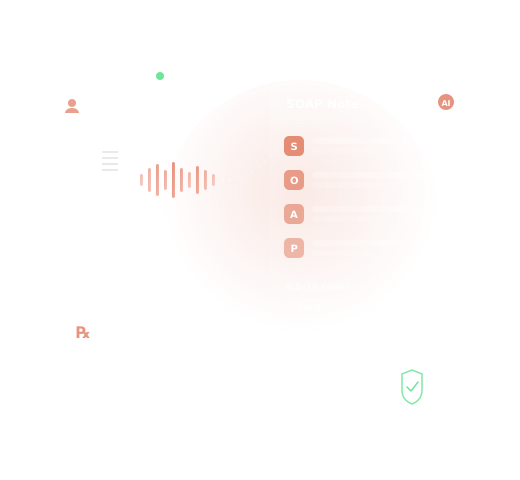
- Draft a SOAP note automatically: The structured transcript is used to generate a SOAP-format draft. Key details from the conversation are organized into subjective, objective, assessment, and plan sections so the clinician starts with a usable clinical summary rather than raw text.
- Suggest coding for review: Based on the drafted note, the system surfaces ICD-10 and CPT suggestions to support coding workflows. These are review aids only, allowing the clinician or authorized staff to accept, edit, or ignore them based on the actual encounter.
- Review, edit, and sign off: The clinician reviews the draft note, makes corrections, adds missing context, and confirms the final version before the record is finalized. Human review is an operational checkpoint, ensuring the output remains aligned with clinical intent and documentation standards.
- Choose deployment posture for governance needs: Depending on the organization’s setup, MedScribe can be deployed in on-premise or private environments. This supports teams that want documentation workflows aligned with internal governance, IT architecture, and data-handling preferences.
Local context
For providers evaluating an AI medical scribe in India, the local context is operational. OP departments often manage variable patient loads, mixed infrastructure, and consultations that may include English plus regional language usage. Documentation tools therefore need to be practical, not theoretical. A system that supports multilingual conversations, structured note drafting, and flexible deployment can be more relevant than a generic transcription tool.
In Indian clinics and hospitals, Pharmacy OP workflows also depend on clear medication-related documentation and timely handoffs. That is why an AI medical scribe in India should support the broader care process, not just produce text. The goal is to help clinicians complete records faster while preserving review control and making the output more usable for downstream teams.
Use cases
High-volume OP clinics: Clinicians can use MedScribe to reduce after-hours documentation and create structured notes more quickly after each consultation.
Hospital outpatient departments: Multi-specialty settings can use a common documentation workflow with SOAP drafting and coding support while allowing each clinician to review and finalize records.
Pharmacy-linked consultation workflows: When medication history, refill discussions, and treatment instructions are central to the visit, clearer notes can support better coordination between the consultation and dispensing process.
Multilingual patient interactions: Teams handling mixed-language consultations can use the platform’s multilingual support to improve documentation continuity without forcing a rigid single-language process.
Organizations with infrastructure preferences: Providers that prefer private or on-premise deployment can evaluate MedScribe as part of a broader governance and workflow design decision.
FAQ
Does MedScribe replace clinician judgment?
No. It is designed to assist with documentation by generating drafts and coding suggestions. The clinician reviews, edits, and signs off before the record is finalized.
Can it support multilingual consultations?
Yes. MedScribe is designed with multilingual support for practical outpatient use where conversations may include English and regional languages.
How does it fit into OP workflows?
It follows the consultation-to-documentation path: capture the conversation, transcribe and structure it, draft a SOAP note, suggest codes, and route the output for clinician review.
Is deployment flexible?
Yes. Organizations can evaluate on-premise or private deployment options based on internal workflow, IT, and governance requirements.
CTA
If your team is exploring an AI medical scribe in India for outpatient documentation, MedScribe offers a practical path from conversation capture to reviewed clinical notes. It is designed for clinics and hospitals that want faster documentation, structured SOAP drafts, coding support, and deployment flexibility without removing clinician oversight. Explore the product pages for features, integrations, and pricing, then assess how the workflow can fit your Pharmacy OP operations.