Introduction
Plastic and reconstructive surgery documentation often spans cosmetic consultations, trauma follow-up, post-operative reviews, wound assessments, graft planning, flap monitoring, and longitudinal recovery notes. In busy OPD and hospital settings, surgeons and assistants may need to capture nuanced history, examination findings, procedural planning, consent-related discussion points, and follow-up instructions without slowing the patient interaction. An AI medical scribe in India can support this process by turning consultation conversations into structured draft notes that clinicians can review, edit, and finalize.
MedScribe is designed as an AI documentation copilot for practical daily use. It helps convert doctor-patient conversations into SOAP-style drafts, supports speaker diarization, and can suggest ICD-10 and CPT-aligned coding options for clinician review. For plastic reconstructive surgery teams, this means less time spent rewriting routine details and more time available for patient counselling, photography workflows, treatment planning, and continuity of care. The goal is not to replace clinical judgment, but to reduce repetitive documentation effort while keeping the surgeon in control of the final record.
Department workflow
Plastic reconstructive surgery workflows are documentation-heavy because each encounter may combine functional, aesthetic, and procedural considerations. A first consultation may include prior treatment history, injury mechanism, scar evolution, tissue loss, infection status, co-morbidities, and patient expectations. Follow-up visits may require serial comparison of healing, flap viability, graft take, drain status, pain, dressing advice, and next-step planning. In hospitals, surgeons may also move between OPD, procedure rooms, wards, and post-op review rounds, creating fragmented documentation windows.
An AI medical scribe in India is useful in this setting because it supports consistent note capture across varied encounter types. Instead of relying only on memory after a long clinic session, teams can structure the conversation closer to the point of care. This is especially relevant when consultations involve multilingual discussion, family participation, or detailed explanation of staged reconstruction plans. The output can then be reviewed by the clinician and adapted to the documentation style of the department or facility.
Features mapped to workflow
For plastic reconstructive surgery, the value of an AI scribe is strongest when features map directly to real clinical steps. Automatic SOAP note generation helps organize subjective complaints, objective findings, assessment, and plan into a usable draft. Speaker diarization helps separate clinician and patient speech during detailed consultations. Multilingual support can help in settings where history-taking and counselling happen in more than one language. Coding suggestions can support downstream billing or record preparation by surfacing likely ICD-10 and CPT options for review rather than forcing manual lookup every time.
Operationally, this can help with pre-op consultation notes, post-op review summaries, wound care visits, scar management follow-ups, reconstructive planning discussions, and procedure documentation support. For institutions with stricter infrastructure preferences, deployment choices such as on-premise or private environments can be considered as workflow and governance decisions. This makes the product relevant for both independent clinics and larger hospitals looking for an AI medical scribe in India that fits existing documentation practices rather than forcing a new one.
How It Works
The workflow is designed to follow the natural flow of a consultation while preserving clinician oversight at every stage.
- Capture the consultation conversation: During an OPD visit, review round, or follow-up discussion, the encounter audio is captured through the configured workflow. This may include a surgeon discussing symptoms, prior procedures, examination findings, healing progress, and next steps with the patient.
- Transcribe and structure the interaction: The system converts speech into text and applies speaker diarization to distinguish who said what. It then organizes the conversation into clinically relevant sections so the raw transcript is easier to use in a surgical documentation context.
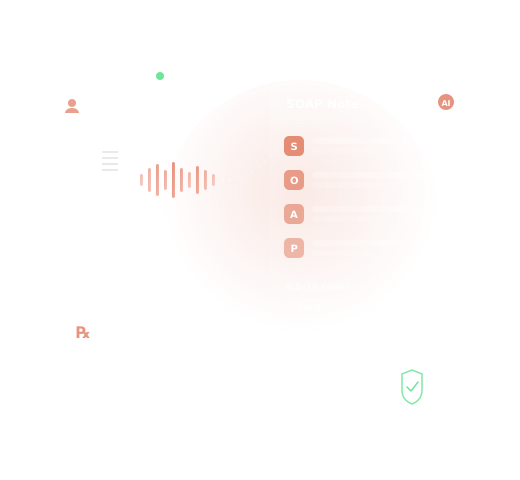
- Draft a SOAP note automatically: Based on the structured transcript, MedScribe generates a draft SOAP note. For plastic reconstructive surgery, this can include presenting concern, relevant history, examination observations, assessment themes, and treatment or follow-up planning in a format the clinician can quickly inspect.
- Surface coding support for review: The system can suggest likely ICD-10 and CPT-aligned codes based on the documented encounter. These are prompts for clinician or administrative review, helping reduce repetitive manual searching while keeping coding decisions under human control.
- Review, edit, and sign off: The clinician checks the draft note, corrects terminology, adds missing procedural nuance, confirms coding relevance, and finalizes the record. Human review is the checkpoint before any note becomes part of the patient chart.
- Choose a suitable deployment posture: Depending on the clinic or hospital setup, teams can evaluate private or on-premise deployment approaches. This supports workflows aligned with internal governance preferences without presenting deployment as a legal guarantee.
Local context
In India, plastic reconstructive surgery practices often manage a mix of elective and medically necessary cases across clinics, day-care centres, and hospitals. Documentation needs can vary by setting, but the common challenge is time pressure. Surgeons may need to maintain detailed records while also handling counselling, photography coordination, procedure planning, and follow-up communication. An AI medical scribe in India can support these realities by helping standardize note creation without making the encounter feel overly administrative.
This is also relevant for teams that work across languages or see patients accompanied by relatives who contribute important history. In such environments, AI-assisted documentation can help create a clearer first draft for review. For buyers evaluating an AI medical scribe India healthcare solution, the practical questions are usually about workflow fit, review controls, deployment options, and whether the output is useful enough to reduce after-hours documentation burden.
Use cases
Common use cases in plastic reconstructive surgery include new consultation documentation for scar revision, trauma reconstruction, burn follow-up, hand injury review, post-operative wound checks, flap and graft monitoring, and staged reconstruction planning. Cosmetic consultations may also benefit when the discussion includes prior procedures, patient goals, examination details, and treatment options that need to be summarized clearly. In each case, the clinician remains responsible for confirming the final note.
Hospitals may use the product to support consultant-led OPD sessions, resident-assisted documentation, or follow-up clinics where repetitive note structures are common. Smaller practices may use it to reduce the time spent typing routine findings after each visit. Because the product focuses on conversation capture, SOAP drafting, coding support, and review checkpoints, it is suitable for teams looking for an AI medical scribe in India that is practical rather than overly theoretical.
FAQ
Below are common implementation questions from clinics and hospitals evaluating AI-assisted documentation for this specialty.
Can it handle detailed reconstructive follow-up visits?
Yes. It is designed to convert detailed consultation conversations into structured draft notes, which can be useful for serial follow-up visits where healing progress, examination findings, and next-step plans need to be documented consistently.
Does it replace clinician review?
No. The workflow includes human review, edits, and final sign-off before the record is finalized. The system supports documentation efficiency, but the clinician remains responsible for the final note and coding decisions.
Is it useful in multilingual consultations?
It can support multilingual workflows, which is helpful in many Indian clinical settings where history-taking and counselling may happen in more than one language during the same encounter.
Can hospitals consider private or on-premise deployment?
Yes. Deployment posture can be evaluated based on operational and governance needs. The product is designed to support workflows aligned with institutional preferences, without claiming guaranteed compliance outcomes.
CTA
If your clinic or hospital is exploring a practical AI medical scribe in India for plastic reconstructive surgery, MedScribe can help streamline consultation documentation while keeping clinicians in control. Review the core product at /medscribe, explore workflow capabilities at /medscribe/features, and assess fit for your OPD or hospital documentation process.