Introduction
An AI medical scribe in India can help PMR teams reduce repetitive documentation work while keeping the clinician in control of the final record. In Physical Medicine and Rehabilitation, consultations often include functional history, pain patterns, mobility findings, therapy plans, assistive device discussions, and follow-up instructions. Capturing all of this clearly during a busy OPD can be time-consuming. An AI medical documentation copilot supports this workflow by turning consultation conversations into structured drafts that are easier to review, edit, and finalize.
For PMR departments in clinics and hospitals, the goal is practical: spend less time typing and more time focusing on patient interaction, rehabilitation planning, and continuity of care. This platform is designed for daily OPD use, with automatic SOAP note drafting, coding suggestions, speaker diarization, multilingual support, and deployment options such as private or on-premise setups. Rather than replacing clinical judgment, it supports a more consistent documentation process for doctors, rehab-focused teams, and administrative staff who depend on complete notes.
Department workflow
PMR documentation has its own rhythm. A typical visit may begin with the patient describing pain, stiffness, weakness, gait issues, spasticity, post-injury limitations, or recovery goals. The clinician then explores prior treatment, imaging, medications, therapy adherence, and functional status in daily activities. Examination findings may include range of motion, muscle power, tone, reflexes, posture, balance, and mobility assessment. The plan may cover rehabilitation goals, medications, injections, therapy referrals, home exercise advice, orthotic recommendations, and follow-up timelines.
Because these visits are detail-heavy, notes can become inconsistent when clinicians are under time pressure. An AI medical scribe in India helps organize the encounter into a usable structure without forcing a rigid template too early in the consultation. This is especially useful in PMR settings where the conversation often moves between symptoms, function, examination, and long-term rehabilitation planning. The result is a draft that supports continuity across repeat visits and multidisciplinary care.
Features mapped to workflow
Conversation capture and transcription: The system captures the consultation audio and converts it into text for documentation support. This helps preserve key details from longer PMR discussions, including symptom progression and functional limitations.
Speaker diarization: By separating clinician and patient speech, the draft becomes easier to review. In PMR consultations, this matters because patient-reported limitations and clinician findings need to remain distinct.
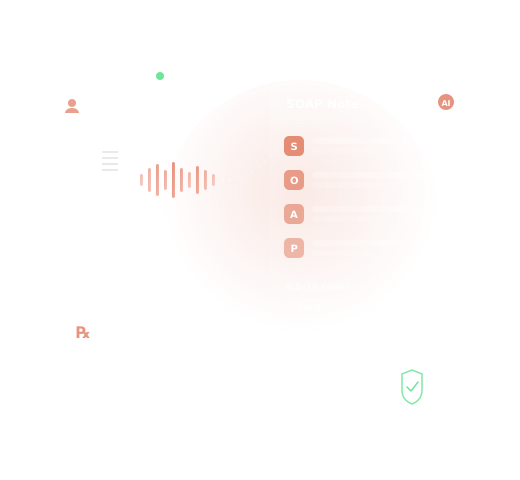
Automatic SOAP note generation: The platform drafts Subjective, Objective, Assessment, and Plan sections from the encounter. For PMR, this can support clearer recording of pain history, examination findings, rehabilitation goals, and treatment plans.
ICD-10 and CPT suggestions: Coding support can help clinicians and billing teams review likely codes based on the documented encounter. Suggestions are intended to support workflow efficiency and still require clinician validation.
Multilingual support: PMR consultations in India may involve English mixed with regional languages. Multilingual capability can help teams document more naturally in real-world OPD settings.
Private or on-premise deployment options: Some organizations prefer tighter control over infrastructure and data handling. Deployment posture can be chosen based on internal workflow, IT preferences, and governance needs.
How It Works
The workflow is designed to follow the real sequence of a consultation, from conversation capture to clinician-approved documentation.
- Capture the consultation conversation: During the PMR visit, the system records the interaction between clinician and patient. It can support multilingual conversations and uses speaker diarization to distinguish who said what, which is useful when documenting symptoms, functional complaints, and clinician advice.
- Transcribe and structure the encounter: The audio is converted into text and organized into clinically relevant segments. Instead of leaving the team with a raw transcript, the platform prepares a structured draft that reflects the flow of history, examination, assessment, and plan.
- Draft a SOAP note automatically: Based on the conversation, the system generates a SOAP-style note. In PMR, this may include pain history, mobility concerns, examination findings, rehabilitation assessment, and the proposed treatment or therapy plan.
- Suggest coding for review: The documentation copilot surfaces ICD-10 and CPT suggestions linked to the encounter content. These suggestions are meant to support coding review and should be checked by the clinician or authorized staff before use.
- Review, edit, and sign off: The clinician reviews the draft, corrects details, adds missing findings, and confirms the final note. Human review is an operational checkpoint, ensuring the record reflects clinical judgment before finalization.
- Finalize within the chosen deployment model: Depending on organizational preference, teams can use a private or on-premise deployment approach. This is a workflow and governance decision that can support internal data handling practices and integration planning.
Local context
In India, PMR teams often work across varied care settings, from independent clinics to multispecialty hospitals and rehabilitation-focused centers. Documentation needs can differ by setup, but the common challenge is the same: balancing detailed notes with high patient volumes. An AI medical scribe in India is useful when clinicians need support for mixed-language consultations, repeat follow-ups, and structured records that can be reviewed quickly.
The practical value of an AI medical scribe in India is not just speed. It is also about making documentation more usable for follow-up care, therapy coordination, and coding review. For organizations evaluating infrastructure choices, private or on-premise deployment may be relevant where internal governance and IT control are important considerations. The product is designed to align with operational needs in India healthcare environments without making workflow overly complex.
Use cases
Busy PMR OPD clinics: Support clinicians who manage high consultation volumes and need faster first-draft notes.
Rehabilitation follow-up visits: Track symptom changes, function, therapy response, and plan updates across repeat encounters.
Hospital-based PMR departments: Improve consistency in documentation where multiple clinicians or teams contribute to patient care.
Mixed-language consultations: Help structure encounters where English and regional language usage shifts during the visit.
Coding review workflows: Provide ICD-10 and CPT suggestions that can be checked before billing or record completion.
Governance-sensitive deployments: Support organizations that prefer private or on-premise implementation as part of internal workflow planning.
FAQ
Can this be used for PMR consultations with detailed functional assessments?
Yes. The workflow is suited to consultations that include symptom history, mobility concerns, examination findings, rehabilitation goals, and treatment planning. Clinician review remains essential before finalizing the note.
Does it replace the doctor's documentation responsibility?
No. It acts as a documentation copilot that prepares drafts and coding suggestions. The clinician reviews, edits, and signs off on the final record.
Can it support multilingual consultations common in India?
Yes. Multilingual support is part of the product design, which can be useful in OPD settings where English and regional languages are both used.
Are coding suggestions automatic billing decisions?
No. ICD-10 and CPT suggestions are provided as workflow support and should be validated by the clinician or authorized team before use.
Is deployment flexible for hospitals with internal IT preferences?
Yes. Private and on-premise deployment options can support organizations that want infrastructure choices aligned with internal governance and workflow needs.
CTA
If your PMR team wants more consistent notes with less manual typing, explore how an AI medical scribe in India can fit into your daily documentation workflow. Review the core product, features, integrations, and pricing to assess whether the setup matches your clinic or hospital needs. For India healthcare teams looking for a practical documentation copilot, this AI medical scribe in India approach supports structured notes, coding review, and clinician-controlled finalization.