Introduction
Point Of Care Testing teams work in fast clinical environments where every minute matters. When doctors, nurses, and technicians are moving between patient interaction, test interpretation, and treatment decisions, documentation can become a bottleneck. An AI medical scribe in India can help reduce manual note-taking by turning consultation conversations into structured clinical drafts that are easier to review and finalize. For clinics, diagnostic-led OPDs, emergency-linked units, and hospitals, the goal is not to replace clinical judgment. It is to support better documentation flow, reduce repetitive typing, and help clinicians stay focused on the patient encounter.
MedScribe is designed as an AI documentation copilot for practical daily use. It converts spoken consultations into usable note drafts, supports SOAP formatting, suggests ICD-10 and CPT codes, and helps organize information for clinician review. In Point Of Care Testing settings, where rapid tests often influence immediate decisions, this kind of workflow support can be useful for documenting symptoms, test context, assessment, and next steps without forcing the clinician to start from a blank screen each time.
This page focuses on how an AI medical scribe in India can fit into Point Of Care Testing workflows in a practical, implementation-oriented way for healthcare teams.
Department workflow
Point Of Care Testing often sits close to the patient encounter. A patient may present with fever, respiratory symptoms, glucose concerns, cardiac complaints, infection suspicion, or anticoagulation monitoring needs. The clinician evaluates the patient, orders or reviews a near-patient test, discusses findings, and decides on treatment or escalation. Documentation usually needs to capture the presenting complaint, relevant history, test performed or reviewed, interpretation, assessment, and plan.
In many Indian clinics and hospitals, this workflow is compressed into short OPD slots or high-throughput care windows. That creates common friction points: incomplete notes, delayed charting after clinic hours, inconsistent structure across providers, and missed opportunities to capture coding-relevant details. An AI medical scribe in India is most useful when it supports this exact sequence rather than adding another tool that interrupts care delivery.
For Point Of Care Testing teams, the documentation need is not only about recording what was said. It is also about organizing the encounter into a format that helps the clinician verify the note quickly, connect test findings to the assessment, and complete sign-off with confidence.
Features mapped to workflow
Conversation capture and transcription: During the consultation, the system captures the clinical conversation and converts it into text. This is useful in busy OPD and bedside settings where manual typing can slow the encounter.
Speaker diarization: By separating clinician and patient speech, the draft becomes easier to interpret and review. This matters when symptoms, instructions, and clarifications are exchanged rapidly.
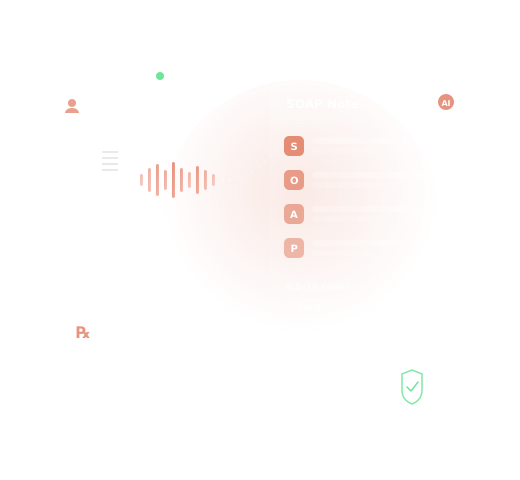
Automatic SOAP note generation: The transcript is structured into Subjective, Objective, Assessment, and Plan sections. For Point Of Care Testing, this helps connect symptoms, observed findings, test context, and treatment decisions in a familiar clinical format.
ICD-10 and CPT suggestions: Coding support can help surface likely documentation-linked codes for clinician review. These are suggestions, not final coding decisions, and should be validated by the care team.
Multilingual support: In India, consultations may shift between English and regional languages. Multilingual capability can support more natural patient interactions while still producing usable documentation drafts.
On-premise or private deployment options: Some organizations prefer deployment choices that support internal governance and workflow control. These decisions should be evaluated based on operational needs, IT readiness, and documentation processes.
How It Works
The workflow below reflects how the product is designed to support real clinical documentation from start to finish.
- Capture the consultation conversation: During a Point Of Care Testing encounter, the clinician conducts the visit as usual while the system records the discussion. This may include symptoms, relevant history, examination comments, test-related discussion, and treatment planning.
- Transcribe and structure the interaction: The audio is converted into text with speaker diarization so the system can distinguish patient and clinician contributions. This creates a clearer base record for downstream note drafting.
- Draft a SOAP note automatically: The transcript is organized into a SOAP-style clinical note. Subjective details may include symptoms and history, Objective may include observed findings and test context, Assessment summarizes the clinical impression, and Plan captures medications, follow-up, repeat testing, or referral steps.
- Generate coding suggestions for review: Based on the documented encounter, the system can surface ICD-10 and CPT suggestions to support coding workflows. These suggestions are intended to assist review, not replace clinician or billing team judgment.
- Clinician reviews, edits, and signs off: The doctor or authorized user checks the draft, corrects wording, adds missing context, confirms coding relevance, and finalizes the record. Human review is a required operational checkpoint before the note becomes part of the patient record.
- Choose a deployment posture that fits governance needs: Organizations can evaluate on-premise or private deployment approaches based on workflow, infrastructure, and internal data handling preferences. This supports workflows aligned with local operational requirements without making blanket compliance claims.
Local context
Healthcare teams in India often manage high patient volumes, mixed language consultations, and varied digital maturity across clinics and hospitals. In Point Of Care Testing environments, documentation may need to keep pace with rapid decisions around glucose checks, infectious disease screening, cardiac markers, coagulation monitoring, pregnancy testing, or other near-patient diagnostics. An AI medical scribe in India should therefore be practical, flexible, and easy to fit into existing OPD and hospital workflows.
For many organizations, the value comes from reducing after-hours charting, improving note consistency, and helping clinicians document test-linked encounters more efficiently. An AI medical scribe in India may also be relevant where teams want multilingual support and deployment options that can be aligned with internal IT and governance preferences. The focus should remain on workflow fit, clinician oversight, and operational usability in real care settings.
Use cases
Fever and infection screening visits: Capture symptom history, rapid test discussion, assessment, and treatment advice in a structured note.
Diabetes and glucose monitoring encounters: Document patient complaints, point-of-care glucose values, medication review, counseling, and follow-up planning.
Cardiac triage support: Record chest pain history, bedside observations, test-related discussion, and escalation decisions for review.
Anticoagulation and coagulation monitoring: Organize visit details, test context, dose adjustments, and next review instructions.
Urgent care and high-throughput OPD: Support faster draft creation when clinicians need to move quickly between patients without sacrificing note structure.
Across these scenarios, an AI medical scribe in India is most effective when it supports the clinician's existing process rather than forcing a new documentation habit.
FAQ
Can this be used in busy OPD settings?
Yes. The product is designed for practical daily workflows where clinicians need help converting conversations into structured draft notes for quick review.
Does it replace the doctor's documentation responsibility?
No. The system drafts notes and suggests codes, but the clinician remains responsible for reviewing, editing, and signing off before finalization.
Is it useful for multilingual consultations in India?
Yes. Multilingual support can help teams document encounters where patient conversations move between English and regional languages.
Can hospitals choose different deployment approaches?
Yes. Organizations may evaluate on-premise or private deployment options based on workflow, infrastructure, and governance preferences.
CTA
If your clinic or hospital wants to improve Point Of Care Testing documentation without adding more manual work, explore how an AI medical scribe in India can support consultation capture, SOAP drafting, coding assistance, and clinician review. Review the product pathways for MedScribe overview, features, integrations, and pricing to assess fit for your care setting. For teams evaluating AI medical scribe India healthcare workflows, the best next step is to map the tool to your actual OPD, bedside, and documentation process before rollout.