Introduction
Post Anesthesia Care teams work in a fast, observation-heavy environment where clinicians must track recovery status, pain, airway, vitals, medications, handoffs, and discharge readiness without slowing patient flow. An AI medical scribe in India can support this setting by turning clinician-patient and clinician-team conversations into structured draft documentation that is easier to review and finalize. For hospitals, day-care surgery centres, and multispecialty clinics, the goal is practical: reduce repetitive typing, improve note completeness, and help clinicians stay focused on recovery monitoring rather than manual documentation.
MedScribe is designed as an AI documentation copilot for daily clinical workflows. It converts consultation or bedside conversations into usable clinical notes, supports SOAP-style drafting, and provides coding suggestions for clinician review. In Post Anesthesia Care, this can help teams document immediate recovery observations, interventions, and follow-up instructions in a more consistent way. The product is built to support workflows aligned with operational and governance needs in India, including multilingual care environments and deployment choices such as private or on-premise setups where required.
Department workflow
In Post Anesthesia Care, documentation often spans several short but important interactions: receiving handoff from the OT team, assessing airway and consciousness, recording pain and nausea, noting medications administered, documenting recovery milestones, and preparing transfer or discharge summaries. These steps are clinically routine, but the documentation burden can become fragmented when teams are moving between beds, monitors, and family updates.
An AI medical scribe in India is useful here because PACU workflows are highly conversational and time-sensitive. Nurses and doctors may verbally confirm procedure details, anesthesia type, immediate post-op concerns, and response to interventions. Instead of relying only on delayed recall, the scribe workflow can capture the conversation, structure it into a draft note, and present it for clinician review. This is especially relevant in India healthcare settings where departments may handle mixed case loads, multilingual communication, and variable documentation formats across facilities.
Typical PACU documentation needs include post-anesthesia assessment, pain score trends, nausea or vomiting observations, oxygen support, fluid status, medication administration context, escalation notes, and readiness for transfer. A documentation copilot helps bring these elements into a consistent draft while keeping the clinician in control of edits and sign-off.
Features mapped to workflow
MedScribe maps well to Post Anesthesia Care because its core capabilities align with how recovery documentation is created in practice.
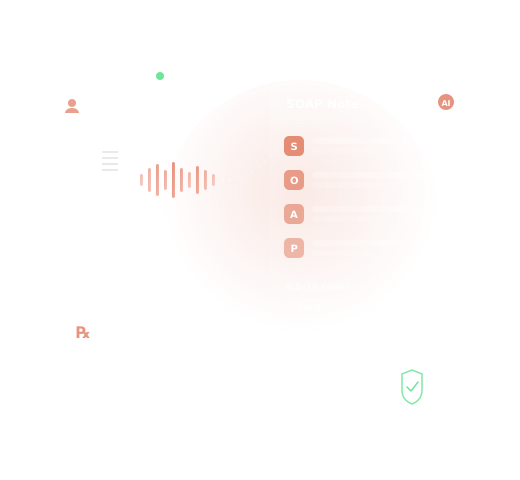
Automatic SOAP note generation: Recovery conversations and assessments can be converted into structured draft notes, helping clinicians move from spoken observations to organized documentation faster.
Speaker diarization: In PACU, multiple voices may be involved, including anesthetists, surgeons, nurses, and the patient. Speaker separation helps the system distinguish contributors and improve note clarity during review.
Multilingual support: Many facilities in India operate in English plus regional languages. Multilingual capture can support more natural communication during bedside care while still producing a usable draft note.
ICD-10/CPT suggestions: Coding support can assist administrative and billing workflows by surfacing relevant suggestions based on the documented encounter. These remain suggestions for human validation, not automatic final coding.
On-premise or private deployment options: For organizations with specific IT governance preferences, deployment posture can be chosen as a workflow and infrastructure decision. This supports teams that want tighter control over where documentation systems run.
Clinician review before finalization: The product is designed around draft-first documentation. PACU teams can edit, verify, and sign off before the record is finalized, which is important in high-acuity recovery settings.
How It Works
The MedScribe workflow for Post Anesthesia Care follows the real sequence of documentation from bedside interaction to finalized note.
- Capture the recovery conversation: During handoff, bedside review, or discharge readiness assessment, the clinician starts conversation capture. This may include procedure context, anesthesia recovery status, pain updates, airway observations, medications, and next-step instructions.
- Transcribe and structure the interaction: MedScribe converts the audio into text and applies speaker diarization to separate participants where possible. It then organizes the content into clinically relevant sections so the PACU team does not start from a blank screen.
- Draft a SOAP-style note: Based on the captured interaction, the system prepares a structured draft note. For Post Anesthesia Care, this can include subjective symptoms such as pain or nausea, objective observations such as vitals or oxygen support, assessment of recovery progress, and plan elements such as monitoring, transfer, or discharge instructions.
- Surface coding suggestions: The platform can provide ICD-10/CPT suggestions linked to the documented encounter. These are intended to support downstream workflows and should be reviewed by the clinician or authorized staff before use.
- Review, edit, and sign off: The clinician checks the draft, corrects details, adds missing context, and confirms the final note. Human review is the operational checkpoint before the record is finalized, helping maintain documentation quality.
- Choose deployment posture for governance needs: Depending on organizational preferences, teams can evaluate private or on-premise deployment approaches. This is a practical infrastructure choice that can support internal governance and workflow alignment.
Local context
For providers evaluating an AI medical scribe in India, local practicality matters more than generic automation claims. PACU teams in India may work across standalone surgical centres, specialty hospitals, and larger health systems with different documentation maturity levels. Some need a lightweight way to reduce typing during busy shifts, while others need a more controlled deployment model that fits internal IT policies.
This is where AI medical scribe India healthcare workflows should stay grounded in day-to-day use. The value is not just transcription. It is the ability to support multilingual communication, create structured drafts for recovery notes, and keep clinicians in charge of final edits. For organizations comparing options, it is also useful to review related product information across core pages such as /medscribe, /medscribe/features, /medscribe/integrations, and /medscribe/pricing to understand fit with existing systems and workflows.
Use cases
Immediate post-op assessment: Draft notes from the first PACU review, including consciousness level, airway status, pain, nausea, and monitoring plan.
Handoff documentation: Capture key details exchanged between OT, anesthesia, and recovery teams to support clearer continuity.
Medication and intervention context: Record why antiemetics, analgesics, oxygen support, or observation extensions were needed.
Transfer readiness: Summarize recovery progress and plan for transfer to ward, ICU, or discharge area.
Day-care surgery discharge instructions: Support structured documentation of recovery milestones and follow-up advice after short-stay procedures.
These scenarios show why an AI medical scribe in India can be especially relevant for departments where short interactions generate important documentation that must still be reviewed carefully.
FAQ
Can this be used only for OPD consultations?
No. While many AI scribe tools are discussed in OPD contexts, MedScribe can also support conversational documentation in areas like Post Anesthesia Care where bedside assessments and handoffs are common.
Does the system finalize notes automatically?
No. The workflow is draft-first. Clinicians review, edit, and sign off before the record is finalized.
Can it handle multilingual conversations?
Yes, multilingual support is part of the product design, which can be useful in India healthcare environments where clinicians and patients may switch between languages.
Are coding outputs automatic?
No. ICD-10/CPT outputs are suggestions intended to support review workflows. Final coding decisions should be validated by the appropriate clinician or authorized staff.
CTA
If your recovery unit is looking for a practical AI medical scribe in India solution, MedScribe can help reduce manual note creation while keeping clinicians in control of review and sign-off. Explore the product, compare features, and assess whether the workflow fits your Post Anesthesia Care documentation needs.