Introduction
Psychiatry consultations often involve long-form conversations, nuanced symptom histories, medication reviews, risk assessment, and careful follow-up planning. That makes documentation essential, but also time-consuming. An AI medical scribe in India can help psychiatry teams reduce manual note-taking during OPD and follow-up visits by turning clinician-patient conversations into structured draft documentation for review. Instead of replacing clinical judgment, the tool is designed to support psychiatrists, psychologists working with medical teams, and hospital outpatient departments with faster note preparation, clearer records, and more consistent documentation workflows.
For Indian clinics and hospitals, the practical value is simple: less time spent typing after each consultation and more time available for patient interaction, review, and care coordination. In psychiatry, where context matters, documentation support needs to capture narrative detail without disrupting the therapeutic flow. An AI medical scribe in India is most useful when it fits naturally into daily practice, supports multilingual conversations, and keeps the clinician in control of edits and final sign-off.
Department workflow
Psychiatry workflows differ from many other specialties because the consultation itself is often the primary diagnostic tool. A typical visit may include presenting complaints, psychiatric history, family history, substance use review, mental status examination, medication adherence discussion, and a treatment plan. In busy OPD settings, clinicians may also need to document risk indicators, comorbid conditions, referrals, and follow-up instructions. This creates a documentation burden across new assessments, review visits, therapy-linked medical reviews, and inpatient consults.
In practice, teams often move through a sequence: patient interaction, note drafting, coding support, review, and record completion. Delays usually happen after the consultation, when the doctor must reconstruct details from memory or shorthand notes. For psychiatry departments in India, this can be harder when consultations switch between English, Hindi, or regional languages, or when family members contribute to the discussion. An AI medical scribe in India supports this workflow by helping capture the conversation, separate speakers, organize the content into a usable clinical structure, and prepare a draft that the clinician can refine before finalizing the record.
Features mapped to workflow
MedScribe is built as an AI medical documentation copilot for doctors and clinics. For psychiatry teams, its value comes from mapping product capabilities to real documentation steps rather than adding another disconnected tool.
- Conversation capture and transcription: Supports consultation documentation by converting spoken interaction into text that can be used for note preparation.
- Speaker diarization: Helps distinguish between clinician, patient, and where relevant, caregiver speech, which is useful in psychiatric evaluations and family-supported visits.
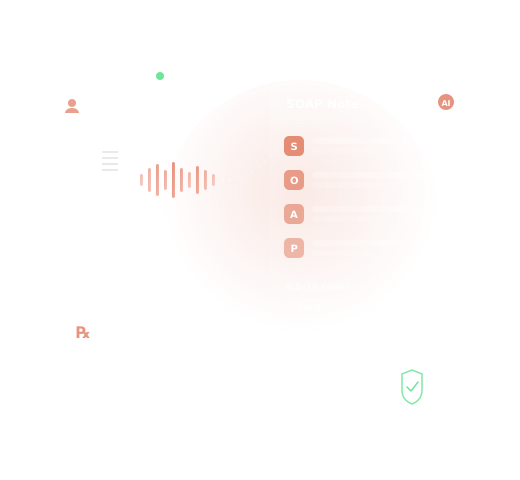
- Automatic SOAP note generation: Structures the consultation into a draft format that can support subjective history, objective observations, assessment, and plan.
- ICD-10 and CPT suggestions: Provides coding support to assist administrative workflows, subject to clinician review and local billing processes.
- Multilingual support: Useful for Indian healthcare settings where consultations may move across languages within the same visit.
- On-premise deployment options: Supports organizations that prefer private or on-premise deployment choices based on internal governance and IT workflow preferences.
These features are relevant because psychiatry documentation is rarely just a short summary. It often requires chronology, symptom detail, medication context, and a clear plan. An AI medical scribe in India should therefore help with structure and speed while preserving the clinician's ability to review nuance, remove irrelevant text, and finalize the note responsibly.
How It Works
The workflow below reflects how the product is designed to support psychiatry documentation from consultation to finalized record.
- Capture the consultation conversation: During an OPD or follow-up visit, the consultation audio is captured through the configured workflow. This may include psychiatrist-patient dialogue and, where relevant, caregiver input. The system is designed to support multilingual conversations common in Indian practice settings.
- Transcribe and separate speakers: The audio is converted into text, and speaker diarization helps identify who said what. This is especially useful in psychiatry, where symptom descriptions, clinician prompts, and family observations should not be mixed together in the draft record.
- Structure the transcript into a clinical draft: The transcribed conversation is organized into a usable note format, including automatic SOAP note generation. For psychiatry, this can help clinicians quickly review presenting concerns, history elements, observations, assessment points, and the treatment plan in a structured way.
- Add coding support for review: The system can generate ICD-10 and CPT suggestions based on the documented encounter. These are intended as workflow aids for clinician or administrative review, not as automatic final coding decisions.
- Clinician review, edit, and sign-off: The psychiatrist reviews the draft note, corrects wording, adds missing clinical nuance, confirms coding relevance, and approves the final version before record completion. Human review is the operational checkpoint that keeps the clinician in control.
- Choose deployment posture based on workflow needs: Clinics and hospitals can evaluate deployment options such as private or on-premise setups depending on internal IT, data handling preferences, and governance requirements. This is a workflow and infrastructure decision that should align with organizational processes.
Local context
Psychiatry practices in India often manage high documentation variability across solo clinics, multispecialty hospitals, and mental health departments within larger institutions. Some settings need quick OPD note support, while others need more standardized records across multiple doctors. There may also be practical requirements around multilingual consultations, caregiver participation, and internal preferences for private deployment models. An AI medical scribe in India is most effective when it adapts to these operational realities rather than forcing a rigid workflow.
For healthcare organizations evaluating digital documentation tools, the focus should be on usability, review controls, and fit with existing systems and teams. The product can support workflows aligned with internal documentation standards and broader digital health adoption efforts in India, but the day-to-day value comes from helping clinicians complete records more efficiently without losing oversight.
Use cases
- New psychiatric evaluations: Drafting detailed initial assessment notes from long consultations.
- Follow-up medication reviews: Summarizing symptom changes, adherence, side effects, and plan updates.
- Family-supported consultations: Separating patient and caregiver inputs for clearer documentation.
- Hospital psychiatry OPD: Supporting faster note completion across high-volume outpatient sessions.
- Cross-language consultations: Assisting documentation where clinicians and patients switch between English and Indian languages.
- Coding-assisted workflows: Preparing draft coding suggestions to support downstream administrative review.
These scenarios show why an AI medical scribe in India can be useful in psychiatry: it helps convert complex conversations into structured drafts while keeping the clinician responsible for interpretation, edits, and final approval.
FAQ
Can this be used for psychiatry consultations with long narrative histories?
Yes. The workflow is designed to help convert extended conversations into structured draft notes, which can then be reviewed and refined by the clinician.
Does the product replace psychiatrist review?
No. The draft output should be reviewed, edited where needed, and signed off by the clinician before the record is finalized.
Is multilingual use relevant for Indian psychiatry practice?
Yes. Multilingual support can be useful where consultations move between English, Hindi, or other regional languages during the same visit.
Can hospitals consider private or on-premise deployment?
Yes. Deployment posture can be evaluated based on internal IT, workflow, and governance preferences.
CTA
If your psychiatry clinic or hospital wants a more practical way to handle consultation documentation, explore how an AI medical scribe in India can support daily OPD workflows, draft SOAP notes, and streamline clinician review without taking control away from the care team. Review the product pathways for MedScribe, compare capabilities on features, and assess fit for your documentation process, deployment preferences, and psychiatry workflow needs.