Introduction
Public health and epidemiology teams often work across high-volume clinics, surveillance programs, outreach settings, and hospital-linked reporting units. In these environments, documentation quality matters because every consultation note, symptom summary, and coded diagnosis can influence continuity of care, reporting consistency, and downstream analysis. An AI medical scribe in India can help reduce manual note-taking during OPD and field-linked consultations by turning clinician-patient conversations into structured drafts that are easier to review and finalize. For hospitals, medical colleges, district programs, and public health units, the goal is practical: save clinician time, improve note completeness, and support workflows aligned with routine documentation standards without disrupting care delivery.
MedScribe is designed as an AI documentation copilot for doctors and care teams. It converts consultation conversations into usable clinical notes, supports SOAP drafting, suggests ICD-10 and CPT codes, and helps teams maintain a consistent documentation process. For public health epidemiology settings in India, this is especially useful where multilingual interactions, variable infrastructure, and mixed digital maturity are common. Rather than replacing clinical judgment, the platform supports a review-first workflow so clinicians can edit, verify, and sign off before records are finalized.
Department workflow
Public health epidemiology workflows are different from single-specialty private practice. A clinician may see fever cases in OPD, review follow-up patients from community programs, document risk factors, and coordinate with surveillance or reporting teams. Notes may need to capture symptoms, exposure history, comorbidities, treatment advice, and coding in a format that can be reused for clinical records and internal reporting. In many Indian settings, doctors also switch between English and regional languages during the same consultation, while support staff manage registration, queue flow, and record updates.
An AI medical scribe in India fits this workflow by reducing the burden of typing during or after consultations. Instead of relying on fragmented handwritten notes or delayed data entry, clinicians can capture the conversation, generate a structured draft, and review it quickly. This is useful for outpatient departments, infectious disease screening desks, maternal and child health programs, NCD follow-ups, and hospital public health units that need consistent records across multiple providers. The value is not only speed; it is also standardization, clearer summaries, and better handoff between clinicians, nurses, and administrative teams.
Features mapped to workflow
For public health epidemiology teams, product value comes from how features map to daily work:
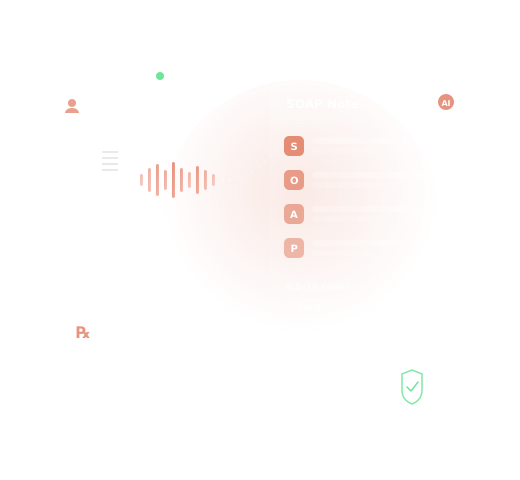
- Automatic SOAP note generation: Converts consultation dialogue into a structured subjective, objective, assessment, and plan format that clinicians can review and refine.
- Speaker diarization: Separates clinician and patient speech, which helps when consultations involve attendants, interpreters, or multiple care team members.
- Multilingual support: Useful in Indian care settings where conversations may move between English, Hindi, and regional languages.
- ICD-10 and CPT suggestions: Supports coding workflows by surfacing likely options based on the documented encounter, while keeping final selection with the clinician or coding team.
- Human review checkpoints: Drafts are meant for clinician validation, edits, and sign-off before record finalization.
- On-premise or private deployment options: Supports organizations that prefer tighter control over infrastructure and governance decisions.
These capabilities make AI medical scribe in India relevant for both busy OPDs and structured public health programs. The platform is designed to align with operational needs such as faster note completion, more consistent documentation, and easier collaboration between frontline clinicians and back-office teams.
How It Works
The workflow is built around real consultation documentation rather than generic transcription. A typical process looks like this:
- Capture the consultation conversation: During an OPD or program-linked visit, the clinician records the encounter through the configured workflow. The system captures the dialogue while preserving speaker separation, which is helpful when the doctor, patient, and attendant all contribute.
- Transcribe and structure the interaction: The audio is converted into text and organized into clinically relevant sections. Instead of leaving teams with a raw transcript, the system prepares structured content that can support note drafting and coding review.
- Draft a SOAP note automatically: Based on the conversation, MedScribe generates a SOAP-style draft with the main complaints, relevant observations, assessment cues, and plan elements. This gives clinicians a usable starting point rather than a blank screen.
- Surface coding suggestions: The platform can suggest ICD-10 and CPT options linked to the documented encounter. These suggestions are intended to support coding workflows, not replace clinician or coder judgment.
- Review, edit, and sign off: The clinician checks the draft, corrects details, adds missing context such as epidemiological history or follow-up instructions, and approves the final version before it becomes part of the record.
- Choose a deployment posture that fits governance needs: Organizations can evaluate on-premise or private deployment approaches based on workflow, IT, and governance preferences. This supports teams that want documentation tools aligned with internal data handling practices.
This practical sequence is why an AI medical scribe in India can be useful in public health epidemiology settings: it supports documentation from first conversation to final review without removing clinician control.
Local context
In India, public health documentation often spans government-linked programs, teaching hospitals, trust hospitals, urban clinics, and district-level facilities. Teams may work with mixed infrastructure, varying internet reliability, and multilingual patient populations. They also need tools that can fit into existing habits rather than force a complete process redesign. An AI medical scribe in India should therefore be practical for daily OPD use, adaptable to different deployment preferences, and supportive of clinicians who need to move quickly between patients while maintaining record quality.
For epidemiology-oriented departments, local relevance also means capturing details that matter for follow-up and trend review, such as symptom duration, exposure history, travel context, household risk, and treatment advice. While broader analytics and reporting may happen in separate systems, better frontline documentation improves the quality of information available for those downstream tasks. This is where AI medical scribe India healthcare workflows can add value: not by making exaggerated claims, but by helping teams create cleaner, more reviewable records at the point of care.
Use cases
- High-volume OPD documentation: Draft notes faster during fever clinics, respiratory clinics, NCD follow-ups, and general public health consultations.
- Multilingual consultations: Support encounters where clinicians and patients switch languages during history taking and counseling.
- Teaching and supervision settings: Help junior doctors and supervised teams maintain more consistent note structure.
- Coding support for hospital workflows: Surface likely ICD-10 and CPT options to reduce manual lookup effort.
- Private or on-premise deployment decisions: Fit organizations that want infrastructure choices aligned with internal governance and IT preferences.
FAQ
Common implementation questions from hospitals and clinics evaluating AI medical scribe India healthcare workflows are answered below.
CTA
If your public health epidemiology team is looking for a more consistent way to document consultations, an AI medical scribe in India can support faster note drafting, coding assistance, and clinician-led review. Explore how MedScribe fits OPD and hospital workflows through the core product pages at /medscribe, feature details at /medscribe/features, integration pathways, and deployment discussions tailored to your operational setup. The right approach is one that helps clinicians document efficiently while keeping review, edits, and final sign-off in their hands.