Introduction
Pulmonary rehabilitation programs depend on clear, timely documentation across assessment visits, exercise sessions, symptom reviews, education, and follow-up planning. For clinics and hospitals managing busy OPD schedules, repetitive note-taking can reduce face time with patients and slow record completion. An AI medical scribe in India can help pulmonary rehabilitation teams convert consultation conversations into structured draft notes that are easier to review, edit, and finalize. Instead of replacing clinical judgment, the tool supports the documentation layer around routine encounters.
MedScribe is designed as an AI documentation copilot for doctors and care teams. It listens to the consultation workflow, structures the conversation, drafts SOAP-style notes, and provides coding suggestions for clinician review. For pulmonary rehabilitation settings in India, this is useful when teams need consistent records for respiratory history, functional limitations, exercise tolerance, inhaler technique counselling, home program instructions, and follow-up recommendations. The result is a more practical documentation process that supports workflows aligned with existing hospital or clinic record practices.
An AI medical scribe in India is especially relevant where multilingual consultations, variable documentation styles, and high patient throughput are common. The goal is not to create generic summaries, but to help clinicians move from conversation to usable documentation with a clear review and sign-off step.
Department workflow
Pulmonary rehabilitation documentation often spans multiple touchpoints rather than a single short visit. A patient may arrive with chronic respiratory symptoms, reduced exercise capacity, post-hospital recovery needs, or long-term disease management goals. During the encounter, the clinician or therapist may review symptoms, breathlessness triggers, medication use, prior admissions, oxygen needs, exercise tolerance, education topics, and adherence barriers. Each of these details matters, but capturing them manually can be time-consuming.
In a typical workflow, the team first records the reason for visit and relevant respiratory history. Next comes assessment of symptoms, functional status, and rehabilitation goals. The clinician may then discuss breathing exercises, endurance training, strength work, pacing, airway clearance methods, smoking cessation counselling, or home exercise planning. Finally, the visit ends with documentation of the plan, follow-up interval, and any referrals or investigations. An AI medical scribe in India fits into this sequence by helping convert spoken interactions into structured drafts that can be reviewed quickly before the record is finalized.
For pulmonary rehabilitation departments, the value is practical: less time spent reconstructing the visit after the patient leaves, more consistency in note structure, and easier capture of education and plan details that are often missed in rushed documentation.
Features mapped to workflow
MedScribe supports common documentation needs in pulmonary rehabilitation by mapping product capabilities to real clinical steps:
- Conversation capture: Supports the start of the encounter by capturing clinician-patient dialogue during assessment and counselling.
- Speaker diarization: Helps distinguish speakers so the draft note better reflects who reported symptoms, who provided instructions, and where clarifications were made.
- Multilingual support: Useful in Indian care settings where consultations may move between English and regional languages during the same visit.
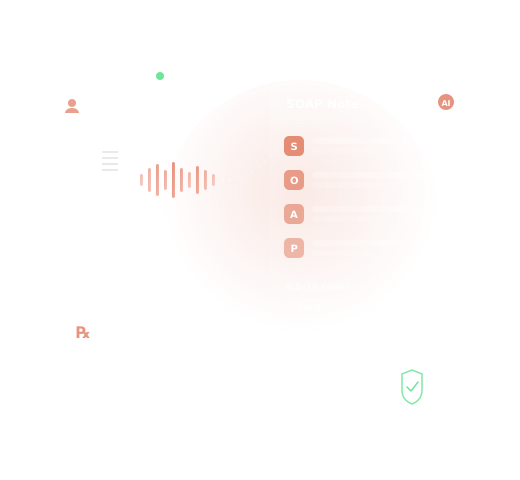
- Automatic SOAP note generation: Converts the interaction into a structured draft with subjective history, objective observations, assessment context, and plan elements.
- ICD-10/CPT suggestions: Provides coding support as a review aid, helping teams prepare documentation for downstream billing or reporting workflows where relevant.
- Human review and edits: Keeps the clinician in control before any note is finalized in the medical record.
- On-premise or private deployment options: Supports organizations that prefer tighter control over infrastructure as part of their governance and workflow decisions.
This combination makes AI medical scribe in India deployments practical for departments that need both speed and oversight.
How It Works
The workflow is designed around day-to-day OPD and rehabilitation documentation rather than abstract AI outputs. A typical pulmonary rehabilitation use flow looks like this:
- Capture the consultation conversation: During the visit, the system records the interaction between clinician and patient, including symptom review, exercise tolerance discussion, medication adherence, education, and follow-up planning. This creates the raw input for documentation.
- Transcribe and structure the encounter: The audio is converted into text with speaker separation, helping organize patient-reported symptoms, clinician observations, and counselling points. This is useful when pulmonary rehabilitation visits include both assessment and education in one sitting.
- Draft a SOAP note automatically: The platform turns the structured transcript into a draft SOAP note. Subjective sections may include breathlessness, cough, fatigue, or activity limitation; objective sections may reflect observed findings or session details; assessment and plan sections summarize rehabilitation goals, exercise advice, and follow-up instructions.
- Add coding support for review: The system can surface ICD-10 and CPT suggestions based on the documented encounter. These are suggestions only and remain subject to clinician or administrative review before use.
- Clinician review, edit, and sign-off: The doctor or authorized team member reviews the draft, corrects nuances, adds missing context, and approves the final note. Human review is an operational checkpoint before record finalization.
- Choose deployment posture based on workflow needs: Organizations can evaluate on-premise or private deployment approaches depending on internal IT preferences, data handling expectations, and integration planning. This is a workflow and governance choice, not a compliance guarantee.
This stepwise approach helps an AI medical scribe in India remain useful in real care delivery: capture, structure, draft, review, and finalize.
Local context
In India, pulmonary rehabilitation services may operate across multispecialty hospitals, chest clinics, recovery programs, and outpatient therapy settings. Documentation needs can vary by team size, specialty mix, and digital maturity. Some organizations want faster note completion for busy OPDs, while others focus on standardizing records across clinicians and therapists. An AI medical scribe in India can support both goals by reducing repetitive documentation effort while preserving clinician oversight.
Local care delivery also often involves multilingual communication, family participation in counselling, and follow-up instructions that need to be clearly documented. In this context, practical features such as multilingual support, structured note drafting, and private deployment options matter more than generic automation claims. For India healthcare environments, the product is best evaluated on workflow fit, review controls, and ease of adoption within existing documentation habits.
Use cases
- Initial pulmonary rehabilitation assessment: Draft notes for symptom history, functional limitations, prior treatment context, and rehabilitation goals.
- Follow-up OPD reviews: Capture interval changes in breathlessness, exercise adherence, inhaler use, and patient-reported progress.
- Education-heavy visits: Document breathing techniques, pacing advice, airway clearance instruction, and home program counselling.
- Post-discharge recovery pathways: Support structured notes for patients returning after hospitalization who need rehabilitation planning and monitoring.
- Multidisciplinary workflows: Help standardize documentation where physicians, therapists, and support staff contribute to the care journey.
FAQ
Can this be used only by pulmonologists?
No. It can support documentation workflows for pulmonologists, rehabilitation physicians, therapists, and outpatient teams involved in pulmonary rehabilitation, depending on internal processes.
Does the tool finalize notes automatically?
No. The intended workflow includes clinician review, edits, and final sign-off before the record is completed.
How does it help with coding?
It can provide ICD-10 and CPT suggestions based on the documented encounter. These suggestions are review aids and should be checked by the appropriate clinician or administrative team.
Is it suitable for multilingual consultations in India?
Yes, multilingual support is part of the product description, which can be useful when consultations shift between English and regional languages.
Can hospitals choose a private deployment approach?
Yes. On-premise or private deployment options can be considered based on organizational workflow, IT, and governance preferences.
CTA
If your pulmonary rehabilitation team wants faster, more consistent documentation without removing clinician control, explore how MedScribe can fit your OPD workflow. Review the core product at /medscribe, compare capabilities at /medscribe/features, and assess whether an AI medical scribe in India is the right operational fit for your clinic or hospital.