Introduction
Pulmonology consultations often involve detailed history taking, symptom progression, prior imaging, inhaler use, smoking exposure, sleep and breathing complaints, and follow-up planning. That makes documentation important but time-consuming in busy OPD and hospital settings. An AI medical scribe in India can help pulmonologists and care teams turn consultation conversations into structured clinical notes that are easier to review, edit, and finalize. Instead of replacing clinical judgment, the system is designed to support the doctor during routine documentation work so more attention can stay on the patient interaction.
MedScribe is an AI medical documentation copilot built for practical clinical workflows. It converts consultation audio into structured drafts, supports SOAP note creation, identifies speakers, and suggests coding options such as ICD-10 and CPT for clinician review. For pulmonology teams in India, this is useful in recurring scenarios such as chronic cough evaluation, asthma follow-up, COPD review, sleep-related breathing complaints, interstitial lung disease monitoring, and post-discharge respiratory follow-up. The goal is simple: reduce manual note burden while keeping the clinician in control of edits and sign-off.
Department workflow
Pulmonology documentation usually spans multiple steps before a note is complete. A patient may arrive with prior prescriptions, spirometry reports, CT findings, oxygen saturation trends, or referral notes from internal medicine or critical care. During the consultation, the doctor captures symptom duration, triggers, occupational exposure, smoking history, allergy background, medication adherence, inhaler technique concerns, and examination findings. In many clinics, this information is then manually typed into the EMR or written first and entered later.
An AI medical scribe in India fits into this workflow by helping capture the conversation in real time or near real time, organizing it into clinically useful sections, and preparing a draft that the pulmonologist can quickly review. This is especially relevant in high-volume OPD settings where follow-up visits are short but still require complete documentation. It can also support inpatient respiratory reviews where concise progress notes matter for continuity across shifts and departments.
For pulmonology, the documentation burden is not only about note length. It is also about consistency. Teams need a reliable way to document symptoms, respiratory history, examination details, treatment changes, and follow-up advice without repeatedly starting from a blank screen. That is where structured drafting and coding support become operationally useful.
Features mapped to workflow
MedScribe is designed around the actual sequence of clinical documentation tasks rather than generic transcription alone. Automatic SOAP note generation helps convert the consultation into a familiar format for assessment and plan review. Speaker diarization helps separate clinician and patient voices, which is useful when history is detailed or when a caregiver is also speaking. Multilingual support can help in settings where English mixes with Hindi or regional language speech during the visit. Coding suggestions for ICD-10 and CPT are presented as support for review, not as final coding decisions.
For pulmonology teams, these capabilities map well to common workflows:
- Initial respiratory evaluation: capture symptom history, exposure details, prior treatment, and examination into a structured draft.
- Asthma and COPD follow-up: summarize interval symptoms, adherence, inhaler use, exacerbation history, and medication adjustments.
- Sleep and breathing complaints: organize history, associated symptoms, and next-step recommendations into a reviewable note.
- Inpatient respiratory review: support faster progress note drafting while preserving clinician review before finalization.
- Multi-location practices: choose deployment approaches such as private or on-premise setups based on workflow and governance needs.
This makes AI medical scribe India healthcare relevant not just for solo specialists but also for group practices, hospitals, and respiratory care teams that want more consistent documentation processes.
How It Works
The product workflow is built around end-to-end clinical documentation support for everyday consultations.
- Capture the consultation conversation: During the visit, the system records the doctor-patient interaction through the configured workflow. This can be used in OPD, follow-up visits, or review settings where the goal is to reduce manual note-taking while preserving the natural consultation flow.
- Transcribe and structure the discussion: The audio is converted into text with speaker diarization to distinguish who said what. The transcript is then organized into clinically relevant sections so the pulmonologist does not need to sort through raw conversation alone.
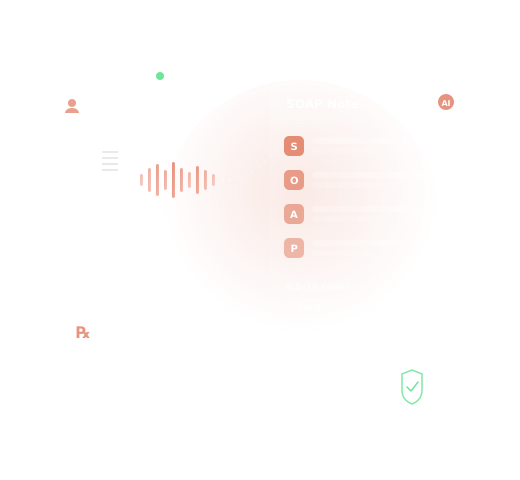
- Draft a SOAP note automatically: Based on the structured transcript, MedScribe prepares a SOAP-style draft that can include history, symptoms, observations, assessment cues, and plan elements. This gives the clinician a usable starting point instead of a blank documentation screen.
- Add coding support for review: The system can surface ICD-10 and CPT suggestions linked to the documented encounter. These are intended to support workflow efficiency and clinician review, not replace coding judgment or final approval.
- Review, edit, and sign off: The clinician checks the draft, makes corrections, adds missing clinical nuance, and confirms the final note before it becomes part of the record. Human review is the operational checkpoint that keeps the doctor in control.
- Choose deployment posture based on workflow needs: Clinics and hospitals can evaluate private or on-premise deployment options where needed. This should be treated as a governance and operational decision that supports workflows aligned with internal data handling preferences.
Local context
In India, pulmonology practices often manage a mix of acute respiratory complaints, chronic disease follow-ups, seasonal surges, and referrals from general medicine, ENT, sleep medicine, and critical care. Documentation needs can vary across standalone clinics, multispecialty hospitals, and enterprise groups. An AI medical scribe in India is most useful when it adapts to these practical realities: variable consultation lengths, multilingual interactions, and the need for quick but complete notes.
For many teams, the value is not only speed. It is also standardization across doctors, locations, and visit types. A practical AI medical scribe in India should help clinicians document consistently while still allowing edits for specialty nuance, such as respiratory examination details, inhaler counseling, or interpretation context around prior reports. This is why the product is best viewed as a documentation copilot for Indian healthcare workflows rather than a generic voice tool.
Use cases
- Busy OPD clinics: reduce after-hours documentation by preparing review-ready drafts during or soon after consultations.
- Asthma and COPD management: document symptom control, triggers, adherence, and treatment changes in a repeatable format.
- Hospital pulmonology teams: support progress note drafting for respiratory reviews while keeping consultant sign-off central.
- Multilingual patient interactions: handle mixed-language consultations more effectively than manual note reconstruction alone.
- Private and enterprise setups: evaluate deployment options that fit internal IT and governance preferences.
FAQ
Can this be used for pulmonology OPD visits?
Yes. It is designed for day-to-day consultation workflows where doctors need faster documentation for new and follow-up respiratory visits.
Does it replace clinician review?
No. The draft note and coding suggestions are meant to support the workflow. The clinician reviews, edits, and signs off before finalization.
Can it help with SOAP notes?
Yes. Automatic SOAP note drafting is a core capability, helping convert conversation into a structured clinical format.
Is it suitable for India healthcare settings?
It is designed for practical use in Indian clinical environments, including multilingual consultations and varied OPD workflows.
Are deployment options flexible?
Yes. Teams can explore private or on-premise deployment approaches based on workflow, infrastructure, and governance needs.
CTA
If your pulmonology team wants to reduce manual documentation effort without losing control over note quality, explore how an AI medical scribe in India can fit into your daily workflow. Review the core product at /medscribe, compare capabilities at /medscribe/features, and assess whether the workflow matches your clinic or hospital documentation needs.