Introduction
For hospitals and clinics focused on quality and patient safety, documentation quality is not just an administrative concern. It affects continuity of care, handoffs, coding accuracy, audit readiness, and the ability to review incidents with confidence. An AI medical scribe in India can support these goals by helping clinicians convert consultation conversations into structured clinical notes without adding more manual work to already busy OPD workflows.
MedScribe is designed as an AI documentation copilot for doctors, clinics, and hospital teams that want faster note creation with clinician oversight. Instead of replacing clinical judgment, it supports the routine steps that often consume time: capturing the encounter, structuring the conversation, drafting SOAP notes, and suggesting coding options for review. For Quality Patient Safety teams, this means more consistent records, clearer documentation trails, and workflows that are easier to standardize across departments.
In the Indian healthcare context, where multilingual consultations, variable documentation habits, and high patient volumes are common, an AI medical scribe in India needs to be practical. It should fit into real OPD operations, support human review before finalization, and offer deployment choices that align with internal governance preferences.
Department workflow
Quality Patient Safety teams often work across clinical, operational, and administrative touchpoints. Their interest in documentation tools usually centers on reducing avoidable variation in records while making it easier for clinicians to complete notes on time. In a typical outpatient or specialty workflow, the process begins with patient consultation, moves into note creation, then into coding, review, and record completion. Delays or inconsistencies at any of these stages can affect downstream care coordination.
An AI medical documentation copilot can support this workflow by creating a structured first draft from the consultation itself. Instead of relying only on post-visit recall, the system helps organize subjective complaints, objective findings, assessment, and plan into a usable format. Speaker diarization can help distinguish doctor and patient speech, while multilingual support can be useful in settings where consultations shift between English and Indian languages. For quality-focused teams, the value is not only speed but also better standardization of note structure and a clearer review path before records are finalized.
For hospitals evaluating an AI medical scribe in India, the key question is often operational: can it reduce documentation friction while preserving clinician control? In quality and safety programs, that balance matters because records must remain clinically meaningful, reviewable, and suitable for internal audits and case discussions.
Features mapped to workflow
Conversation capture: The product supports the first step of the encounter by turning spoken consultation content into text that can be processed further. This is useful in busy OPD settings where manual note-taking can interrupt patient interaction.
Speaker diarization: By separating clinician and patient speech, the draft can be easier to interpret and review. This helps maintain context when building a structured note from a natural conversation.
Automatic SOAP note generation: The system drafts notes in a familiar clinical format, helping teams move toward more consistent documentation patterns across providers and locations.
ICD-10 and CPT suggestions: Coding support can assist clinicians and administrative teams by surfacing likely options for review. This is especially helpful when the goal is to reduce missed documentation details before coding is finalized.
Multilingual support: In India, consultations may include mixed-language interactions. Multilingual capability can help make the documentation process more usable in everyday practice.
On-premise deployment options: Some organizations prefer private or on-premise setups as part of their internal IT and governance approach. This supports workflows aligned with institutional preferences for data handling and system access.
How It Works
The workflow for this product is designed around real consultation documentation, with clear checkpoints for clinician review and final sign-off.
- Capture the consultation conversation: During or immediately after the visit, the consultation audio is captured through the configured workflow. The system is designed to process doctor-patient conversations from routine OPD encounters and specialty visits.
- Transcribe and structure the interaction: The audio is converted into text, with speaker diarization helping separate patient and clinician contributions. This creates a more usable base for downstream documentation rather than a raw transcript alone.
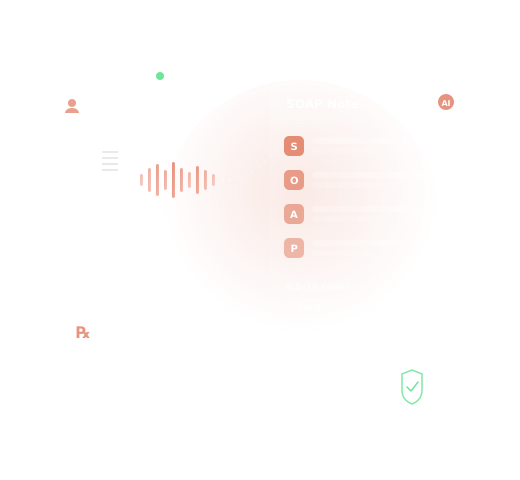
- Draft a SOAP note automatically: The system organizes the encounter into subjective, objective, assessment, and plan sections. This gives the clinician a structured first draft that can be edited instead of writing from scratch.
- Surface coding suggestions for review: Based on the documented encounter, the product can suggest ICD-10 and CPT options to support coding workflows. These suggestions are intended for clinician or authorized staff review, not automatic finalization.
- Clinician reviews, edits, and signs off: The doctor checks the draft, corrects details, adds missing context, and confirms the final note before it becomes part of the record. This human review checkpoint is essential for documentation quality and patient safety.
- Choose deployment posture based on governance needs: Organizations can evaluate cloud, private, or on-premise approaches as workflow and governance decisions. This helps teams adopt an AI medical scribe in India in a way that fits internal operational requirements.
Local context
Healthcare organizations in India often manage high consultation volumes, mixed digital maturity, and multilingual patient interactions. That makes documentation improvement projects successful only when they are practical for frontline clinicians. An AI medical scribe in India should therefore support daily OPD realities: short consultation windows, variable note styles, and the need to complete records without extending clinician work after hours.
For Quality Patient Safety stakeholders, local relevance also means focusing on consistency. Standardized note drafting can make internal reviews easier, support clearer communication between teams, and reduce dependence on memory-based documentation. In multi-site groups, a common documentation approach can also help align workflows across clinics and hospitals while still allowing clinician edits and specialty-specific nuance.
The secondary consideration is deployment flexibility. Some Indian providers may prefer private infrastructure or on-premise options as part of their internal technology strategy. Rather than treating this as a marketing claim, it is better viewed as a practical implementation choice for organizations evaluating an AI medical scribe India healthcare workflow.
Use cases
OPD documentation support: Doctors can generate a structured first draft after each consultation, reducing time spent on repetitive note writing.
Quality review readiness: More consistent note formats can make internal chart reviews and documentation audits easier to conduct.
Patient safety handoffs: Clearer records can support communication when patients move between providers, departments, or follow-up visits.
Coding workflow support: Suggested ICD-10 and CPT options can help teams review documentation completeness before coding is finalized.
Multilingual clinical environments: Clinics serving diverse patient populations can benefit from workflows that better reflect real consultation language patterns.
FAQ
Can this replace clinician judgment?
No. The product is intended to support documentation workflows by creating drafts and suggestions. Clinicians still review, edit, and sign off before finalization.
Is it suitable for busy OPD settings?
Yes, the workflow is designed to be practical for routine consultations where clinicians need faster documentation without losing control over the final note.
Does it support coding workflows?
It can provide ICD-10 and CPT suggestions based on the documented encounter, which can then be reviewed by the clinician or authorized team members.
Can hospitals choose how it is deployed?
Yes, organizations can evaluate deployment options such as on-premise or private environments based on internal workflow and governance needs.
CTA
If your hospital or clinic is evaluating documentation improvement for quality and patient safety, MedScribe offers a practical starting point. Explore how an AI medical scribe in India can support consultation capture, SOAP drafting, coding review, and clinician sign-off without disrupting daily workflows. Review the product pathways for MedScribe, compare capabilities on features, and assess fit for your operational model.