Introduction
Renal replacement therapy teams manage complex, repetitive, and time-sensitive documentation across consultations, dialysis planning, follow-up reviews, and care coordination. An AI medical scribe in India can help reduce manual note-taking by turning clinician-patient conversations into structured draft documentation that is ready for review. For nephrology and renal replacement therapy settings, this matters because the clinical story often includes symptoms, fluid balance concerns, access issues, medication changes, dialysis history, and ongoing monitoring decisions that need to be captured clearly.
MedScribe is designed as an AI documentation copilot for doctors, clinics, and hospitals that want faster note creation without removing clinician oversight. It supports automatic SOAP note drafting, coding suggestions, speaker diarization, multilingual conversations, and deployment choices such as private or on-premise setups. For teams evaluating an AI medical scribe in India, the practical value is straightforward: less time spent typing, more consistent draft notes, and a workflow that still keeps the clinician in control of edits and final sign-off.
This page focuses on how the product fits renal replacement therapy workflows in India, while keeping the core product value reusable across OPD and specialty documentation environments.
Department workflow
Renal replacement therapy documentation usually spans more than a single encounter. A patient may arrive for nephrology review, dialysis planning, vascular access discussion, symptom assessment, medication reconciliation, and follow-up instructions. In many settings, clinicians and staff must document history, current complaints, dialysis-related observations, assessment, and next steps while also coordinating with nursing teams, technicians, and administrative staff.
Common workflow pressure points include capturing long conversations accurately, separating doctor and patient speech, summarising repeated follow-up visits, and converting spoken details into a usable note format. In busy hospitals and clinics, these tasks can slow down OPD flow and increase after-hours documentation. An AI medical scribe India healthcare workflow is most useful when it supports the real sequence of care: conversation capture, structured transcription, note drafting, coding support, clinician review, and final record completion.
For renal replacement therapy teams, draft documentation may need to reflect dialysis tolerance, access-related concerns, fluid restriction counselling, medication adjustments, lab discussion, and care plan updates. The goal is not to replace clinical judgment, but to make routine documentation easier to complete and easier to review.
Features mapped to workflow
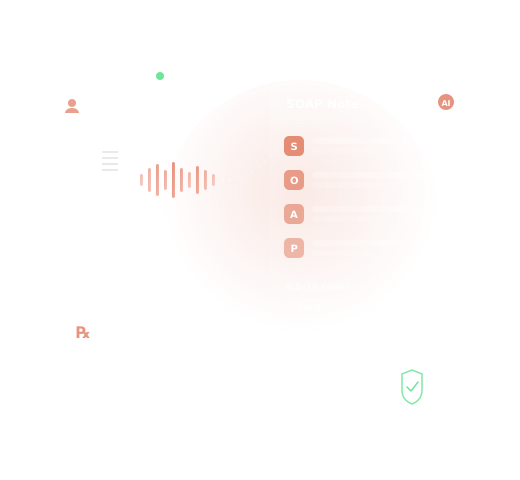
Automatic SOAP note generation: Converts consultation dialogue into a structured draft note that can be reviewed and edited by the clinician. This is useful for nephrology OPD visits, dialysis follow-ups, and counselling-heavy encounters.
Speaker diarization: Helps distinguish between clinician and patient speech, which supports cleaner summaries when multiple people are involved in the conversation.
ICD-10 and CPT suggestions: Provides coding support based on the documented encounter, helping teams prepare more complete records for downstream workflows. Suggestions should always be reviewed by the clinician or billing team.
Multilingual support: Useful in Indian care settings where consultations may shift between English and regional languages. This can help preserve context from real conversations instead of forcing clinicians into rigid documentation patterns.
On-premise or private deployment options: Supports organisations that prefer tighter control over infrastructure decisions. These choices can be aligned with internal governance, IT, and data handling preferences.
Practical fit for OPD operations: The product is designed to complement daily documentation workflows rather than add another complex system for clinicians to manage.
How It Works
The product workflow is built around the real path from consultation to finalized note. For renal replacement therapy teams, the sequence below keeps documentation support practical and reviewable.
- Capture the consultation conversation: During a nephrology or dialysis-related encounter, the consultation audio is captured through the configured workflow. This may include symptom review, dialysis history, medication discussion, and care planning. Speaker diarization helps separate clinician and patient contributions for cleaner downstream processing.
- Transcribe and structure the encounter: The system converts the conversation into text and organises it into clinically relevant sections. Multilingual support helps when the interaction includes mixed-language dialogue common in Indian practice settings.
- Draft a SOAP note automatically: Based on the structured transcript, MedScribe generates a draft SOAP note. For renal replacement therapy visits, this can help organise subjective complaints, objective findings discussed during the visit, assessment themes, and the treatment or follow-up plan.
- Add coding support: The platform can surface ICD-10 and CPT suggestions linked to the documented encounter. These are intended as workflow aids, not final coding decisions, and should be checked by the responsible clinician or operations team.
- Review, edit, and sign off: The clinician reviews the draft, corrects details, adds missing context, and approves the final version before it becomes part of the record. This human checkpoint is essential for accuracy and clinical accountability.
- Choose deployment posture for operations: Hospitals and clinics can evaluate private or on-premise deployment options based on IT preferences, workflow design, and governance needs. This supports workflows aligned with internal data handling practices rather than a one-size-fits-all setup.
Local context
In India, renal care teams often work across high patient volumes, mixed digital maturity, and multilingual communication patterns. That makes documentation tools more useful when they are flexible, practical, and easy to fit into existing routines. An AI medical scribe in India should support the reality of OPD and specialty care rather than assume a uniform workflow across every hospital or clinic.
For nephrology and dialysis-linked services, the local need is often less about novelty and more about consistency: capturing the same important details every time, reducing repetitive typing, and helping clinicians complete notes faster after each encounter. An AI medical scribe in India can also be relevant for organisations that want deployment options shaped by internal IT and governance preferences, especially when evaluating private infrastructure models.
Use cases
Nephrology OPD consultations: Draft notes from detailed follow-up conversations involving symptoms, medication changes, and treatment planning.
Dialysis counselling visits: Summarise patient education, adherence discussions, and next-step instructions in a structured format.
Access-related reviews: Capture discussions around vascular access concerns, complications, and referral planning.
Longitudinal follow-ups: Support repeat visits where clinicians need a faster way to document evolving complaints and management decisions.
Multilingual encounters: Help teams document consultations where patients and clinicians switch between English and local languages.
Hospital specialty workflows: Provide a documentation layer that can complement broader digital systems while keeping clinician review central.
FAQ
Can this replace clinician documentation entirely?
No. The product creates draft notes and coding suggestions, but clinicians should review, edit, and approve the final record.
Is it useful for dialysis and renal follow-up visits?
Yes. It is designed to support conversation-heavy encounters where structured summaries and SOAP drafts can save time.
Does it support multilingual consultations?
Yes. Multilingual support is intended to help with real-world consultations in Indian healthcare settings.
Can hospitals choose private deployment options?
Yes. Private or on-premise deployment options can be evaluated based on workflow, IT, and governance requirements.
CTA
If your nephrology clinic or hospital team is exploring an AI medical scribe in India for renal replacement therapy workflows, MedScribe offers a practical path from conversation capture to clinician-reviewed documentation. Explore the product overview at /medscribe, review capabilities at /medscribe/features, and assess how the workflow can fit your OPD or specialty documentation process.