Introduction
An AI medical scribe in India can help reproductive medicine teams reduce documentation load during busy OPD sessions, follow-up visits, counselling discussions, and treatment planning conversations. In fertility and reproductive care, clinicians often balance detailed history taking, sensitive patient communication, ultrasound findings, medication planning, and repeat visit documentation. That makes note creation time-consuming even when the clinical interaction itself is efficient. An AI medical documentation copilot is designed to convert consultation conversations into structured draft notes that clinicians can review, edit, and finalize.
For clinics and hospitals, the practical value is not just faster typing. It is better workflow continuity across first consultations, infertility workups, ovulation induction reviews, IVF counselling, procedure discussions, and longitudinal follow-up. MedScribe supports this by generating draft SOAP notes, identifying speakers, supporting multilingual conversations, and suggesting coding support for clinician review. For teams evaluating an AI medical scribe in India, the key question is whether the tool fits real reproductive medicine workflows without adding friction. The answer depends on how well it supports daily documentation habits, review checkpoints, and deployment preferences.
Department workflow
Reproductive medicine documentation usually spans multiple touchpoints rather than a single isolated visit. A typical workflow may begin with registration and prior record review, followed by detailed history taking for infertility duration, menstrual history, prior pregnancies, prior treatments, hormonal workup, imaging, semen analysis, and comorbidities. The consultation may then move into counselling on investigations, treatment options, timelines, medication plans, and next steps. Follow-up visits often include scan findings, response to stimulation, lab updates, cycle changes, and patient questions.
Because these encounters are information-dense, clinicians often document after the visit or split attention during the consultation. An AI medical scribe in India is useful here because it supports conversation-led note capture while preserving clinician review before finalization. In reproductive medicine, this can be especially helpful for repeat visits where the note needs to be concise but clinically usable, and for counselling-heavy appointments where the discussion matters as much as the final plan.
Hospitals and fertility centres may also need flexibility across solo consultants, group practices, and multi-location operations. Some teams prefer cloud-connected workflows, while others evaluate private or on-premise deployment based on internal governance preferences. The product value remains the same: reduce manual note burden, improve draft consistency, and support workflows aligned with existing record-keeping practices.
Features mapped to workflow
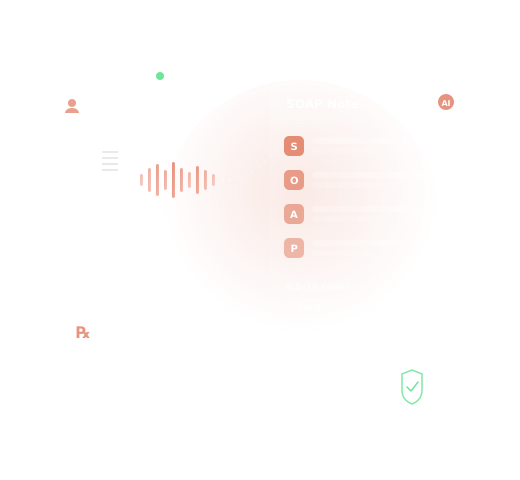
Automatic SOAP note drafting: Consultation conversations are converted into structured draft notes, helping clinicians move from raw dialogue to usable documentation faster. This is relevant for first infertility consults, treatment counselling, and follow-up reviews.
Speaker diarization: The system distinguishes between speakers so the draft can better separate clinician guidance from patient-reported history. In reproductive medicine, where both partners may participate in counselling, this can improve note clarity.
Multilingual support: Many clinics in India switch between English and regional languages during consultations. Multilingual support helps capture mixed-language interactions more naturally for later review.
ICD-10 and CPT suggestions: Coding support is presented as suggestions for clinician validation, helping teams prepare documentation that is easier to review for billing or internal coding workflows.
Human review and sign-off: Drafts are not the final record by default. Clinicians review, edit, and approve the note before it is saved or used downstream. This is important for nuanced reproductive medicine plans where wording and context matter.
Deployment options: On-premise or private deployment choices can support organizations that want tighter control over infrastructure decisions. These are workflow and governance choices, not blanket compliance claims.
How It Works
The workflow of this AI medical scribe in India is designed around real consultation flow rather than generic dictation.
- Capture the consultation conversation: During an OPD visit, counselling session, or follow-up review, the clinician starts conversation capture. The system records the interaction and prepares it for transcription, including multilingual exchanges where relevant.
- Transcribe and structure the dialogue: The audio is converted into text and organized with speaker diarization, helping separate patient history, partner inputs where applicable, and clinician recommendations. This creates a cleaner base for documentation.
- Draft a SOAP note automatically: The structured transcript is transformed into a draft SOAP note. In reproductive medicine, this may include subjective history, objective findings discussed during the visit, assessment context, and the treatment or investigation plan.
- Generate coding support: The system surfaces ICD-10 and CPT suggestions based on the documented encounter. These are prompts for review, not automatic final coding decisions.
- Clinician reviews and edits: Before any record is finalized, the doctor or authorized team member reviews the draft, corrects details, refines wording, and confirms that the note reflects the actual encounter accurately.
- Finalize based on deployment workflow: After sign-off, the note can move into the clinic's chosen documentation process. Organizations can evaluate private or on-premise deployment models depending on operational and governance needs.
Local context
In India, reproductive medicine clinics often manage high consultation volumes, repeat visits, mixed-language communication, and counselling-heavy interactions. This makes documentation support especially relevant in urban fertility centres as well as growing specialty practices in tier 2 and tier 3 markets. An AI medical scribe in India should therefore be practical, not theoretical: it should fit OPD timing, support multilingual use, and allow clinicians to stay focused on patient communication.
For administrators, the local decision is often about workflow fit. Can the tool support doctors who move quickly between first consults, scan reviews, treatment planning, and follow-ups? Can it reduce after-hours note completion? Can it support infrastructure preferences such as private or on-premise deployment? These are the questions that matter more than broad marketing claims. The right setup is one that supports documentation quality while respecting how Indian clinics actually operate day to day.
Use cases
New infertility consultation: Capture detailed history and counselling discussion, then generate a draft SOAP note for clinician review.
IVF or IUI counselling: Document treatment options, timelines, medication instructions, and patient questions without relying only on manual typing.
Follicular monitoring and follow-up visits: Create concise drafts for repeat encounters where findings and plan updates need to be recorded quickly.
Partner-inclusive consultations: Use speaker diarization to improve clarity when multiple people contribute to the discussion.
Multi-language OPD workflows: Support consultations that shift between English and regional languages during history taking and counselling.
Coding-assisted documentation: Provide ICD-10 and CPT suggestions to support downstream review by the clinical or administrative team.
FAQ
Can this be used during sensitive reproductive counselling visits?
Yes. The workflow is designed to support conversation-based documentation, while keeping clinician review and final sign-off central before the note becomes part of the record.
Does it replace the doctor's judgment?
No. It creates draft notes and coding suggestions, but the clinician reviews, edits, and approves the final documentation.
Will it work for multilingual consultations common in India?
It is designed with multilingual support so clinics can handle consultations that move between English and local languages more naturally.
Can hospitals choose a private or on-premise setup?
Yes. Deployment posture can be evaluated based on workflow, IT, and governance preferences, including private or on-premise options where suitable.
CTA
If your reproductive medicine team is evaluating an AI medical scribe in India, focus on practical fit: consultation capture, SOAP drafting, coding support, multilingual use, and reliable clinician review before finalization. Explore the main product, features, integrations, and pricing paths to assess how the workflow can support your OPD and counselling documentation needs.