Introduction
An AI medical scribe in India can help hospitals, clinics, and specialty practices reduce the documentation burden that often slows billing and collections. In Revenue Cycle Management, the quality of clinical documentation affects coding readiness, claim submission speed, and the effort needed for follow-up. When consultation notes are delayed, incomplete, or inconsistent, downstream teams spend more time clarifying records before they can move work forward.
MedScribe is an AI medical documentation copilot designed to convert consultation conversations into usable clinical notes and coding suggestions. For Indian healthcare organisations managing busy OPD workflows, this means doctors can complete records faster while RCM teams receive more structured inputs for coding and billing review. The goal is practical: support cleaner documentation, reduce manual rework, and help teams move from encounter to claim with fewer avoidable gaps.
This page focuses on how an AI medical scribe in India fits into Revenue Cycle Management workflows, especially where multilingual consultations, variable documentation styles, and high patient volumes are common. Rather than replacing clinician judgment, the system supports workflows aligned with clinician review and final sign-off before records are completed.
Department workflow
Revenue Cycle Management depends on timely, accurate clinical documentation. In a typical outpatient workflow, the patient visit begins with registration and consultation, but the financial workflow depends on what happens next: note completion, diagnosis capture, procedure documentation, coding review, and claim preparation. If the note is incomplete or delayed, coders and billing staff may need to chase clinicians for clarification, which can slow submission and increase administrative effort.
For many organisations, the challenge is not only note creation but note standardisation. Different doctors may document in different formats, use shorthand, or complete notes after clinic hours. This creates friction for coding teams that need structured information to support ICD-10 and CPT mapping. An AI medical scribe in India is useful here because it helps convert the consultation into a more consistent draft, making the handoff from clinician to RCM more efficient.
In practical terms, the workflow value appears in three places: first, faster draft creation after the encounter; second, clearer capture of history, assessment, and plan; and third, coding support that gives billing teams a better starting point. For hospitals and clinics in India, this can be especially relevant in high-volume OPD settings where documentation delays often affect the revenue cycle more than the consultation itself.
Features mapped to workflow
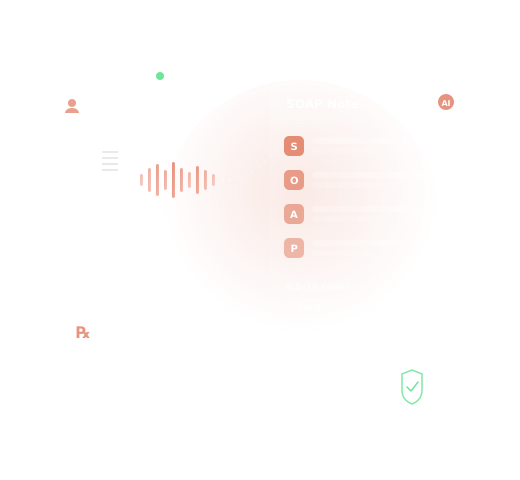
Automatic SOAP note generation: Consultation conversations are converted into structured SOAP drafts, helping clinicians move from raw discussion to usable documentation quickly. This supports RCM by improving note completeness before coding review begins.
ICD-10 and CPT suggestions: The platform can surface coding suggestions based on the documented encounter. These suggestions are not a substitute for professional review, but they can help coding teams start from a more organised draft.
Speaker diarization: By separating clinician and patient speech, the system improves transcript clarity and helps preserve context for note drafting. This is useful when multiple details are discussed rapidly during OPD consultations.
Multilingual support: Indian healthcare settings often involve mixed-language conversations. Multilingual support helps capture consultations more naturally, reducing the need to reconstruct details later from memory.
On-premise or private deployment options: Deployment posture can be chosen based on workflow, IT governance, and operational preferences. This supports organisations that want tighter control over where documentation processing occurs.
Clinician review before finalisation: Drafts and coding suggestions remain part of a supervised workflow. Doctors and authorised staff can edit, validate, and sign off before records are finalised for downstream billing use.
How It Works
The product workflow is designed around the real sequence of documentation and billing preparation, not just transcription.
- Capture the consultation conversation: During or immediately after the patient encounter, the consultation audio is captured through the configured workflow. The system is built to support practical OPD use, including multilingual conversations and speaker diarization so clinician and patient dialogue are separated clearly.
- Transcribe and structure the encounter: The captured conversation is converted into a transcript and organised into clinically relevant sections. Instead of leaving teams with raw text, the platform prepares structured inputs that are easier to turn into documentation and coding-ready records.
- Draft a SOAP note automatically: Based on the consultation content, MedScribe generates a SOAP note draft. This gives the clinician a usable starting point rather than a blank screen, helping reduce after-hours documentation and improving note turnaround for RCM teams.
- Surface coding suggestions for review: The system can provide ICD-10 and CPT suggestions linked to the documented encounter. These suggestions support coding workflows, but human review remains an operational checkpoint before anything is used for billing.
- Review, edit, and sign off: The clinician or authorised reviewer checks the draft note, makes edits where needed, and confirms the final version. This human review step is essential because the record should be validated before it moves into the billing and collections workflow.
- Route into operational systems: Once approved, the finalised documentation can support downstream workflows such as coding review, billing preparation, and record management. Organisations can choose on-premise or private deployment approaches as governance and workflow decisions, depending on their operational needs.
Local context
In India, healthcare organisations often balance high patient throughput with limited time for documentation. OPD clinics may handle rapid consultations, mixed-language conversations, and varying documentation habits across departments. These realities make standardised note creation difficult, which in turn affects coding and billing readiness.
An AI medical scribe in India is most useful when it fits these day-to-day conditions. That means supporting multilingual interactions, helping clinicians complete notes faster, and giving RCM teams more structured records to work from. For multi-specialty hospitals, single-specialty centres, and growing clinic networks, the value is not only in transcription but in creating a more reliable bridge between the consultation room and the revenue cycle.
The India healthcare environment also requires practical deployment choices. Some organisations may prefer private or on-premise setups based on internal IT and governance preferences. An AI medical scribe India healthcare solution should therefore be evaluated not just on note quality, but also on how well it supports operational control, review workflows, and integration planning.
Use cases
Busy outpatient departments: Doctors can complete structured notes faster after consultations, helping coding teams receive documentation sooner.
Specialty clinics with repetitive documentation patterns: SOAP drafting can reduce repetitive manual note writing while preserving clinician review before finalisation.
Hospitals improving coding readiness: ICD-10 and CPT suggestions can help coders start from a more organised draft and reduce back-and-forth for basic clarification.
Multilingual consultation settings: Mixed-language patient interactions can be captured more effectively, supporting more complete records for billing review.
Organisations seeking controlled deployment: Private or on-premise deployment options can support workflows aligned with internal governance and infrastructure preferences.
FAQ
Can an AI medical scribe replace coder or clinician review?
No. It is best used to create structured drafts and coding suggestions that clinicians and authorised teams review before final use.
How does this help Revenue Cycle Management?
It can improve documentation turnaround, create more consistent notes, and give coding teams clearer inputs for billing preparation.
Is it useful for OPD workflows in India?
Yes, especially where consultation volumes are high and multilingual conversations make manual documentation slower.
What kind of notes can it generate?
It is designed to generate SOAP note drafts from consultation conversations and support coding review with ICD-10 and CPT suggestions.
CTA
If your organisation wants to reduce documentation delays and improve the handoff from consultation to coding, an AI medical scribe in India can be a practical next step. Explore how MedScribe supports OPD documentation, coding preparation, and RCM workflows with clinician review at the centre. For broader product details, teams can also review the main MedScribe product, features, integrations, and pricing pages as part of their evaluation.