Introduction
An AI medical scribe in India can help hospitals and clinics improve documentation quality while reducing the operational burden on clinicians. For risk management teams, the value is practical: clearer records, more consistent note structure, better visibility into documentation gaps, and a workflow that supports clinician review before anything is finalized. In busy OPD environments, handwritten or delayed notes can create avoidable ambiguity. A medical documentation copilot helps convert consultation conversations into structured drafts that are easier to review, edit, and store within existing processes.
This page focuses on how an AI medical scribe supports risk-aware documentation workflows in Indian healthcare settings. The goal is not to replace clinical judgment. Instead, it is to assist doctors and operations teams with faster note creation, coding support, and standardized outputs such as SOAP notes. For organizations evaluating an AI medical scribe in India, the key question is whether the tool fits daily practice, supports multilingual consultations, and gives clinicians control over final sign-off.
Department workflow
Risk management teams often look at documentation through a simple lens: is the record complete, understandable, timely, and reviewable? In outpatient and hospital workflows, documentation risk can arise when notes are delayed, inconsistent across doctors, or missing important context from the consultation. This becomes harder in high-volume departments where clinicians move quickly between patients and administrative work competes with care delivery.
An AI medical documentation copilot fits into this workflow by helping capture the consultation, organize the transcript, and draft a structured note for review. Instead of relying only on memory after the visit, clinicians can work from a draft that reflects the conversation flow and separates speakers. For risk management, this creates a more standardized starting point for documentation without removing the clinician from the decision loop. It also supports internal quality processes by making note review more systematic and easier to audit operationally.
For Indian clinics and hospitals, the workflow benefit is especially relevant in multilingual settings, where consultations may shift between English and regional languages. A practical AI medical scribe in India should support these realities while keeping the final record usable for the care team, billing workflow, and internal governance.
Features mapped to workflow
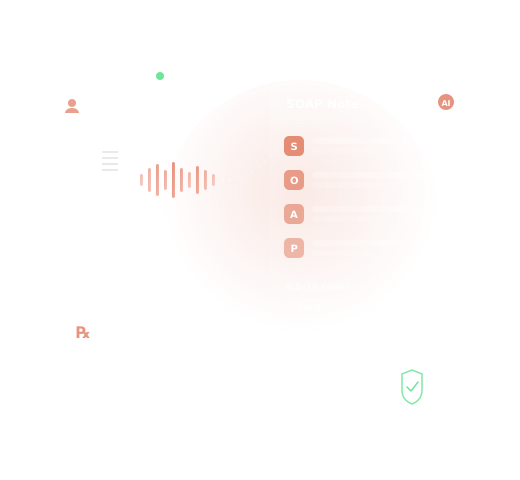
Automatic SOAP note generation: Consultation conversations can be converted into draft SOAP notes, giving clinicians a structured format that is easier to review and finalize. This helps reduce variation in note style across providers.
Speaker diarization: Separating doctor and patient speech improves transcript clarity and helps the draft reflect who said what. For risk-aware workflows, this is useful when teams want cleaner source material before note finalization.
ICD-10 and CPT suggestions: Coding support can help clinicians and administrative teams move faster from documentation to downstream workflows. Suggestions should still be reviewed by the clinician or authorized staff before use.
Multilingual support: In India, consultations often include mixed-language conversations. Multilingual capability helps the documentation process stay closer to real clinical interactions rather than forcing rigid language patterns.
On-premise deployment options: Some organizations prefer private or on-premise deployment based on internal governance, IT architecture, or data handling preferences. This is best treated as a workflow and infrastructure decision that supports workflows aligned with organizational policies.
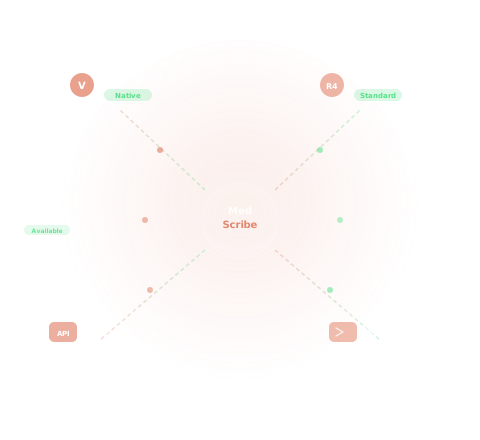
Related product pathways: Teams exploring broader capabilities can align this page with deeper product information available through MedScribe sections such as features, integrations, and pricing, while keeping this page focused on day-to-day documentation operations.
How It Works
The workflow of an AI medical scribe in India should be easy for clinicians to adopt during routine consultations. A practical implementation follows a clear sequence from conversation capture to clinician-approved record finalization.
- Capture the consultation conversation: During the patient visit, the system records or ingests the consultation audio based on the clinic or hospital workflow. This can be set up to suit OPD operations, specialty consultations, or internal documentation preferences.
- Transcribe and structure the interaction: The audio is converted into text, with speaker diarization used to distinguish clinician and patient speech. This creates a more organized transcript that can be reviewed as source material rather than a raw block of text.
- Draft a SOAP note automatically: The system converts the structured conversation into a draft SOAP note. This gives the doctor a usable starting point instead of creating notes from scratch after the consultation.
- Suggest coding support: Based on the documented encounter, the tool can surface ICD-10 and CPT suggestions to support downstream coding workflows. These are suggestions only and should be checked by the clinician or relevant team before acceptance.
- Review, edit, and sign off: The clinician reviews the draft, makes edits, confirms accuracy, and completes final sign-off before the record is stored or shared with connected systems. This human review checkpoint is essential for safe documentation workflows.
- Choose deployment posture: Depending on organizational needs, the solution may be deployed in a private or on-premise setup. This supports governance choices and operational control without changing the core documentation flow.
Local context
Healthcare organizations in India often manage high patient volumes, mixed digital maturity, and multilingual communication across departments. That makes documentation consistency a practical concern for both care delivery and risk management. An AI medical scribe in India should therefore be evaluated on usability in real OPD conditions, not just on technical features. Teams usually want to know whether doctors can review notes quickly, whether the output is structured enough for internal standards, and whether deployment choices fit existing IT environments.
For hospitals and clinics that are still balancing paper, EMR, and hybrid workflows, the right approach is often incremental. Start with documentation assistance in selected departments, define review checkpoints, and measure whether clinicians are able to finalize notes faster and more consistently. In this context, AI medical scribe India healthcare adoption is less about novelty and more about reducing friction in everyday documentation.
Use cases
OPD documentation support: Doctors can move from consultation to draft note faster, reducing after-hours documentation burden while keeping review control.
Risk-aware note standardization: Structured SOAP drafts help reduce variation in note format and make internal review easier for quality and risk teams.
Multilingual consultations: Clinics serving diverse patient populations can document encounters more effectively when the system supports mixed-language conversations.
Coding assistance: ICD-10 and CPT suggestions can support billing and administrative workflows when reviewed and confirmed by the appropriate user.
Private deployment preferences: Organizations with specific infrastructure requirements can evaluate private or on-premise deployment as part of governance planning.
FAQ
Can this replace clinician documentation responsibility?
No. The tool is designed to assist with drafting and structuring notes, but the clinician should review, edit, and approve the final record.
Is this useful for risk management teams?
Yes, because it can support more consistent documentation workflows, clearer draft records, and defined review checkpoints before finalization.
Does it support multilingual consultations common in India?
Yes, multilingual support is part of the product narrative, which is important for clinics and hospitals handling mixed-language patient interactions.
Can it work with different deployment preferences?
Yes. Private or on-premise deployment can be considered based on organizational workflow, IT, and governance needs.
CTA
If your organization is evaluating an AI medical scribe in India for risk management and documentation quality, start with the workflow: capture, structure, draft, review, and sign off. Assess how the solution fits your OPD volume, multilingual consultations, coding process, and governance preferences. Explore the core product, features, integrations, and pricing paths to build a practical rollout plan for clinics or hospitals that want clearer documentation without adding more manual work to the care team.