Introduction
Sleep medicine teams often manage detailed consultations that include symptom history, sleep patterns, comorbidities, medication review, prior studies, and follow-up planning. That makes documentation time-consuming in busy OPD settings. An AI medical scribe in India can help clinicians turn consultation conversations into structured draft notes that are easier to review, edit, and finalize. For sleep clinics and hospital departments, the goal is practical support: reduce repetitive typing, improve note consistency, and help doctors stay focused on the patient interaction.
This page explains how an AI documentation copilot can fit into sleep medicine workflows in India. The emphasis is on day-to-day usability for clinics and hospitals, not on exaggerated claims. MedScribe is designed to convert consultation conversations into usable clinical notes and coding suggestions, with clinician review remaining central before any record is finalized.
Department workflow
Sleep medicine documentation usually spans more than a simple chief complaint. A typical visit may include snoring history, daytime sleepiness, witnessed apneas, insomnia patterns, shift-work concerns, CPAP adherence, prior sleep study findings, obesity or ENT-related factors, and associated conditions such as hypertension, diabetes, anxiety, or depression. Follow-up visits may also require comparison against prior notes, treatment tolerance, and next-step planning.
In many Indian clinics and hospitals, this creates a familiar workflow challenge: the doctor must listen carefully, ask targeted questions, document findings, and maintain throughput across a busy schedule. An AI medical scribe in India supports this workflow by capturing the consultation, structuring the conversation, and preparing a draft SOAP note that the clinician can refine. This is especially useful when the consultation includes a mix of English and regional language phrases, family inputs, or repeated counseling points.
For sleep medicine, the value is not only speed. It is also consistency. Structured drafts can help ensure that history, assessment, and plan elements are not missed during a long clinic day. Coding suggestions can support downstream billing and record organization, while still requiring clinician judgment.
Features mapped to workflow
Conversation capture and transcription: The system listens to the consultation and converts speech into text, helping reduce manual note-taking during the visit.
Speaker diarization: It distinguishes between speakers so the doctor and patient portions of the conversation are easier to interpret in the draft record. This is useful in sleep medicine visits where caregivers may also contribute history.
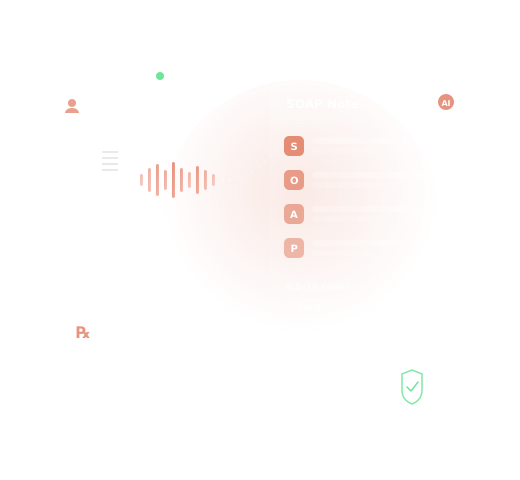
Automatic SOAP note generation: The transcript is structured into subjective, objective, assessment, and plan sections. For sleep medicine, this can help organize symptom duration, sleep habits, prior investigations, and treatment recommendations into a familiar clinical format.
ICD-10 and CPT suggestions: The platform can surface coding suggestions based on the documented encounter. These suggestions are intended to support clinician workflows, not replace coding review.
Multilingual support: In Indian healthcare settings, consultations may move between English, Hindi, and other local languages. Multilingual support helps preserve context when the conversation is not fully in one language.
On-premise or private deployment options: For organizations with specific governance preferences, deployment posture can be chosen as an operational decision. This supports workflows aligned with internal IT and data handling requirements.
How It Works
The workflow for an AI medical scribe in India should be clear, reviewable, and easy to adopt in routine OPD practice. A practical flow for sleep medicine looks like this:
- Capture the consultation: During the visit, the clinician starts the documentation session and the system captures the conversation. This may include symptom history, sleep schedule details, prior sleep study discussion, medication review, and treatment counseling.
- Transcribe and structure the dialogue: The audio is converted into text, with speaker diarization used to separate clinician and patient speech. The transcript is then organized into clinically relevant sections so the encounter is easier to review.
- Draft the SOAP note: Based on the structured transcript, the system prepares a draft SOAP note. In sleep medicine, this can include subjective complaints such as snoring or insomnia, objective references such as prior reports discussed in the visit, assessment themes, and a plan for testing, counseling, or follow-up.
- Surface coding support: The platform presents ICD-10 and CPT suggestions linked to the documented encounter. These are workflow aids for the clinician or billing team and should be checked before use.
- Review, edit, and sign off: The clinician reviews the draft, corrects details, adds missing findings, and confirms the final note. Human review is the operational checkpoint that matters before the record is finalized.
Deployment can also be aligned to organizational preferences. Some teams may prefer a private or on-premise setup based on internal governance, integration planning, or infrastructure choices. That decision should be treated as a workflow and IT consideration rather than a blanket compliance claim.
- Store or route into existing systems: After final sign-off, the approved note can be used within the clinic's documentation workflow and may be aligned with integration plans for broader record management.
Local context
In India, sleep medicine services are delivered across standalone clinics, multispecialty hospitals, pulmonology-led practices, ENT-linked programs, and neurology or psychiatry-associated centers. Documentation needs can vary by setup, but the operational pressure is similar: maintain quality notes without extending consultation time unnecessarily. An AI medical scribe in India is useful when teams want a practical documentation layer that supports throughput while preserving clinician control.
Local context also matters for language, staffing, and infrastructure. Some clinics need multilingual support because patients describe symptoms in mixed language conversations. Others may prioritize private deployment options because of internal IT preferences. In both cases, the product should adapt to the workflow rather than forcing the department to change how it practices.
Use cases
New patient sleep consultation: Capture a long first visit covering snoring, daytime fatigue, insomnia, sleep hygiene, and comorbidities, then generate a structured draft note for review.
Follow-up after sleep study: Summarize discussion of study findings, treatment options, CPAP counseling, and adherence barriers into a usable SOAP format.
Multidisciplinary sleep care: Support documentation when history includes inputs from family members, technicians, or referring specialists.
High-volume OPD sessions: Reduce repetitive typing and help standardize note structure across multiple consultations in a clinic day.
Documentation support for coding workflows: Provide ICD-10 and CPT suggestions that can be reviewed by the clinician or operations team before final use.
For organizations evaluating an AI medical scribe India healthcare solution, the practical question is whether it fits real consultation behavior. In sleep medicine, that means handling detailed histories, counseling-heavy visits, and follow-up documentation without removing the clinician from the center of decision-making.
FAQ
Can this be used in a sleep clinic with mixed-language consultations?
Yes. Multilingual support can help when consultations move between English and regional language phrases, which is common in Indian clinical settings.
Does the system finalize notes automatically?
No. The draft note should be reviewed, edited where needed, and signed off by the clinician before the record is finalized.
What kind of note format does it generate?
It is designed to generate structured SOAP-style drafts from the consultation conversation, which can then be refined by the doctor.
Can it help with coding?
Yes. It can provide ICD-10 and CPT suggestions as workflow support, but these should be checked by the clinician or billing team.
Is deployment flexible for hospitals and clinics?
Yes. Private or on-premise deployment options may be considered based on workflow, IT, and governance preferences.
CTA
If your sleep medicine team wants more consistent documentation with less manual typing, explore how an AI medical scribe in India can support daily OPD workflows. Review the core product at /medscribe, explore capabilities at /medscribe/features, and assess whether the workflow fits your clinic or hospital setup in India.