Introduction
Social Work Services teams often manage detailed conversations, psychosocial assessments, care coordination notes, discharge planning inputs, and follow-up documentation across busy hospital and clinic settings. An AI medical scribe in India can help reduce manual note-taking by turning consultation and counselling conversations into structured draft documentation that clinicians and care teams can review before finalizing. For social work departments, this means less time spent rewriting interactions after the session and more time available for patient support, family communication, and coordination with multidisciplinary teams.
This page explains how an AI medical scribe can fit into Social Work Services workflows in Indian healthcare settings. The focus is practical: capturing conversations, organizing information into usable note formats, supporting coding suggestions where relevant, and keeping a clear human review step before anything becomes part of the record. For hospitals, clinics, and care networks evaluating an AI medical scribe in India, the value is not just faster documentation, but a more consistent process for handling high-volume, conversation-heavy encounters.
Department workflow
Social Work Services documentation is often narrative-rich and time-sensitive. A typical workflow may include intake discussions, psychosocial history collection, risk or support assessments, counselling interactions, referral coordination, discharge planning, and communication with doctors, nurses, and administrative teams. Unlike short transactional notes, social work documentation may involve family context, socioeconomic factors, barriers to care, and follow-up actions that need to be captured accurately and clearly.
In many Indian hospitals, these workflows happen alongside OPD pressure, inpatient rounds, and cross-functional coordination. Teams may document in mixed formats, switch between English and regional languages, and need to summarize long conversations into concise, clinically useful notes. An AI medical scribe India healthcare workflow is especially relevant here because it can support structured note creation from spoken interactions while preserving the clinician or social worker as the final decision-maker.
For Social Work Services, the ideal documentation flow is simple: capture the interaction, convert speech to text, identify speakers, organize the content into a structured draft, suggest coding support where applicable, and route the note for review and sign-off. This helps reduce repetitive typing while keeping the department in control of quality and context.
Features mapped to workflow
MedScribe is designed as an AI documentation copilot for real clinical environments. For Social Work Services, its capabilities map well to day-to-day documentation needs:
- Conversation capture: Supports documentation from live or recorded interactions, helping teams avoid reconstructing long sessions from memory.
- Transcription and structuring: Converts spoken dialogue into organized text that is easier to review and edit.
- Speaker diarization: Distinguishes between participants in the conversation, which is useful when social workers speak with patients, caregivers, and other staff in the same session.
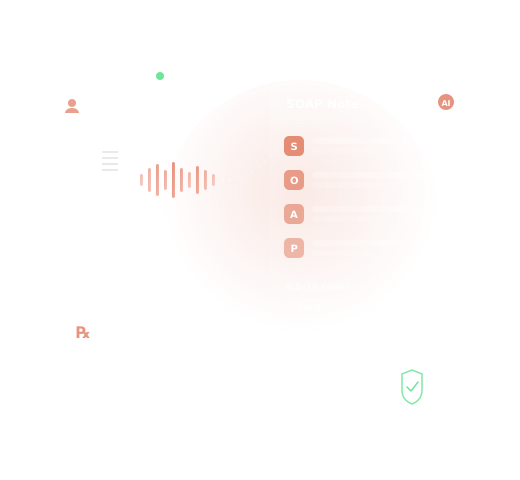
- Automatic SOAP note generation: Drafts structured notes that can be adapted for counselling summaries, assessment notes, and follow-up documentation.
- ICD-10/CPT suggestions: Provides coding support where workflows require it, while leaving final coding decisions to the clinician or authorized team member.
- Multilingual support: Helpful for Indian care settings where interactions may move between English, Hindi, and other regional languages.
- On-premise or private deployment options: Supports organizations that prefer tighter control over infrastructure and data handling as part of internal governance decisions.
These features make an AI medical scribe in India useful not only for physician notes but also for departments like Social Work Services that depend on accurate, timely, and reviewable documentation.
How It Works
The workflow below reflects how the product is designed to support documentation from consultation through final review:
- Capture the interaction: A social worker, clinician, or department user records or streams the patient conversation during intake, counselling, assessment, or discharge planning. The system is designed to support practical OPD and inpatient workflows where documentation starts from the actual interaction rather than retrospective typing.
- Transcribe and identify speakers: The audio is converted into text, and speaker diarization helps separate patient, caregiver, and provider voices. This is useful in social work sessions where multiple people may contribute to the discussion.
- Structure the content into a draft: The transcript is organized into a usable clinical draft, including SOAP-style sections where appropriate. Teams can adapt this structure for psychosocial summaries, support assessments, care coordination notes, or follow-up documentation.
- Add coding support and workflow cues: The system can surface ICD-10 and CPT suggestions to support downstream documentation workflows. These suggestions are meant to assist review, not replace professional judgment.
- Review, edit, and sign off: A clinician or authorized team member checks the draft, corrects wording, removes irrelevant details, and confirms the final note before it is added to the record. This human review checkpoint is central to safe use of an AI medical scribe in India.
- Choose deployment posture for operations: Organizations can evaluate on-premise or private deployment approaches based on internal IT, workflow, and governance preferences. This supports workflows aligned with local operational requirements without presenting deployment as a legal guarantee.
This end-to-end flow is especially relevant for Social Work Services because it balances speed with oversight. The product helps create a first draft quickly, but the final record still depends on human review, edits, and sign-off.
Local context
Healthcare teams in India often work across high patient volumes, multilingual interactions, and mixed digital maturity levels. Social Work Services may need to document counselling sessions, financial or social barriers, family discussions, and discharge coordination in a way that is understandable to the broader care team. An AI medical scribe in India can support these realities by helping standardize note creation while still allowing local workflow flexibility.
For example, some hospitals may prefer centralized documentation review, while others may want department-level control. Some organizations may prioritize private infrastructure decisions, while others may focus first on reducing turnaround time for notes. In this context, an AI medical scribe India healthcare solution is most useful when it fits existing operational patterns rather than forcing a new documentation model.
Use cases
- Psychosocial assessments: Draft structured summaries from detailed patient interviews.
- Counselling documentation: Capture key concerns, interventions discussed, and next steps.
- Discharge planning support: Summarize family discussions, social barriers, and coordination actions.
- Care coordination notes: Create clearer handoff documentation for multidisciplinary teams.
- Follow-up interactions: Reduce repetitive typing for repeat visits and ongoing support sessions.
- Multilingual encounters: Support documentation where conversations include more than one language.
These use cases show why an AI medical scribe in India can be valuable beyond physician charting alone. In Social Work Services, the benefit is often consistency, speed, and easier review of narrative-heavy encounters.
FAQ
Can this be used for social work and counselling documentation?
Yes. The workflow is suitable for conversation-heavy documentation such as psychosocial assessments, counselling summaries, care coordination notes, and discharge planning inputs, with human review before finalization.
Does the product replace clinician or social worker judgment?
No. It creates draft documentation and coding support, but the final note should be reviewed, edited, and signed off by the appropriate professional.
Is multilingual documentation supported?
The product is designed with multilingual support in mind, which is useful for Indian healthcare settings where patient interactions may span English and regional languages.
What deployment options are available?
Organizations can evaluate on-premise or private deployment approaches based on internal workflow, IT, and governance preferences.
CTA
If your hospital or clinic wants to reduce documentation burden in Social Work Services, MedScribe can help teams move from conversation to structured draft notes with a clear review step before finalization. Explore the product journey through /medscribe, review capabilities on /medscribe/features, and assess how an AI medical scribe in India can support practical, day-to-day documentation workflows for your care teams.