Introduction
An AI medical scribe in India can help sports medicine clinics and hospital departments reduce documentation load during busy OPD sessions, follow-up visits, injury assessments, and rehabilitation reviews. In sports medicine, clinicians often move quickly between history taking, physical examination, imaging review, treatment planning, return-to-play guidance, and coordination with physiotherapists or trainers. That pace makes accurate note creation important, but also time-consuming. MedScribe is designed as an AI documentation copilot that converts consultation conversations into structured clinical notes and coding suggestions, while keeping the clinician in control of review and sign-off.
For sports medicine teams, the value is practical: less manual typing, more consistent note structure, and easier capture of details such as mechanism of injury, pain progression, functional limitation, prior treatment, and rehabilitation advice. Rather than replacing clinical judgment, the system supports workflows aligned with day-to-day documentation needs in Indian healthcare settings. This makes an AI medical scribe in India useful for private clinics, multispecialty hospitals, and sports injury centres that want faster documentation without losing oversight.
Department workflow
Sports medicine documentation has its own rhythm. A typical visit may begin with a patient describing an acute injury during training, a chronic overuse complaint, or a post-operative recovery concern. The clinician then documents the history of present illness, sport or activity context, prior injuries, examination findings, movement restrictions, imaging references, diagnosis considerations, and management plan. Follow-up visits may add rehabilitation milestones, pain scores, exercise adherence, and return-to-activity recommendations.
In many Indian clinics, this workflow happens under time pressure. Doctors may switch between new consultations, procedure discussions, injection counselling, and coordination with physiotherapy or orthopaedic teams. Manual note entry can slow the visit or push documentation to the end of the day. An AI medical scribe in India fits into this workflow by listening to the consultation, separating speakers, transcribing the discussion, and drafting structured notes that the clinician can edit before finalizing. This is especially helpful when the same department handles athletes, school sports injuries, weekend fitness injuries, and occupational strain cases in one schedule.
Features mapped to workflow
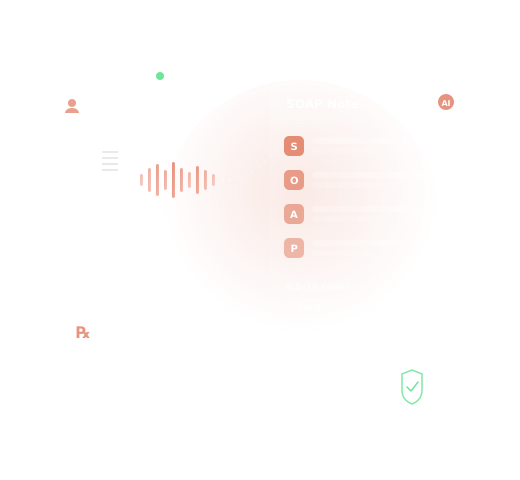
MedScribe focuses on documentation tasks that matter during real consultations. Automatic SOAP note generation helps convert a free-flowing conversation into a usable clinical draft. In sports medicine, the subjective section can capture injury onset, training load, aggravating movements, and prior treatment. The objective section can support documentation of examination findings, range-of-motion observations, tenderness, swelling, gait notes, or imaging references discussed during the visit. The assessment and plan can then be drafted for clinician review.
Speaker diarization is useful when a patient, parent, coach, or caregiver is part of the conversation. It helps distinguish who said what, which can improve clarity in the draft note. Multilingual support is relevant in India because consultations may shift between English and regional languages, especially when explaining symptoms, exercise instructions, or recovery expectations. Coding suggestions such as ICD-10 and CPT support can help clinicians and administrative teams prepare documentation more efficiently, while still requiring human validation. For organizations with stricter internal governance preferences, on-premise deployment can be considered as a workflow and infrastructure choice.
These capabilities make AI medical scribe India healthcare workflows more practical for sports medicine departments that need speed, structure, and clinician oversight rather than generic transcription alone.
How It Works
The product workflow is designed to follow the natural path of a consultation and keep the doctor in control at each checkpoint.
- Capture the consultation conversation: During the sports medicine visit, the system records or ingests the doctor-patient conversation from the consultation environment. This may include discussion of injury mechanism, training history, symptoms, examination cues, and treatment options. Speaker diarization helps separate clinician and patient voices for cleaner downstream structuring.
- Transcribe and organize the encounter: The audio is converted into text and organized into clinically relevant segments. Instead of leaving the output as a raw transcript, the system prepares it for documentation use by identifying history, findings, and plan-related content. Multilingual support helps when the conversation includes mixed-language explanations common in Indian practice.
- Draft structured SOAP notes: Based on the consultation content, MedScribe generates a SOAP-style draft note. For sports medicine, this can include symptom timeline, activity triggers, examination observations, working diagnosis, rehabilitation advice, and follow-up instructions. The draft is meant to save time, not to bypass clinical review.
- Suggest coding support: The system can provide ICD-10 and CPT suggestions linked to the documented encounter. These suggestions are intended to support documentation and billing workflows, but the clinician or authorized staff should verify relevance before use.
- Review, edit, and sign off: Before any record is finalized, the clinician reviews the draft, corrects details, adds missing findings, and confirms the final note. This human review checkpoint is essential for accuracy, especially in cases involving procedures, return-to-play decisions, or complex rehabilitation plans.
- Choose deployment posture for operations: Depending on organizational needs, teams can evaluate deployment approaches such as private or on-premise setups. This is best treated as a governance and workflow decision based on infrastructure, access controls, and operational preferences.
Local context
In India, sports medicine practices often serve a wide mix of patients: competitive athletes, school and college players, recreational runners, gym users, and patients recovering from orthopaedic procedures. Documentation needs can vary from concise OPD notes to more detailed rehabilitation follow-ups. An AI medical scribe in India should therefore support practical realities such as multilingual conversations, variable consultation lengths, and coordination across doctors, physiotherapists, and front-office teams.
Hospitals and clinics may also differ in how they manage infrastructure and records. Some may prefer cloud-based workflows, while others may evaluate private or on-premise options based on internal IT and governance preferences. The key point is that the tool should fit the care setting rather than force a rigid process. For sports medicine departments, that means supporting fast note turnaround while preserving clinician review and department-specific terminology.
Use cases
Common use cases include first-visit sports injury assessments, where the clinician needs to capture the mechanism of injury, pain location, swelling, instability, and immediate management advice. Another use case is follow-up rehabilitation review, where progress, exercise adherence, pain changes, and return-to-activity milestones need to be documented consistently. Procedure counselling visits can also benefit when the doctor explains injection options, recovery expectations, or imaging findings and wants a structured summary afterward.
Sports medicine teams in hospitals may use an AI medical scribe in India to support documentation across orthopaedic-sports overlap clinics, post-operative recovery reviews, and multidisciplinary care discussions. Smaller clinics may use it to reduce after-hours charting and improve note consistency across high-volume OPD schedules. In both settings, the goal is not automation for its own sake, but a more usable documentation process.
FAQ
Can this help with sports injury follow-up notes?
Yes. It can draft structured notes from follow-up conversations, including symptom changes, rehabilitation progress, and next-step plans, subject to clinician review.
Does it replace the doctor's documentation responsibility?
No. The system prepares drafts and coding suggestions, but the clinician reviews, edits, and signs off before the record is finalized.
Can it handle multilingual consultations in India?
It is designed with multilingual support, which can be useful when consultations move between English and regional languages.
Is deployment flexible for hospitals and clinics?
Yes. Teams can evaluate deployment options, including private or on-premise approaches, based on workflow and governance preferences.
CTA
If your sports medicine clinic or hospital team wants faster, more structured documentation, explore how an AI medical scribe in India can fit into daily OPD and follow-up workflows. Review the product overview, features, integrations, and pricing paths to assess operational fit, then plan a workflow-led evaluation for your department.