Introduction
Stroke medicine teams work in a time-sensitive environment where documentation must stay clear, structured, and clinically useful without slowing down care. An AI medical scribe in India can support neurologists, stroke physicians, emergency teams, and hospital OPD staff by turning consultation conversations into draft notes that are easier to review and finalize. Instead of relying only on manual typing after each encounter, clinicians can use AI-assisted documentation to capture history, examination details, assessment points, and follow-up plans in a more consistent format.
For hospitals and clinics managing stroke evaluations, follow-up visits, risk-factor counselling, rehabilitation reviews, and medication adjustments, the value is practical: less repetitive note creation, better structure for routine encounters, and a clearer path from conversation to finalized record. This page focuses on how an AI medical scribe in India can fit daily stroke medicine workflows in a realistic way, with clinician review remaining central to the final record.
Department workflow
Stroke medicine documentation often spans multiple encounter types. In acute or urgent settings, clinicians may need to capture symptom onset, neurological deficits, prior history, medication use, imaging context, and immediate management decisions quickly. In OPD and follow-up settings, the workflow may include secondary prevention counselling, blood pressure and diabetes review, antiplatelet or anticoagulation discussions, rehabilitation progress, speech or motor recovery updates, and caregiver questions.
These workflows create recurring documentation demands: recording a focused history, organizing neurological examination findings, summarizing assessment and differential considerations, and documenting treatment plans and follow-up instructions. In many Indian hospitals, teams also work across mixed digital maturity levels, where some departments need integration-ready outputs while others need flexible note generation that can be reviewed and copied into existing systems. An AI medical scribe India healthcare solution is most useful when it supports these practical realities rather than forcing a rigid process.
Features mapped to workflow
For stroke medicine, the product value comes from matching capabilities to the actual consultation sequence. Automatic SOAP note drafting helps convert spoken interactions into a familiar clinical structure. Speaker diarization helps separate clinician and patient speech, which is useful when family members or caregivers are also part of the discussion. Multilingual support can help in consultations where English mixes with Indian languages during history taking or counselling. Coding suggestions such as ICD-10 and CPT support can help teams prepare cleaner drafts for downstream billing or record workflows, while still keeping clinician validation in the loop.
Where governance or infrastructure needs are stricter, deployment choices such as on-premise or private environments can support workflows aligned with internal IT and data-handling preferences. This is especially relevant for larger hospitals that want documentation tools to fit existing operational controls. Across these settings, the goal of an AI medical scribe in India is not to replace clinical judgment, but to reduce repetitive documentation effort and improve note readiness for review.
- SOAP note generation: useful for first consults, follow-ups, risk-factor reviews, and discharge-related documentation.
- ICD-10/CPT suggestions: supports coding review after the clinical summary is drafted.
- Speaker diarization: helps organize multi-speaker conversations involving caregivers.
- Multilingual support: fits consultations where history and counselling happen in mixed languages.
- On-premise deployment options: supports hospitals that prefer tighter infrastructure control.
How It Works
The workflow is designed to move from consultation capture to clinician-approved documentation in a controlled sequence.
- Capture the consultation conversation: During a stroke medicine visit, the clinician records or streams the consultation discussion, including symptom history, neurological complaints, medication review, and follow-up advice. This can include patient and caregiver input where relevant.
- Transcribe and structure the interaction: The system converts speech into text and uses speaker diarization to distinguish who said what. It then organizes the content into clinically relevant sections so the encounter is easier to review than a raw transcript.
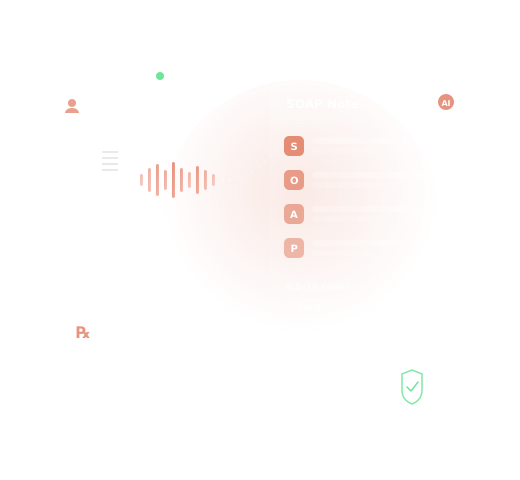
- Draft a SOAP note automatically: Based on the structured conversation, the product prepares a draft SOAP note. For stroke medicine, this may include presenting concerns, relevant history, examination discussion, assessment summary, and plan elements such as investigations, medication changes, rehabilitation advice, or follow-up timing.
- Add coding support: The system can surface ICD-10 and CPT suggestions linked to the documented encounter. These are support prompts for staff or clinicians to review, not final coding decisions made without oversight.
- Review, edit, and sign off: The clinician checks the draft, corrects details, adds missing findings, and confirms the final wording before the record is finalized. Human review is the operational checkpoint that keeps the note clinically accountable.
- Choose deployment posture for workflow fit: Depending on the hospital or clinic setup, teams may use deployment options such as on-premise or private environments. This is a workflow and governance choice intended to align with internal IT preferences and documentation processes.
Local context
In India, stroke medicine services often operate across tertiary hospitals, multispecialty centers, and growing neurology clinics with varied documentation systems. Some teams need a lightweight way to improve OPD note quality, while others need a more controlled deployment model that can fit internal infrastructure decisions. An AI medical scribe in India is most relevant when it adapts to these mixed operating environments and supports practical day-to-day use rather than adding another layer of admin work.
For Indian healthcare teams, multilingual consultations are common, and caregiver participation is frequent in stroke recovery and secondary prevention visits. That makes structured conversation capture especially useful. An AI medical scribe India healthcare workflow can help standardize note preparation across clinicians while still allowing each doctor to review and finalize records according to their own clinical style and institutional process.
Use cases
Stroke medicine departments can use this product across several recurring scenarios:
- Acute assessment documentation: draft notes for symptom onset history, deficits discussed, prior risk factors, and immediate plan.
- Follow-up visits: summarize recovery progress, medication tolerance, rehabilitation updates, and prevention counselling.
- Caregiver-inclusive consultations: capture questions and observations from family members without losing note structure.
- Risk-factor management clinics: document hypertension, diabetes, lipid management, smoking cessation, and adherence discussions.
- Discharge and post-discharge reviews: prepare structured summaries for ongoing care planning and follow-up coordination.
Across these scenarios, an AI medical scribe in India helps reduce repetitive drafting work while keeping the clinician in control of edits and final sign-off. That balance is important for hospitals and clinics that want documentation support without disrupting established care pathways.
FAQ
Below are common implementation questions from stroke medicine teams evaluating an AI medical scribe in India.
Can it be used for both OPD and hospital-based stroke workflows?
Yes. The workflow can support outpatient follow-ups, risk-factor reviews, and hospital consultations where conversation-based documentation is useful. The final note should still be reviewed by the clinician before completion.
Does it replace clinician documentation responsibility?
No. The product prepares draft notes and coding suggestions, but the clinician remains responsible for reviewing, editing, and approving the final record.
Is it useful when patients and caregivers speak in mixed languages?
Yes. Multilingual support can help in consultations where English and Indian languages are used together, which is common in stroke counselling and follow-up visits.
Can hospitals choose how the system is deployed?
Yes. Deployment options such as on-premise or private environments can be considered based on workflow, IT, and governance preferences. These options are designed to align with internal processes rather than make blanket compliance claims.
CTA
If your neurology or stroke medicine team wants faster draft documentation with clinician-controlled review, explore how an AI medical scribe in India can fit your OPD and hospital workflows. Start with the core product overview at /medscribe, review workflow capabilities at /medscribe/features, and assess fit for your documentation process, infrastructure preferences, and daily consultation volume.