Introduction
An AI medical scribe in India can help surgical oncology teams reduce documentation burden during busy OPD sessions, pre-operative consultations, post-operative reviews, and multidisciplinary follow-ups. For hospitals and clinics managing complex cancer care pathways, documentation often spans symptoms, imaging references, pathology findings, staging discussions, consent conversations, treatment planning, and follow-up instructions. An AI medical documentation copilot is designed to convert consultation conversations into structured clinical notes that clinicians can review, edit, and sign off before the record is finalized.
For surgical oncology, the value is practical: less time spent typing routine details, more consistency in note structure, and better support for coding-ready documentation. Rather than replacing clinician judgment, the system supports workflows aligned with real-world care delivery by drafting SOAP notes, identifying speakers, and suggesting ICD-10 or CPT codes based on the documented encounter. This makes an AI medical scribe in India relevant for consultants, residents, day-care units, and hospital administrators looking to improve documentation quality without disrupting clinical flow.
The focus on India matters because many organisations need flexible deployment choices, multilingual interactions, and workflows that fit high-volume OPD environments. In that setting, an AI medical scribe should be practical, review-first, and easy to fit into existing documentation habits.
Department workflow
Surgical oncology documentation is rarely limited to a single note type. A typical workflow may begin with a new patient consultation covering presenting complaints, prior treatment history, biopsy status, imaging summaries, comorbidities, and surgical fitness considerations. It may continue into tumour board preparation, procedure counselling, admission planning, operative documentation support, discharge summaries, and longitudinal follow-up.
These encounters often involve detailed conversations with patients and families, where clinicians explain diagnosis, likely next steps, risks, expected recovery, and coordination with medical or radiation oncology. Capturing all of this accurately can be time-consuming, especially when the clinician must also maintain eye contact, answer questions, and move quickly between patients. An AI medical scribe in India helps by turning the consultation conversation into a structured draft that reflects the encounter while leaving final clinical control with the treating team.
In surgical oncology, note quality also affects downstream workflows. Better structured notes can support coding review, internal handoffs, follow-up planning, and continuity across departments. This is especially useful when multiple clinicians contribute to the same patient journey.
Features mapped to workflow
For new consultations, automatic SOAP note generation helps organise subjective history, objective findings, assessment, and plan into a usable draft. During complex discussions, speaker diarization helps separate clinician and patient speech, which can improve readability when reviewing the transcript-derived note. In multilingual settings, support for multiple languages can be useful when patients speak in one language and the clinician documents in another preferred format.
For coding-oriented workflows, ICD-10 and CPT suggestions can support teams that want a clearer bridge between clinical documentation and billing or reporting processes. These suggestions are not a substitute for coder or clinician review, but they can reduce manual lookup effort. For hospitals with stricter infrastructure preferences, on-premise or private deployment options can support workflows aligned with internal governance and IT decisions.
Because surgical oncology often includes repeat visits, treatment planning, and post-operative reviews, consistency matters. A documentation copilot can help standardise note structure across clinicians while still allowing edits for specialty-specific details such as tumour site, stage references, operative planning, margins discussion, reconstruction considerations, or adjuvant treatment coordination.
How It Works
The workflow of this product is designed around real consultation documentation rather than generic transcription alone.
- Conversation capture during the encounter: The clinician starts the documentation workflow during an OPD consultation, counselling session, or follow-up visit. The system captures the conversation audio from the consultation setting and prepares it for processing. This can fit routine surgical oncology encounters such as first opinions, pre-surgery counselling, or post-operative reviews.
- Transcription with speaker separation: The captured conversation is transcribed and structured with speaker diarization so the system can distinguish between clinician and patient speech. This is useful when the encounter includes symptom review, prior treatment history, family questions, and treatment planning discussion in the same session.
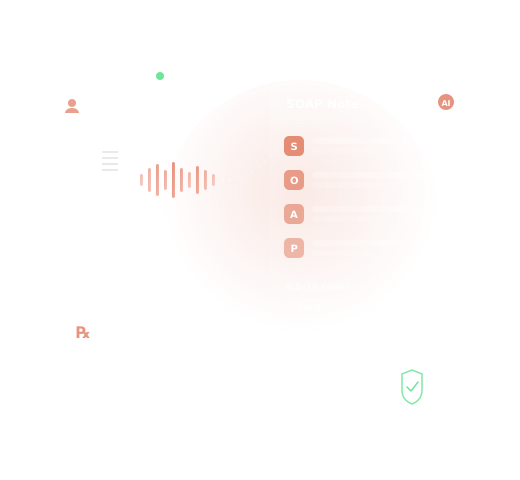
- SOAP draft generation: The transcript is converted into a draft clinical note, typically in SOAP format. Relevant details from the conversation are organised into history, findings, assessment, and plan so the clinician does not have to build the note from scratch after every consultation.
- Coding support and workflow enrichment: Based on the drafted note, the system can surface ICD-10 and CPT suggestions to support documentation and coding workflows. In surgical oncology, this can help teams prepare more complete records for internal review, billing support, or downstream administrative processes.
- Clinician review, edits, and sign-off: Before anything becomes part of the final record, the clinician reviews the draft, corrects terminology, adds specialty-specific details, and confirms the plan. Human review is the operational checkpoint that keeps the final note clinically accountable and aligned with the actual encounter.
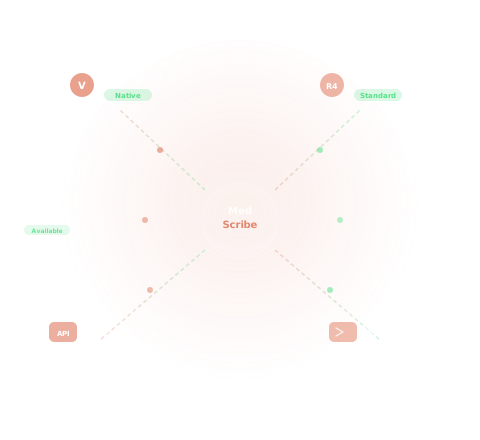
- Deployment and governance choice: Organisations can choose a deployment posture such as on-premise or private environments based on workflow, IT, and governance preferences. This is positioned as an operational decision to support internal processes, not as a blanket compliance claim.
Local context
In India, surgical oncology teams often work across high patient volumes, mixed language interactions, and varied digital maturity across clinics and hospitals. Some organisations may want a lightweight documentation layer for OPD use, while others may evaluate deeper integration with existing systems over time. That is why an AI medical scribe in India should be assessed not only for note quality, but also for how well it fits consultation speed, clinician review habits, and infrastructure preferences.
For many providers, multilingual support is not a nice-to-have; it is part of daily care delivery. Patients may describe symptoms in one language, while the final note may need to be reviewed in a more standard clinical format. Similarly, private or on-premise deployment discussions may be important for institutions that prefer tighter control over operational environments. The practical question is whether the tool helps the team document faster without creating extra review burden.
Use cases
Common use cases in surgical oncology include first consultation documentation, second-opinion visits, pre-operative counselling, post-operative follow-up, recurrence review, and survivorship follow-up. The product can also support clinicians who need more consistent note structure across consultants, fellows, and residents. In a day-to-day setting, an AI medical scribe in India may be useful for reducing after-hours note completion, improving documentation completeness, and supporting coding-oriented workflows with draft suggestions.
Hospitals can also use it where multiple departments touch the same patient journey. A clearer note from the surgical oncology visit can make it easier for downstream teams to understand the current plan, pending investigations, and follow-up instructions. For smaller clinics, the value may be simpler: less manual typing and a more standard note format that can be reviewed quickly before sign-off.
FAQ
Below are common implementation questions from clinics and hospitals evaluating an AI medical scribe in India for surgical oncology.
Can it replace clinician documentation entirely?
No. It is best used as a documentation copilot that creates a draft from the consultation. The clinician still reviews, edits, and signs off before the note is finalized.
Is it useful for complex oncology consultations?
Yes, especially where conversations include history, treatment planning, and family counselling. The main benefit is faster drafting and more consistent structure, while final clinical interpretation remains with the doctor.
Does it support coding workflows?
It can provide ICD-10 and CPT suggestions based on the drafted note. These suggestions should be reviewed by the clinician or coding team before use in operational workflows.
Can hospitals choose how it is deployed?
Yes. Deployment options such as on-premise or private environments can be considered based on IT, workflow, and governance preferences.
CTA
If your surgical oncology department is evaluating ways to reduce documentation load without compromising review control, an AI medical scribe in India can be a practical starting point. Explore how conversation capture, SOAP drafting, coding support, and clinician sign-off can fit your OPD and follow-up workflows. Review the broader product details at /medscribe and feature-specific information at /medscribe/features to assess fit for your clinic or hospital.