Introduction
Trauma and critical care teams work in fast, interruption-heavy environments where documentation must keep pace with urgent clinical decisions. An AI medical scribe in India can support this reality by turning clinician-patient or clinician-team conversations into structured draft notes that are easier to review, edit, and finalize. For hospitals, emergency units, and critical care departments, the goal is not to replace clinical judgment. It is to reduce repetitive typing, improve note consistency, and help doctors spend more attention on patient care during high-pressure encounters.
MedScribe is designed as an AI documentation copilot for practical daily workflows. It converts captured conversations into usable clinical documentation, supports SOAP note drafting, and provides coding suggestions such as ICD-10 and CPT references for clinician review. In trauma critical care, where handoffs, reassessments, and multidisciplinary communication are common, this kind of workflow support can help teams document faster while keeping the clinician in control of the final record.
Department workflow
Trauma critical care documentation often spans emergency assessment, stabilization, bedside procedures, ICU monitoring, consultant input, and repeated progress updates. In many Indian hospitals, clinicians move between OPD follow-ups, emergency admissions, ward reviews, and ICU rounds, creating a mix of short and complex encounters. Notes may need to capture presenting complaints, mechanism of injury, vitals, examination findings, interventions, response to treatment, and ongoing plans.
This creates a workflow challenge: doctors need documentation that is timely and structured, but they also need flexibility for evolving cases. An AI medical scribe in India can fit into this environment by helping capture spoken interactions, separating speakers, organizing the transcript into clinically relevant sections, and preparing a draft note for review. Instead of starting from a blank screen after every encounter, clinicians can begin with a structured draft and refine it based on the case context.
Features mapped to workflow
For trauma critical care teams, useful documentation tools must map to real operational steps rather than generic automation claims. MedScribe supports conversation capture and transcription, then structures the output into draft clinical notes. Automatic SOAP note generation can help clinicians move from raw conversation to a more usable format. Speaker diarization is especially relevant in critical care settings where multiple voices may be present, such as the primary doctor, resident, nurse, patient, or family member.
Multilingual support is also important in India healthcare settings, where conversations may shift between English and regional languages. Coding suggestions can support downstream documentation workflows by surfacing likely ICD-10 or CPT references for clinician validation, rather than forcing manual lookup from scratch. For organizations with specific governance preferences, deployment options such as on-premise or private environments can support workflows aligned with internal IT and data handling requirements. This makes AI medical scribe India healthcare adoption more practical for institutions that need flexibility in how the system is deployed.
How It Works
The product workflow is designed to follow the natural path of a clinical encounter while preserving clinician review before finalization.
- Capture the encounter: During a trauma review, ICU round, or emergency consultation, the conversation is captured through the configured workflow. This may include doctor-patient dialogue or clinician-team discussion relevant to the note.
- Transcribe and separate speakers: The system converts speech to text and uses speaker diarization to distinguish participants. This helps organize who said what, which is useful when multiple people contribute to the encounter.
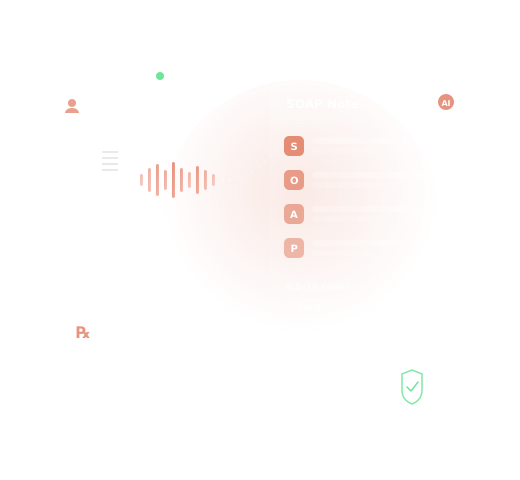
- Structure the clinical content: The transcript is processed into clinically meaningful sections. MedScribe drafts a SOAP-style note using the conversation context, helping transform unstructured speech into a usable documentation format.
- Surface coding support: Based on the drafted note, the system can suggest ICD-10 and CPT references for clinician consideration. These are support cues, not final coding decisions, and should be reviewed in the context of the case.
- Review, edit, and sign off: The clinician checks the draft note, corrects details, adds missing findings, and confirms the final wording. Human review is the operational checkpoint before the record is finalized.
- Choose deployment posture: Hospitals can evaluate whether a private or on-premise setup better fits their workflow and governance needs. This is a practical implementation decision that supports internal processes rather than a blanket compliance claim.
Local context
In India, trauma critical care teams often manage high patient volumes, variable staffing patterns, and mixed digital maturity across departments. Some hospitals may already use electronic systems, while others rely on hybrid workflows that combine dictated notes, typed summaries, and scanned records. An AI medical scribe in India should therefore be practical enough to support day-to-day documentation without forcing a complete workflow reset.
For this reason, the value is strongest when the tool helps clinicians document faster, maintain note structure, and reduce repetitive administrative effort. Multilingual conversations, consultant coordination, and repeated reassessment are common realities in trauma and ICU care. A practical documentation copilot can support these realities by making draft creation easier while leaving final clinical responsibility with the treating team.
Use cases
Trauma critical care departments can use this workflow support across several common scenarios. During emergency intake, clinicians can capture the initial history, examination, and immediate plan to generate a draft note quickly. During ICU rounds, the tool can help summarize interval events, current status, and treatment plans into a structured progress note. For post-procedure or bedside intervention documentation, it can help organize the discussion and findings into a more complete draft.
It can also support consultant reviews where multiple participants contribute to the encounter, making speaker separation useful for clarity. In follow-up reviews after stabilization, an AI medical scribe in India can help clinicians maintain documentation continuity across repeated assessments. Across these use cases, the common benefit is not autonomous record creation, but faster preparation of a clinician-reviewed draft that fits the pace of acute care.
FAQ
Below are common implementation questions from hospitals and clinics evaluating documentation support for trauma critical care.
Can this be used in ICU and emergency workflows?
Yes. The workflow is suited to high-acuity settings where conversations need to be converted into structured draft notes for clinician review.
Does the system finalize notes automatically?
No. The draft should be reviewed, edited, and signed off by the clinician before the record is finalized.
Can it handle multilingual conversations?
It is designed with multilingual support, which is useful in India healthcare environments where encounters may include English and regional language usage.
Does it provide coding support?
Yes. It can surface ICD-10 and CPT suggestions to support documentation workflows, but coding decisions still require human validation.
Is private or on-premise deployment possible?
Deployment posture can be evaluated based on hospital workflow and governance needs, including private or on-premise approaches where appropriate.
CTA
If your hospital or clinic is evaluating an AI medical scribe in India for trauma critical care, focus on workflow fit: how conversations are captured, how draft notes are structured, how coding support is presented, and how clinicians review the final output. MedScribe is designed to support practical documentation workflows for Indian healthcare teams that need faster note preparation without losing clinical oversight. Explore the product pathways for features, integrations, and implementation options to assess whether this approach fits your department.