Introduction
Urgent care teams work in a fast, interruption-heavy environment where clinicians need to move quickly from triage to assessment, treatment, discharge, or referral. An AI medical scribe in India can help reduce documentation burden by turning consultation conversations into structured clinical notes that are ready for clinician review. For urgent care clinics, day hospitals, and multi-specialty facilities, the goal is not to replace clinical judgment. It is to support faster note preparation, clearer records, and more consistent documentation across busy OPD and walk-in workflows.
MedScribe is designed as an AI documentation copilot for doctors and care teams. It converts spoken consultation content into draft SOAP notes, supports speaker separation, and provides coding suggestions that clinicians can verify before finalizing the record. For organisations evaluating an AI medical scribe in India, the practical value often comes from smoother daily operations: less time spent typing, better continuity between shifts, and easier note completion after high-volume sessions. It also supports multilingual environments commonly seen in Indian healthcare settings, where patient conversations may shift between English, Hindi, and regional languages.
Department workflow
Urgent care documentation has different pressures from scheduled specialty OPD. Patients may arrive without prior records, symptoms can be broad, and clinicians often need to document concise but complete encounters under time pressure. A typical workflow includes registration, triage, clinician consultation, treatment or procedure documentation, discharge advice, and follow-up instructions. In many centres, the documentation challenge is not only writing the note but also keeping the note structured enough for coding, internal review, and continuity of care.
An AI medical scribe in India is especially relevant in urgent care because the consultation pace is high and the need for rapid note completion is constant. During a walk-in fever case, minor injury review, respiratory complaint, or dehydration assessment, clinicians need a usable draft that captures history, findings, assessment, and plan without forcing them to pause repeatedly for manual entry. In this setting, the product should fit around the clinician's workflow rather than forcing a new one.
Features mapped to workflow
Conversation capture and transcription: The product supports consultation audio capture and converts it into structured text for downstream note creation. This is useful when urgent care doctors need to focus on patient interaction instead of typing throughout the encounter.
Speaker diarization: In a busy room, separating clinician and patient speech helps produce cleaner drafts. This is particularly helpful when attendants contribute history or when multiple staff members are involved in the encounter.
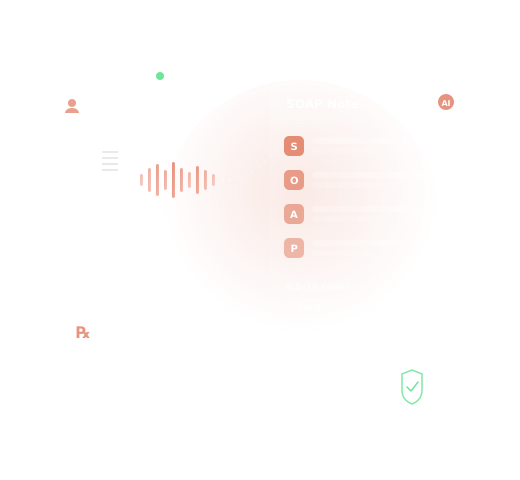
Automatic SOAP note generation: Draft SOAP notes help standardise urgent care documentation. Instead of starting from a blank screen, clinicians can review a pre-structured note and make targeted edits.
ICD-10 and CPT suggestions: Coding support can help teams prepare more complete records for billing and internal workflows. Suggestions remain reviewable and should be validated by the clinician or authorised staff before use.
Multilingual support: Indian urgent care settings often involve mixed-language consultations. Multilingual capability supports more natural patient interactions while still producing usable documentation outputs.
On-premise or private deployment options: For hospitals and larger clinic groups, deployment posture can be chosen based on IT governance, infrastructure preferences, and workflow design. These options support workflows aligned with internal data handling practices.
How It Works
The workflow for this AI medical scribe in India is designed to follow the real sequence of an urgent care consultation, from conversation capture to clinician sign-off.
- Capture the consultation: During the urgent care visit, the consultation conversation is captured through the configured workflow. The system listens for the clinical interaction while preserving the natural pace of the encounter, so the doctor can focus on assessment and patient communication.
- Transcribe and structure the interaction: The audio is converted into text, with speaker diarization helping distinguish clinician and patient speech. The transcript is then organised into clinically relevant sections so the raw conversation becomes easier to review and use.
- Generate a draft SOAP note: Based on the structured transcript, the system prepares a draft SOAP note covering subjective history, objective findings, assessment, and plan. This gives urgent care clinicians a working note that can be edited instead of written from scratch.
- Add coding support: The platform can surface ICD-10 and CPT suggestions linked to the documented encounter. These are intended as support tools for review, not automatic final coding decisions, which is important in variable urgent care presentations.
- Clinician review and edits: Before anything is finalised, the clinician reviews the draft note, corrects wording, adds missing findings, and confirms the coding suggestions if appropriate. Human review is the operational checkpoint that keeps the final record clinically usable.
- Final sign-off and record completion: After edits, the clinician signs off on the note and the final version can move into the record workflow. Depending on organisational preference, deployment can be configured in on-premise or private environments as a governance and workflow decision.
Local context
In India, urgent care and walk-in OPD environments often manage fluctuating patient volumes, multilingual communication, and mixed digital maturity across sites. Some facilities may want a lightweight documentation aid for doctors, while others may need a more controlled deployment model for hospital IT teams. That is why an AI medical scribe in India should be evaluated not only for note quality, but also for fit with existing workflows, review practices, and infrastructure choices.
For clinic groups and hospitals comparing options, AI medical scribe India healthcare adoption usually depends on practical questions: Can doctors review notes quickly? Does the output match urgent care documentation style? Can the system support multilingual consultations? Can deployment be aligned with internal governance preferences? These are the operational questions that matter more than generic AI claims.
Use cases
High-volume walk-in consultations: Help clinicians prepare notes faster during peak OPD hours.
Minor injury and acute symptom visits: Create structured drafts for common urgent care presentations where speed and clarity both matter.
Shift-based teams: Improve continuity by producing more consistent documentation that another clinician can review later if needed.
Multilingual patient interactions: Support documentation when the consultation moves across English and Indian languages.
Hospital-attached urgent care units: Use deployment options that fit broader IT and governance decisions while keeping clinician review central.
For organisations seeking an AI medical scribe in India, these use cases are often the starting point for a pilot: identify where documentation delays occur, map the note workflow, and test whether draft generation reduces after-hours charting without disrupting care delivery.
FAQ
Below are common implementation questions from urgent care clinics and hospitals evaluating an AI medical scribe in India.
Can it replace clinician documentation?
No. The system is intended to assist with draft creation and coding support. Clinician review, edits, and final sign-off remain essential before record finalisation.
Is it suitable for multilingual urgent care consultations?
Yes, multilingual support is useful in Indian urgent care settings where patients and clinicians may switch languages during the visit. Teams should still validate output quality during implementation.
How does it help with coding?
It can provide ICD-10 and CPT suggestions based on the documented encounter. These suggestions should be reviewed by the clinician or authorised staff before use.
Can hospitals choose different deployment models?
Yes. On-premise or private deployment options can be considered based on workflow, infrastructure, and governance preferences. These choices support workflows aligned with internal policies rather than offering blanket guarantees.
CTA
If your urgent care team is exploring a practical AI medical scribe in India, start with the real workflow: consultation capture, draft note generation, coding review, clinician edits, and final sign-off. Assess how the tool fits your OPD pace, language mix, and documentation standards. For next steps, review the product overview, feature details, integrations, and pricing to plan a workflow-led evaluation for your clinic or hospital.