Introduction
An AI medical scribe in India can help urology teams reduce documentation burden during busy OPD sessions, follow-ups, and procedure-heavy consultations. For many clinics and hospitals, the challenge is not only capturing the conversation accurately, but also turning it into structured notes that are usable inside daily workflows. MedScribe is designed as an AI documentation copilot that converts consultation conversations into draft clinical notes, supports coding suggestions, and keeps the clinician in control of review and sign-off.
In urology, documentation often includes symptom history, urinary complaints, prior investigations, medication use, procedure planning, and follow-up instructions. That makes note creation repetitive and time-sensitive. An AI medical scribe in India can support this process by helping clinicians document faster while preserving the need for human review. The goal is practical workflow support for doctors, assistants, and hospital operations teams rather than replacing clinical judgment.
For providers evaluating an AI medical scribe India healthcare solution, the most useful approach is to focus on day-to-day fit: multilingual consultations, structured note drafting, coding support, and deployment choices that match internal governance preferences.
Department workflow
Urology workflows in India often combine high-volume outpatient visits with diagnostics, procedure counselling, and recurring follow-up care. A typical patient journey may include registration, consultation, symptom discussion, review of prior reports, examination findings, treatment planning, and discharge or follow-up advice. Documentation has to keep pace with this flow.
Common urology encounters include lower urinary tract symptoms, kidney stone follow-up, recurrent urinary tract issues, prostate-related complaints, incontinence, hematuria workup, infertility-related evaluation, and post-procedure reviews. In each of these scenarios, clinicians may need to capture history, duration, severity, prior treatment, imaging references, medication changes, and next steps. Manual note-taking can slow the consultation or shift attention away from the patient.
An AI medical scribe in India is especially relevant where doctors move between English and regional languages, or where assistants help prepare records before the final clinician review. In these settings, the value comes from turning spoken interactions into structured drafts that can be checked, edited, and finalized quickly.
Features mapped to workflow
MedScribe is built around practical documentation tasks that map well to urology OPD and hospital workflows:
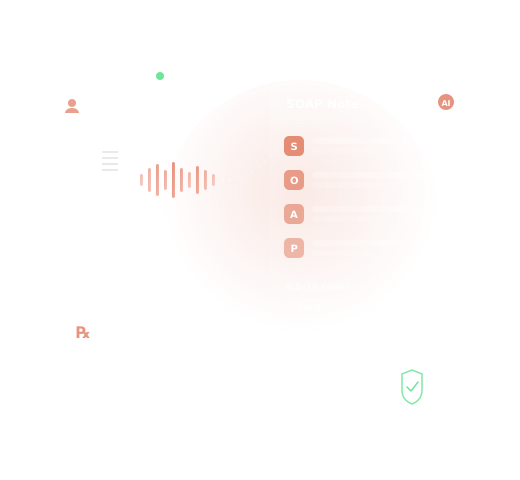
- Automatic SOAP note generation: Converts consultation content into draft subjective, objective, assessment, and plan sections, helping standardize records across routine and complex visits.
- Speaker diarization: Distinguishes between clinician and patient speech, which is useful when symptoms, prior history, and counselling points need to be separated clearly in the note.
- Multilingual support: Helps in consultations where patients describe symptoms in a regional language while the final record may need to be structured in English.
- ICD-10 and CPT suggestions: Supports coding workflows by surfacing likely coding options for clinician review, especially useful in organized hospital billing and reporting processes.
- Human review before finalization: Drafts are meant to be reviewed, edited, and approved by the clinician before becoming part of the final record.
- On-premise or private deployment posture: Supports organizations that prefer infrastructure choices aligned with internal IT and governance requirements.
For teams comparing options, an AI medical scribe India healthcare platform should not only transcribe speech but also fit the operational rhythm of consultation, review, and record completion.
How It Works
The workflow below reflects how MedScribe supports end-to-end documentation for urology consultations:
- Capture the consultation conversation: During the OPD visit, the doctor-patient interaction is captured through the configured workflow. This may include symptom discussion, prior treatment history, test references, and counselling about medication, procedures, or follow-up.
- Transcribe and structure the interaction: The system converts the conversation into text and applies speaker diarization to separate patient statements from clinician inputs. This helps organize details such as urinary symptoms, pain history, medication use, and advice given.
- Draft a SOAP note automatically: MedScribe generates a structured draft note with sections such as subjective history, objective findings, assessment, and plan. In urology, this can help organize recurring details like frequency, urgency, hematuria history, stone recurrence, prostate symptoms, or post-procedure review points.
- Surface coding suggestions: Based on the documented encounter, the product can suggest ICD-10 and CPT options for clinician or billing-team review. These are support cues, not automatic final coding decisions.
- Review, edit, and sign off: The clinician checks the draft, makes corrections, adds missing findings, and confirms the final note before record completion. This human checkpoint is essential to ensure the documentation reflects the actual clinical encounter.
- Choose deployment posture for operations: Clinics and hospitals can evaluate on-premise or private deployment approaches based on workflow, IT preferences, and internal governance needs. This is a practical implementation decision rather than a compliance guarantee.
Local context
In India, urology practices range from single-specialty clinics to multispecialty hospitals with mixed digital maturity. Some teams need a lightweight documentation layer for OPD efficiency, while others need a solution that can fit broader hospital workflows. That is why an AI medical scribe in India should be evaluated for practical adaptability: multilingual use, clinician review controls, and deployment flexibility.
Many providers also want tools that support workflows aligned with internal documentation standards without forcing major process changes. In this context, an AI medical scribe in India can be useful when it helps doctors complete notes faster, supports assistants and billing teams with better structure, and remains practical for real consultation environments.
Use cases
- High-volume OPD clinics: Reduce time spent typing repetitive follow-up notes for stone disease, LUTS, BPH, and post-treatment reviews.
- Procedure counselling visits: Capture discussions around investigations, treatment options, risks, and next steps in a structured draft.
- Multilingual consultations: Support documentation when patient conversations happen in regional languages but records need standardized clinical formatting.
- Hospital documentation support: Help clinicians and operations teams prepare cleaner notes with coding suggestions for downstream review.
- Follow-up continuity: Create more consistent records across repeat visits, making it easier to track symptom progression and treatment response.
FAQ
Can this be used in a urology OPD setting?
Yes. MedScribe is designed for practical consultation workflows, including symptom-heavy and follow-up visits common in urology.
Does it replace clinician review?
No. The draft note should be reviewed, edited where needed, and signed off by the clinician before finalization.
Can it help with coding?
It can provide ICD-10 and CPT suggestions to support review workflows, but final coding decisions remain with the care or billing team.
Is multilingual use supported?
Yes. Multilingual support is useful for consultations where patient speech and final documentation language may differ.
What deployment options are available?
Organizations can evaluate on-premise or private deployment approaches based on workflow, IT, and governance preferences.
CTA
If your team is exploring an AI medical scribe in India for urology documentation, focus on workflow fit first: consultation capture, structured SOAP drafting, coding support, and clinician-controlled review. MedScribe is designed to support practical OPD and hospital documentation workflows in India without overcomplicating adoption. Explore the product pathways through the MedScribe overview, features, integrations, and pricing pages to assess how it can fit your current documentation process.