Introduction
Vaccination and immunization services depend on accurate, repeatable documentation across high-volume outpatient settings, pediatric clinics, family practices, and hospital preventive care units. An AI medical scribe in India can support clinicians by turning consultation conversations into structured draft notes, helping teams spend less time typing and more time focusing on patient counselling, consent discussions, schedule planning, and follow-up instructions. For immunization workflows, documentation often includes vaccine history, due doses, contraindication checks, parental questions, adverse event guidance, and visit summaries. A practical AI documentation copilot helps organize these details into usable clinical records while keeping the clinician in control of review and sign-off.
MedScribe is designed as an AI medical documentation copilot for doctors and clinics. It converts consultation conversations into structured notes and coding suggestions that can fit daily OPD operations. For vaccination and immunization departments in India, this means support for repetitive note creation, multilingual interactions, and clearer handoff from consultation to record completion. The goal is not to replace clinical judgment, but to reduce manual documentation burden and support workflows aligned with routine recordkeeping needs in Indian healthcare settings.
Department workflow
Immunization encounters may look simple on the surface, but the documentation load can be significant. A typical visit may include registration review, prior vaccine history confirmation, discussion of age-appropriate schedules, screening for fever or contraindications, counselling on expected side effects, administration planning, and post-visit instructions. In pediatric settings, clinicians also answer caregiver questions and document consent-related communication. In adult vaccination programs, teams may capture occupational risk, travel plans, chronic disease context, or catch-up schedules.
These visits often happen in fast OPD cycles where clinicians need concise but complete notes. Manual typing can slow throughput, create after-hours charting, and lead to inconsistent note structure between providers. An AI medical scribe in India can support this department workflow by listening to the consultation, separating speakers, extracting clinically relevant details, and drafting a SOAP-style note for review. This is especially useful when the same clinic handles routine childhood vaccines, booster visits, travel immunization counselling, and preventive care check-ins within one session block.
Features mapped to workflow
For vaccination and immunization teams, the value of a documentation copilot comes from how well features map to real visit steps. Automatic SOAP note generation helps convert spoken interactions into a structured draft with subjective history, objective observations, assessment context, and plan details. Speaker diarization helps distinguish clinician and patient or caregiver speech, which is useful when counselling and question-answer exchanges are central to the visit. Multilingual support matters in India because vaccine counselling often happens in English mixed with Hindi or regional languages, and the note still needs to be clinically usable.
Coding suggestions can support downstream documentation review where diagnosis or service coding is part of the workflow. MedScribe can provide ICD-10 and CPT suggestions as a support layer, while the clinician or billing team validates what is appropriate for the encounter. On-premise deployment or private deployment options can also be considered by organizations that want tighter control over infrastructure decisions. In practice, these capabilities help vaccination teams standardize note quality, reduce repetitive typing, and keep the final record under clinician supervision.
- Conversation capture: Supports documentation from live consultations in OPD and preventive care settings.
- Structured drafting: Converts dialogue into SOAP-style clinical notes for immunization visits.
- Speaker diarization: Helps separate clinician and caregiver or patient inputs during counselling-heavy encounters.
- Multilingual support: Useful for mixed-language consultations common in India healthcare environments.
- Coding support: Offers ICD-10/CPT suggestions to assist review workflows.
- Deployment flexibility: Can support on-prem or private deployment choices based on operational preferences.
How It Works
The workflow for an AI medical scribe in India should be clear, practical, and easy to supervise. In vaccination and immunization settings, MedScribe follows an end-to-end process that starts with the consultation and ends only after clinician review and final sign-off.
- Capture the consultation conversation: During the vaccine visit, the system captures the clinician-patient or clinician-caregiver conversation. This may include vaccine history, due dose discussion, symptom screening, contraindication questions, counselling, and follow-up advice.
- Transcribe and structure the interaction: The audio is converted into text with speaker diarization to distinguish who said what. The system then organizes relevant details into clinically meaningful sections rather than leaving teams with a raw transcript.
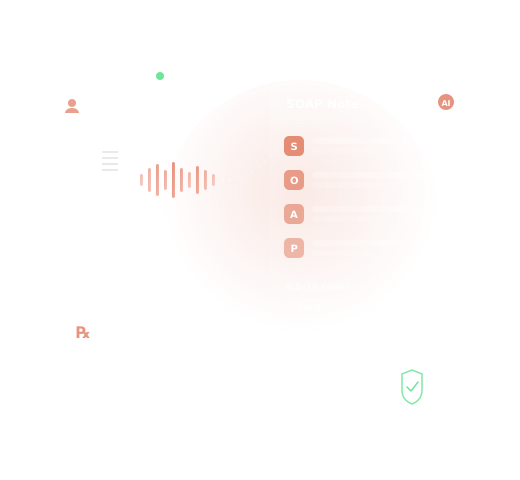
- Draft a SOAP note automatically: Based on the structured conversation, MedScribe generates a draft SOAP note. For immunization visits, this can include history context, current concerns, screening observations, assessment summary, and plan elements such as vaccine administration advice or next-dose follow-up.
- Add coding support for review: The platform can suggest ICD-10 and CPT codes as a support layer. These suggestions are intended to help documentation and billing review, not replace clinician or administrative validation.
- Clinician edits and signs off: The doctor reviews the draft note, makes edits, confirms accuracy, and finalizes the record. Human review is the operational checkpoint that ensures the final chart reflects clinical judgment before record completion.
- Choose deployment posture based on workflow needs: Clinics and hospitals can evaluate on-premise or private deployment approaches as governance and infrastructure decisions. This helps organizations align documentation operations with their internal IT and data handling preferences.
Local context
In India, vaccination services are delivered across independent clinics, pediatric practices, multispecialty hospitals, preventive health programs, and outreach-linked care settings. Documentation needs can vary by organization, but common challenges include high patient volume, mixed-language consultations, uneven note formats, and limited time for same-day chart completion. An AI medical scribe in India is useful when teams want a practical way to improve note consistency without adding more manual work to already busy OPD schedules.
For India healthcare teams, multilingual support and flexible deployment posture are especially relevant. Some organizations may prefer cloud-based workflows for ease of rollout, while others may evaluate private or on-premise setups based on internal governance choices. The product message should stay practical: support faster documentation, clearer note structure, and clinician-controlled review. That is why AI medical scribe India healthcare adoption discussions often focus on workflow fit, review checkpoints, and operational usability rather than generic automation claims.
Use cases
Vaccination and immunization departments can use MedScribe across several common scenarios. In pediatric immunization clinics, it can help document caregiver concerns, prior vaccine history, due schedule discussion, and home-care advice after administration. In hospital preventive care units, it can support adult vaccination counselling for boosters, travel-related vaccines, and chronic disease risk discussions. In family medicine clinics, it can help standardize notes when immunization is one part of a broader OPD consultation.
It is also useful for catch-up vaccination visits where the conversation includes missed doses, prior records, and future scheduling. For clinicians who see many short visits in a session, an AI medical scribe in India can reduce repetitive typing and support more consistent note completion before the day ends. The result is a workflow that remains clinician-led while making documentation more manageable.
FAQ
Can this be used for short vaccine counselling visits?
Yes. It is suited to brief, repetitive encounters where clinicians still need complete notes covering history, counselling, and plan details.
Does the system finalize records automatically?
No. The draft note should be reviewed, edited if needed, and signed off by the clinician before the record is finalized.
Is multilingual consultation support relevant for India?
Yes. Many vaccination visits involve English mixed with Hindi or regional languages, so multilingual support can help capture the conversation more naturally.
Can hospitals consider private or on-premise deployment?
Yes. Deployment posture can be evaluated as an operational and governance decision based on organizational preferences and infrastructure planning.
CTA
If your clinic or hospital wants to simplify immunization documentation, MedScribe offers a practical path from conversation capture to clinician-reviewed notes. Explore how an AI medical scribe in India can support vaccination workflows, reduce repetitive charting, and fit daily OPD operations. Review the core product pages for more detail on capabilities, features, integrations, and pricing, then assess the workflow fit for your immunization team.